Pages

Monday, July 4, 2022

How to Read the AD&D Rules XIV: Grappling with Non-Lethal Combat

In my rush to pummel you with VATAPGOA last time, I overlooked some of the basics of unarmed combat. For instance, I kept calling it "unarmed combat." Of course that's not the term that was actually used in the original Guidebook for Masters of Dungeon-like Structures; rather, it was called "non-lethal and weaponless combat." Henceforth I shall call it some variation on that terminology. Or I'll make up another acronym, how about NLAWC? Too bad, I'm running with it. 

I also failed to mention that there are three different forms of weaponless combat: 

  • Pummeling
  • Grappling
  • Overbearing

Pummeling is, obviously, punching, and grappling is wrestling--WWE style. Overbearing is that loud jackass who won't shut up about their stupid opinions. Yes, I included this list just for that punchline.

But D-Chux, what makes this combat non-lethal? 

I forgot to mention that only 25% of any damage inflicted from a punch or grapple is actual, "permanent" damage--50% of Overbearing damage is permanent, but overbearing tends to inflict a lot less damage than the other 2 forms of NLAWC. The rest will be temporary dmg which heals at a rate of 1 hp per round. 

So if you punch a guy for 4 dmg, he subtracts 4 from his HP total, but 3 of those pts are going in the temporary file, and he'll get one of them back next round. If he takes no more damage in the fight, he'll have all 3 temporary HP back in 3 rounds/minutes. He'll have to sleep off the last hit point over night. 

If you get knocked to 0 or less HP, you're out cold. You regain 1 HP per round, so if you get punched down to -3 HP, you will be conscious once you've returned to 1 HP, or 4 rounds. Unless your permanent HP have been reduced to 0, in which case you're dead. It can happen; non-lethal combat is not always non-lethal.

One more thing: First Attack Initiative is determined by following this order of operations: 

  1. surprise, 
  2. charging to attack, 
  3. higher dex, 
  4. higher die roll. 

It doesn't say what die to roll but presumably it's the standard initiative roll. There's also this weird sentence:

"Whichever first occurs determines the first attack for the round, so in most cases the pummeling attacker will go first in the first round." [L'emphasis est de moi]

Huh? Are pummeling attackers inherently more likely to surprise their opponents? To have higher dexterity? How does the second half of that sentence make any sense? If JB or someone can explain that to me I'd greatly appreciate it.

Next week we'll get into Grappling and Overbearing, I promise.

Wednesday, June 29, 2022

How to read the AD&D Rules Part XIII: Pummeling you with VATAPGOA

You all thought I was dead after that Cuthbert's Day party at Malishefski's place, right? Ha, I'm back.

Today's topic is, of course, unarmed combat. And more specifically, the art of Pummeling. We didn't use these very much back in the day because, like psionix, they just seemed like a different game. Also, they're clumsy and not always clear. Instead of rolling a 20-sider to hit, you roll percentile dice and apply a bunch of modifiers, much like DragonQuest, Star Frontiers, Top Secret, Gangbusters... I played all of those games to some extent back in the day so, by the mid 80's at least, the AD&D unarmed combat rules were no longer completely alien. But, barring the occasional barroom brawl, rare was the occasion that we turned to pg. 72 of the DMG.

Let's see just how much chaos unarmed combat brings to the game:

The first thing you have to do is determine your VATAPGOA. What the heck is that? It's your: Variable Applicable To All Pummeling, Grappling, and Overbearing Attacks. It's right there on page 72 of your Fungeon Masters Guide. And no, no one actually called it VATAPGOA, but they should have. 

This is done by taking "the number of the column he or she uses for weapon attacks." What the hell does that mean? My guess is that you turn to the combat matrix for your class (pg. 74 of the DMG), find your level in the column headings and count the number of columns from the left. So a 5th level cleric would be column 2, as are 1st level fighters, goblins, and 10th level MUs.

Combat columns for clerics
To this is added a "secretly rolled" d6 if you're attacking or d4 if defending. Why is it kept a secret? To add work for the dungeon master. What do you do with this number? You add it to either the chance to hit or to the die roll for determining the result of your successful hit. When on defense, you subtract your number from the opponents roll. You get to choose how to apply your VATAPGOA prior to each attack. So if you're in a barroom brawl and you're duking it out with Elmo at the Welcome Wench, and you each get 2 pummeling attacks a round, you are making this decision at least 4 times per round, twice on offense and twice on defense. Considering that 3 out of the 7 possible results allow you to strike again, it's likely to be even more than 4 times.

While I get that VATAPGOA  is trying to incorporate combat aptitude into unarmed combat, but it's so clumsily handled and amounts to so little--even a 9th level fighter gains only a +6% bonus--it's far more cumbersome than useful. You're having to:

  1. look up your combat column number
  2. roll a d6 for attacking and a d4 for defending and add these to your column number. And since these are, for some inane reason, kept secret, the DM is doing this for every brawler and having to track who rolled what for attack and defense.
  3. decide whether to add/subtract the variable to the to hit or result roll
  4. roll to hit
  5. if you succeed roll the result
  6. add attackers VATAPGOA and subtract defender's VATAP... as appropriate, bearing in mind that only the dungeonmaster knows the result of your VATAPGOA die roll.

In case it's unclear, we never used VATAPGOA in our unarmed combat. It's already convoluted enough without this added layer of confusion.

Let's get to the meat then:

Pummel

That jerk sitting next to you at the bar just called your mother a half elf; what are you gonna do about it? Deck the bozo in the chops, that's what! How? First you have to determine your Base Score to Hit or BaSH. Yes, I made this acronym up too.

For pummeling, BaSH is the opponents AC x 10%. There are modifiers based on Dex, Strength, the armor the attacker is wearing (less is better) and the mobility of the defendant. Even an average combatant is likely to have a +20 bonus. Which is to say that every blow is landing in a barroom brawl.

Got it. But how much damage am I gonna do?

Unlike regular combat where once you successfully hit your opponent you roll a die and the result is the amount of damage, to determine damage in unarmed combat you roll % dice again. This roll is also modified by your strength, opponents armor and general mobility. A successful strike results in a "glancing," "solid," or "crushing" blow and will inflict between 2 and 10 points of damage. Furthermore, a crushing blow automatically stuns your opponent. But if your modified result is less than 20 then you do no damage. So a successful hit can still result in no damage--and is very likely to do so if the defender is wearing heavy armor... couldn't we skip the whole Base Score to Hit and just roll on the results table? 

Seriously, this would massively de-complicate unarmed combat in AD&D. You would only have to configure modifiers once for each blow, you would no longer have to decide which die roll to apply your VATAPGOA toward, and you still get to deliver crushing blows to your opponent. I am absolutely trying this out in my next game.


Thursday, March 17, 2022

Happy St. Cuthbert's Day!

Well, not yet; it's on the 20th. But while you're chugging pints of Guinness, snarfing down bowls of Lucky Charms, and jumping around to the immortal words of House of Pain today on the most celebrated of saint's days, I'm gearing up for St. Cuthbert's big bash a few days hence. I did a quick search and found this interesting article about Cuddy's significance in Durham, England, where Cuthbert posthumously chose to rest after many years of wandering the countryside dodging Vikings and searching for cows. 

The article appears in The Palatinate which is the student newspaper of Durham University. The name Palatinate, it stands to reason, is a reference to the Palatinate that was originally granted to St. Cuthbert by King Ecgfrith in 684. It is said that Cuthbert still patrols the campus, knocking sense into the skulls of Oxbridge rejects with his mighty cudgel.  


Wednesday, March 9, 2022

Havin' a Psionic Blast Part XII: Devouring Your Intellect

It's balls.

Today I'd like to take some time to talk about the psionic adversaries of the Monster Manual. There was a whole ecosystem of monsters in AD&D intended to make being a psionic character dangerous, much like rot grubs and ear seekers existed solely to kill off corpse-looting and door-listening characters. 

First off, see the list of attack and defense modes below showing the letters associated with each mode? (posted somewhere on this page, I hope) These letters are important because they are used as a shorthand for denoting the psionic powers possessed by the monsters in the Monster Manual. It should also be noted that the letters demarking modes in the MM do not, on at least a couple of occasions, match up with the powers listed or described in the monster write-up under the stat block. 

As a for instance, the infamous Mind Flayer only has 1 psionic attack listed: "B", which is Mind Thrust. This is significant because Mind Thrust does not affect non-psionic beings so they're really not going to be flaying many minds, right? But if you read the description underneath the monster stats, it states that M. Flayer's "most feared attack mode ... is the mind blast [sic] of psionic power." Clearly that is supposed to be A. Psionic Blast.

Other Monster Manual Oddities:

Stolen from GM Binder

Brain Moles can cause "Permanent insanity in non-psionically endowed creatures employing psionic energy through spells or magic items." SP even though their one attack mode is B, Mind Thrust, they can still get you if you're using a helm of telepathy or using a spell to do psionic-adjacent things. More on this in a later post.

Cerbral Parasite feeds off of a character's psionic strength without the character knowing what's up. And they reproduce as they feed so, after a while, your psionic strength is getting sapped at an extraordinary rate. They cannot be attacked psionically, so you gotta' cure disease to get rid of 'em.

Demogorgon splits its psionic strength between its two heads which is cool because that's 2 psionic attacks and defenses going on at once. But each head has a strength of only 150, which gives an attack strength of only 75, which is not that great. 

Type III Demons have only one attack and one defense mode: E. Psychic Crush and F. Mind Blank. As G. Thought Shield is the only defense you can use whilst attacking with Psychic Crush, Type III demons cannot both attack and defend at the same time. A huge weakness, to be sure. Or, possibly, this was another case where the letter does not match the intended mode but, since the defense mode is not mentioned in the description, we'll never know.

Some larger Grey Oozes can use Psychic Crush, though their psionic strength can be as low as 21 which... still gives you a 50% chance of taking out one of Demogorgons heads in a single blow.

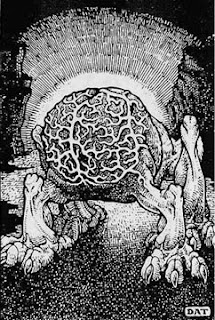
Intellect Devourer not only does this monster have the creepiest illustration in the original Monster Manual (see illustration above) but, like the Mind Flayer, it also has a discrepancy between attack modes listed by letter: "CE", and those described in the text: Ego Whip and Id Insinuation, which would read "CD". 

Thought Eaters don't actually have psionic ability but they do consume the psionic ability of others. Sadly, the MM doesn't tell us how they do it or at what rate, just that it can be done. But this is the first time anyone ever noticed because no one ever included a Thought Eater in an encounter.

Yellow Molds, are similar to grey oozes in that when they form large colonies they can become psionically active. If such a colony senses psionic beings within 120' they can blast them with "the most powerful form of id insinuation." The most powerful Id Insinuation turns any psionic-folk in a 20'x20' area with a Psionic Strength below 260 into a Robot controlled by the victor. That means that a yellow mold could take over each head of Demogorgon at once! It makes one wonder, though, what would it mean to be a robot in service to a mold colony?  [Thanks for the assist, Grodog]


Wednesday, March 2, 2022

Havin' a Psionic Blast (Rules Pt. XI): Attack and Defense Modes

For those keeping score, this is, finally, my actual 300th post.


Yesterday, with the help of Ponce the Paladin, we demonstrated how one determines whether you have psionix and what your Psionic Strength is. Did I mention that half of your attack strength is dedicated to Attack and half to Defense? No? Well now I have. On with it.

Today we're going to talk about the meat of Psionics: Attack and Defense modes. There are five of each and they are descriptively named and lovingly--if not particularly usefully--described in the text of the PHB. But you have to crack open the DMG to the two matrices on pages 76-77 to see what actual effects the attacks and defenses are going to have. 

Attacks against another psionic being who has an operable defense mode in place are only going to impact the defender's Defence Strength--except Psychic Crush which has a small chance of killing even a defended being. But once the poor slob is out of Def Str, that's when the real fun begins. Now you switch to the second matrix and that Mind Thrust that has been slowly depleting your defense for all these rounds suddenly is crippling your psionic abilities for weeks at a time, causing you to slip into a dazed and/or confused state that disallows any psionic usage, or blasting through your Attack strength--or hit points!--like a chainsaw through your neighbor's white picket fence.

Attack!

Listed below are the attack modes, with the attack strength cost in parentheses. Each time you Blast something Psionically, that depletes your Attack Strength by 20 points while Thrusting someone Mindfully costs a mere 4, and so forth.

A. Psionic Blast (20): Can kill opponents who have a very low psionic capacity as well as simple-minded non-psionics; otherwise it can cause a dazed and/or confused state or insanity. Affects all creatures in a cone 60' long, 20' wide at base. Can only be used against non-psionics if your current Attack Str. is 100 or more.

B. Mind Thrust (4): This is the battering ram you use to beat down your opponent's defenses either by doling out big wads of psionic damage or rendering attack or defense modes unusable. Like Ego Whip and Psychic Crush, Mind Thrust affects only one individual.

C. Ego Whip (7): Generally a less effective Mind Thrust that costs more to use, though a powerful ego whip vs. a defenseless opponent can cause permanent loss of psionic ability. Also has decent range.

D. Id Insinuation (10): This power seeks to take over the opposition, turning them into "robots" controlled by the attacker. It is also effective at depleting defense strength. Unlike most other psionic attacks, this one affects all psionic individuals in a 20'x20' area rather than just a single target. It also has the longest range of any attack, up to 18" at long range.

E. Psychic Crush (14): This one kills your opponent dead--or does nothing at all. The chance of a straight-up kill is not very high if the opponent is using any defense mode so it works best if you're either attacking an unsuspecting psionic or one who has no ability to defend itself. 

Let's call up Ponce the Paladin and see how he's doing. He's rolling d100 against a table to determine how many attacks he gets; Ponce rolls a 62, that gives him 3 attack modes.  With a maximum attack strength of 41, he's going to need to attack on a budget so he takes Mind Thrust, the cheapest attack  mode.  At his paygrade, Ego Whip is never going to be cost effective, so he passes on that. Likewise, Psychic Crush won't provide much chance of an instant kill--except against other psionic weaklings like himself--and will quickly deplete his own strength, so he takes Id Insinuation for its range and area of effect. Psionic Blast is also pricey--a single blast will use half of his Attack strength--but at least it might daze or confuse a modestly endowed opponent, allowing him to make a run for it, so he pockets that as well. 

De-Fence

And your Defenses; like Attacks, the cost per usage is given in (parentheses):

F. Mind Blank (1): Cheapest and least effective defense mode--except it is the best all around defense against Id Insinuation attacks for an individual.

G. Thought Shield (2): Another cheap defense mode, generally better than Mind Blank, but it's real advantage is that it's the only defense you can use while simultaneously attacking with Psychic Crush.

H. Mental Barrier (3): A step pricier and more effective than Thought Shield--except against Id Insin, which it is slightly worse at. It's most interesting characteristic is in the intriguing description: 

"A carefully built thought repetition wall which exposes only that small area."    What small area is "that" area that is left exposed?? I need to know!

I. Intellect Fortress (8): The big jump in price reflects not only that this is a much more effective defense mode but, also, it protects everyone in a 10' radius, which includes providing your non-psionic friends a +2 saving throw bonus v. Psionic Blast.

J. Tower of Iron Will (10): The Cadillac of defense modes in almost every way. Even though its protection radius is only 3', it offers a hefty +6 save bonus to your closest chums vs. Psionic Blast.  

Now back to Ponce; he rolls on the table for defenses and gets a 29: three defense modes are available to him. Interestingly, you get 2 defense modes at the minimum. Cheap is always good and you can't get cheaper than Mind Blank, so that's done. [EDIT: As Faoladh points out in the comments below, everyone with psionics gets Mind Blank as one of their defenses whether they want it or not]. Ponce, being a chivalrous sort, also needs to be able to protect a fair maiden--should he ever meet one--from Psionic Blasts, so he needs one of the area of effect defenses; he takes Tower of Iron Will, ostensibly for its better protection but also because it gives him reason to keep the maidens within 3' of his person. Creep. 

What to do with number 3... he doesn't have Psychic Crush as an attack so there's really no reason to take Thought Shield.  Mental Barrier is still pretty cheap and a lot better than Mind Blank at defending against Mind Thrusts and Ego Whips so that decides that. 


Monday, February 28, 2022

Havin' a Psionic Blast: How to read the AD&D rules Part X: Psionics

Let's get this out of the way at the outset: on their own, I think psionics are pretty freaking' cool. Although almost universally ignored back in the day, psionics didn't fall by the wayside because they were too byzantine or clumsy or whatever, they withered on the vine because they seemed like you were playing a different game entirely. It was a fun game, but it just didn't fit with the rest of the D&D vibe.

Back when I was a kid, my gang's first batch of AD&D characters--all multi-classed elf munchkins with 19 Dexes and 18/72 Strengths--also miraculously succeeded at acquiring psionics even though elves are not on the short list of PC races that could be psionic (Humans, Dwarves, Halflings). We went around Psionic Blasting everything in town that we hadn't already Psychic Crushed. It was fun for a while but a few months later we graduated from munchkin gaming and psionics disappeared from our D&D experience ever after.

Enough of my self indulgence. Here's how to read the Psionics rules starting on pg 110 of the PHB:

The rules for acquiring psionix are actually pretty straight forward. You need an Int, Wis, or Cha (the psionic trinity) of 16 to have even a 1% chance of getting psionics. The author then lays out in analog form the possible additions to your roll, it woulda' been helpful to make a table like this:

Even if all three are 16, that's still only a 1% chance.

but he didn't. No big deal, at best, with 18s at I, W, and CH, you get a 9% chance of being psionically gifted. So even if you banish your best rolls to the classic dump stats, you still only had a slight chance of being rewarded. 

e.g. Ponce the Paladin has a 17 Cha (minimum for paladins at the time), 15 Wis and 12 Int. Because one of those scores is 16 or higher, he gets to roll for psionics. He needs a 00 roll on d100, and rolls a 99. Close but no cig--"Wait, I get a 1/2% bonus because of my 17 Cha." he pleads. The Book says to ignore fractions, but we're all gamers here, we can handle fractions: roll a 10 sider, if you get 6 or higher you're in. Ponce rolls and gets another 9! Welcome to the Psionix Club, Ponce.

So you're one of the lucky few who managed the roll, or, more likely, your Dungeonmaster just said "Fine, you can have psionics." Now what? You have to determine your psionic strength; this is done by rolling d100 and adding 1 for each point of I, W, and/or CH exceeding 12. If two of those scores exceed 12, double the total bonus, if all three are 13 or higher, quadruple the crap out of the number

Ponce rolls his 100-sider for psionic strength and gets a 25. To that number he adds (17-12=)5 points for his Ch, plus (15-12=)3 for Wis for a total of 8, doubled because 2 ability scores are >12 for a bonus of (2x8=) 16. 16+25 = 41.

Had Ponce's Int been 1 pt higher he'd have had a 9 base bonus, further, he would have been able to quadruple it for a total bonus of 36 to the d100 roll. Sadly, Ponce was not smart enough to be that smart so he's stuck with 41. This number is doubled to get total Psionic Strength, so Ponce has 82. It's called "psionic ability" in the PHB, but that strikes me as rather ambiguous, so I will be using Psionic Strength or Capacity henceforth.  

What do you do with your psionic strength? You attack people with it, you defend yourself [and maybe your cronies] with it, or you use spell-like functions called "disciplines" that allow you to do a lot of really cool things for just a few points of psionic strength per round. Given that you're probably not encountering other psionic beings every day, more often than not you're just using those disciplines to do cool things like telepathy, teleportation, telempathic projection, telekinesis, or maybe one of the disciplines that don't start with "tele-". 

But really what made Psionics cool was the combat, and I'm running out of room here so we'll get to that tomorrow in what will also be the 300th post here at DiceChuckles Entertainment.


Thursday, February 17, 2022

How to read the AD&D Rules Part IX

I got it way wrong. In case you haven't been reading, I spent a week or more passing along misinformation about AD&D Surprise rules. After a jolting bit of input from some folks the other day, I realized my mistake and decided to give Surprise the Alignment Language treatment. But on doing so, I wanted to make sure I covered all the required terrain, which lead me to read this sentence at the bottom of the left column on pg 62 under Factors Contributing To Surprise

"The overall result would not materially add to the game--in fact, the undue complication would detract from the smooth flow of play." 

While EGG wrote this in reference to listing modifications for a variety of in-game situations that might lead to surprise it should really be extrapolated to encompass the entire sadistically convoluted segment-based AD&D Surprise Party. Never has a more apt sentence been written in description of not just the surprise rules, but also unarmed combat, psionics, weapon vs. AC modifiers, and a host of other rules chaff proliferated by the same pen that crafted this poignant quote.


Tuesday, February 15, 2022

Surprise Party Redux: Surprise rules part 3 (HRAD&DR Part VIII)

I'll admit that the 1 minute melee round renders a bit of sense from the segment-based Surprise Party. In all the other D&Ds that just give you a free round of surprise, the round is only 10 seconds or less, so you're effectively just giving them a free segment. If you ignore, for the moment, the "why?" of one minute melee rounds, having the surprised party stand inert for a full 60 seconds seems a bit ridiculous, and it also seems ridiculous that, with a full minute to molest the surprised party, the Surprisors would only get to attack once, so EGG broke it down to segments. 

Why not just give the surprisers one free segment to act? Well, with AD&D's ridiculously slow movement rates, on most occasions they'd be too far away to take advantage of it (again: please ignore the larger question), so Gary devised the multiple segment Surprise Party, allowing the Suprisors to charge into combat and whack away at the inert dupes. But then he realized that 4 or 5 segments of surprise could easily TPK even the most seasoned of gaming parties, as Quisling and Schlomo discovered last week, so he gives a Dexterity bonus in the form of the Reaction Adjustment to allow high Dexed combatants to get out of surprise early. Surprise was going to be somewhat less deadly for PCs who were crafty enough to fudge their Dex rolls, which, given the AC, missile attack, and [universally house-ruled] initiative bonuses affiliated with a high Dex, was most of us back in the day.

On a related note it strikes me as a bit odd that the Surprise Dice Difference table (above) in the DMG only goes up to 3 segments even though it should go up to 5 (6-1). There's nothing in the text that caps the Surprise Party at 3 segments, and the table doesn't indicate that you should do the math to figure out 5-1, 6-2, and 6-1 on your own, though, obviously, you can. It would have taken very little effort to add 2 more rows to complete the formula and yet they chose not to. Was Gary trying to subtly suggest that beyond 3 segments thar be dragons?

...or maybe the added rows would have forced the printers to shrink the already tight margins down from 1/8" to 7/64", and they just weren't willing to go that far.

Tuesday, February 8, 2022

Rift in time: Surprise! in action (How to Read... Part VII)

While a lot of folks have commented that when they played AD&D back in the day they swapped out a lot of the more confusing gibberish for simpler rules cribbed from the Basic books. Well, probably because we didn't play Basic D&D long enough to actually learn the rules, my gang went a different direction: we did not use surprise rules at all. Unless one party was lying in ambush or actively sneaking up on the other, or one party was clearly distracted or drunk or asleep--surprise was not a state of being that existed. The side that got the drop on the other based on the situation had a free round to assault the stooges. Rolling for Surprise! at the start of every encounter seemed like just another complication in an already complicated rule set.

But the point of today's post is not to lecture you on the olden ways, but to deliver up a demonstration of Surprise! in action. Continuing on the example from last time when Schlomo, Quisling, and the rest of Party B were surprised by Party A...

 Example of Surprise

Six-siders are rolled for surprise:
Party A: 5
Party B: 1
Party B: is surprised for 5-1= 4 segments.

Today we're going to run the above scenario through as it might happen at the gaming table. Party A is a group of six gnolls patrolling their sector of the dungeon, and Party B is a group of six low level adventurers arguing about how to split up the treasure they just secured after killing the ogre in room 14. They are:

Schlomo Slow-mo, Cleric, Dex 4: -2 reaction adj.
Quisling the Quickling, Thief/MU, Dex 17: +2 reaction adj.
Spungoir the Spelliferous, MU
Furdok of Burd, Fighter
Kuburt, Monk
Rajoo, Ranger

As already determined the entire party is surprised for 2 segments after which time Quisling, thanks to his +2 reaction adj. will move out of surprise, except this time Quisling goes against his nature and actually stays loyal to his countrymen. Two segments later everyone except Schlomo will awake from their stupor. Schlomo, whose pitiful dex afflicts him with a -2 rx adj., will have to wait until segment 7 before he's paroled.

The Gnolls have a move of 9" and are 20' away so they won't even be in stabbing range until surprise segment 2. Wait a second, with a move of 9 inches you can cover most of 18 feet in 2 segments? Fear not, we'll have a How to... session on Movement in AD&D soon.

Segment 1: Two gnolls lob spears at Party B (not Cardi B) before advancing. One hits Furdok while the other bounces harmlessly off the wall. Gnoll 6 fires a heavy crossbow for 7 dmg. killing Spungor the Spelliferous--now the Lifeless. The rest of the gnolls move 1/10th of their move, getting 9' closer to the party. Yes, 9' in 6 seconds is p-a-i-n-f-u-l-l-y slow but there are probably several paragraphs somewhere in the DMG where Gary explains that movement in AD&D does not represent actual spacial displacement over time, but is a conceptual representation of  yada yada yada. 

Segment 2: The gnolls now move into melee range and start swiping at Party B. The two who tossed the spears last time choose to charge the party allowing them to cover twice their movement and still get an attack. This makes the other gnolls wonder why they didn't do that in the previous round. [It's probably because they're following this blog series and we haven't covered charging yet.] Anyway, there's one gnoll for each party member because Gnoll 6 is hanging back reloading the heavy crossbow at 3x the normal speed. Let the slaughter begin!

Segment 3: Quisling--"Quiz" to his friends, at least to the ones he hasn't betrayed yet--is no longer surprised, so Gnoll 3, who had attacked him the previous segment can no longer get in those sweet "telling blows." They have to roll initiative at this point, even though everyone else is still involved in Surprise. 

                Quisling: 4, Gnoll: 2. 

Quiz gets to swing first, rolls a 5 and misses with his short sword. Gnoll 3's turn but she says "Screw that, if I attack you I'm done for the round. There's a guy standing next to you who'll be surprised for at least 2 more segments, I'm attacking him instead." She cuffs Schlomo up side the head with a morningstar.

Segment 4: The gnolls keep whaling on the still-surprised party members, some of whom are not looking so hot. Quisling has shot his wad bolt, um, you get the idea, for the round and should, by standard melee protocol, be feinting, parrying, and dodging blows from Gnoll 3 for the next 54 seconds. But Gnoll 3 chose instead to attack a still-suprised party member and therefore remain involved in the Surprise Party. Quisling has fallen into a rift in the melee continuum: he has already used his one attack for the round, but his co-combatant has decided not to return the favor. Does Quisling have to dance around pretending to dodge and parry blows that no one is delivering? That's preposterous. Does he get to deliver another blow on Gnoll 3? Gnoll 3 isn't surprised so segment-based telling blows do not apply, but they do apply to his surprised comrades--don't do it Quisling! He resists temptation and wanders away from combat. [No kiddies, opportunity attacks do not exist in AD&D; for all its flaws it at least has that going for it.]

Segment 5: Everyone but Schlomo is now un-surprised. If not for Slo-mo Schlomo, we'd start a new round here, but since he's still got 2 more segments of inaction, the Surprise Party continues and we're gonna' use the same initiative roll from segment 3. That's ok by Party B since Quisling won that roll; they start retaliating for the punishment they've taken. Most of the gnolls now engage in normal melee, Gnoll 5 drops Furdok of Burd with a blow from his zwei-handed sword, but Gnolls 3 & 4 are still attacking poor Schlomo rather than join the regular initiative. Quisling, still occupying the rift in the space time continuum, takes this opportunity to cast a 1 segment spell, magic missile, at Gnoll 3.

Segment 6: There are still 2 gnolls who insist on beating on poor Schlomo, and Gnoll 5, having used his regular melee attack to kill Furdok during the last segment, decides he wants to go back to the Surprise party and attack Schlomo too. The players all cry foul but the DM persists and Gnoll 5 swings at the beleaguered cleric anyway, hitting for 3 pts of dmg. Schlomo--shockingly--withstands the blow and, even worse for the DM, the players will absolutely use this decision against him in the future.

Segment 7/New Round: Yahweh smiles on Schlomo today, for he has miraculously survived 10 attack rolls from the gnolls and is finally unsurprised. A new round begins and initiative is rolled, much to the chagrin of Gnoll 6--remember her?-- who has finally finished reloading that stupid freakin' crossbow. She will certainly be razzed for this in the mess hall tonight. The PCs, who are busy filing a meta-gaming complaint against Gnoll 5, lose the initiative. Rajoo and Kuburt both fall under gnollish battle axes leaving just Quisling and the sluggish and heavily battered Schlomo to face off against six gnolls. Quisling regrets not betraying his chums when he had the chance.

Friday, February 4, 2022

"The Telling Blow" or, How to read the AD&D rules Part VI: Combat, Surprise

Since no one wants to read a spell by spell re-cap of AD&D, I'm skipping ahead to the meat of the matter: Combat. We're now looking at the DMG folks, page 61. Huge chunks of text in full-justified paragraphs; I have as much difficulty wading through this stuff now as I did when I was 11. 

Paragraphs 1, 3, and 4 all go on about the 1 minute melee round; as long as you understand that melee rounds in AD&D are 1 minute long then you need not read them. And paragraph 2 starts out: "As has been detailed, hit points are not actually a measure of physical damage..." so you can stop reading there if you don't need to hear that sermon again. Just like that we're at the bottom of the page where we find the first step for encounter and combat:

Surprise

  1. Determine surprise: each party rolls a d6, if either or both parties roll a 1 or 2 then the party that rolls lowest is surprised. 

So, surprise dice are rolled and:

Party A: 6
Party B: 3
Neither party is surprised. 
 
Party A: 1
Party B: 3
Party A is surprised 
 

That seems simple enough, right? Too simple for a game called Advanced D&D so Gygax wrote 12 freaking paragraphs of obfuscation on the matter, ensuring that all but the most tenacious of rules lawyers would look elsewhere--like Basic D&D--for a simpler rule or ignore surprise rules altogether. 

Now, I can condense Gary's Compleat and Comprehensive Treatise on Inflicting Surprise on One or More Parties During an Encounter in the Strategic Fantastical Roleplaying Game of Advanced Dungeons, and/or Dragons to a couple of paragraphs for you [Edit: No I can't.], but even that will be painful to read so for those not wanting to waste another moment of their lives on this topic, rest assured that most folks just gave the surprisers 1 free round of action while the surprisee's stood/sat/lay their in stunned silence.

Diehards Only

Have we got rid of all the lightweights? Good, let's dig in:

Like I said, each party rolls a d6 for surprise. If one or both parties roll either a 1 or a 2, then the party that rolls higher is supposed to subtract the low-roller's dice roll from their own, the result is how many segments of free action they have before the surprised party can react, segments being 1/10th of a round which, as Gary has just spent 3 very lengthy paragraphs explaining, are 1 minute long.  [A segment is 6 seconds long, equal to a round in modern D&D, so you 5e kids are finally in your comfort zone]. It looks something like this:
 
Party A: 5
Party B: 1
Party B: is surprised for 5-1= 4 segments.
 
The surprisers, in this case Party A, have 4 segments to act. During each segment of surprise they can move 1/10th of their full movement rate, avoid, parley, and, yes, melee attack the crap out of your ass as if each segment was an entire round! As Gary puts it, because the surprisees are inert, the surprisers can get in "telling blows" in just a 6 second window. This gets back to all the dancing around and feinting and what have you that goes on in a 1 minute melee round.

We're not done yet though because each surprised individual modifies its time in the surprise zone based on their Dexterity. Remember attack/reaction adjustment? Attack is clear, add that to your to hit roll when attacking with missile weapons. This is where the reaction half of he equation comes in: if your party is surprised, each individual adds its dex adj. to the surprise roll for determining how long they are surprised. As an example:

Only 2 members of party B (above) have exceptional dexterities: 

Quisling the Quickling, Dex 17, +2 rx.

Schlomo the Slow-mo, Dex 4, -2 rx adj.  

  • Note: because of Schlomo's egregiously low Dex, we know that he is a cleric. We can surmise from his name that he is likely a rabbi.
  • Further note: it is unlikely in the extreme that anyone would willingly put a 4 on Dex because that would also give you a |3| AC penalty,* i.e., Schlomo's chainmail and shield would give him an AC of 7 instead of the typical 4. That's bad, new schoolers.

*When you're digging around for the "absolute value" symbol you truly appreciate what a pain in the ass descending AC is.

Quisling adds 2 to the surprise roll, which was 1, so: 1+2=3, less than 5 so he is still surprised, but only for 2 segments. And, true to his name, he uses the segments gained to sell out the rest of his compatriots before they can become un-surprised.

Schlomo on the other hand subtracts 2 from the surprise roll; he is surprised for 6 segments and is the last to understand the treachery of his erstwhile colleague.  

Missile Fire During Surprise

In the PHB discussion of surprise Uncle Gareth informs us that 

"Physical attacks during surprise are also possible on a 1 segment basis, whether the form is by weapon, projectile, or method intrinsic to the creature." 

which sure seems to imply that you can launch missiles at a rate of 1 per segment. However, by the time he wrote the DMG he must've realized that just because you can get in more telling blows when your opponent is in a state of stunned surprise doesn't mean you can crank a heavy crossbow 20 times faster.

Instead, the DMG informs us that during surprise you can launch missiles at 3 times the normal rate. Sadly, rate of fire for missiles is given in rounds not segments, so we're going to have to do some math. There are 10 segments in a round and 10 isn't divisible by 3 so the math is not going to be pretty. Stop making up excuses and get on with it DChucks:

You can launch 2 arrows from your composite short bow per round so in a surprise situation you can fire 3x2 = 6 per 10 segments which simplifies to 3 per 5, or 1 every 1.666 segments or, basically, 1 arrow every other segment. Now do the same for the rest...

If Gary didn't hate us so much he would have just made a handy table like this:

How much damage would a heavy crossbow
have to do before you would consider using one?


Did I cover everything? I'm not sure, so next time I'll run a sample surprise encounter to see how this all works in action.


Tuesday, January 25, 2022

How to Read the AD&D Rules Part V: Title Redacted

Also: page 24 of the DMG.

For this part you'll need to go to your local government surplus store and procure a military grade Dark Black marker, regular black won't do; it has to be so dark that no light can escape it's pull. Now go to page 34 of the Players Handbook and, without reading them first, thoroughly blot out paragraphs 2 and 4--paragraph 3 is ok--under the Character Languages heading. I said don't read them! If you understand the language you are reading you will do this or align yourself with forces most foul.

Now, just to be safe, turn to page 29 and do the same to the first primary ability of assassins, it's right there on the bottom of the left column, just above the Minimum Fees for Assassination table. It continues on the top of the right column so make sure to get that bit too. You can leave the list of alignments there if you wish; it's fairly harmless on it's own. Done? Excellent. That's all for today. School's out, run along kiddies.

No idea why this is here.

Friday, January 21, 2022

How to Read the AD&D Rules Part IV: Weapons

We're looking at weapons today kiddies so open to page 37 of your textbooks. You'll notice two tables on this page: 

1. Weapon Proficiency Table:

This table lets you know the following:

  • how many weapons you can be proficient with depending on your class, 
  • how much worse you are at hitting things when attacking with a weapon in which you are not proficient, and 
  • how long you have to wait to get a new weapon proficiency. 

Nowadays everyone is proficient in all the weapons all the time, but I actually like that folks weren't as effective with weapons that they'd never actually used before. 

and 2. Weight and Damage by Weapon Type:

This economical table gets it. Except for the Speed Factor business.

The second table tells you how much your weapon weighs. None of you are going to track your encumbrance, but at least you can meaningfully contemplate whether your footpersons mace is worth its weight in gold.

More importantly, this table tells you you're going to do 2-16 pts of damage to large creatures with your Bastard Sword. If you don't want your fighter to do 2d8 damage against ogres then close the book now, AD&D is not for you. 

Those of you who took a gander at the weapon price list on page 35 are probably wondering why you can't buy such weapons as the Chauves Souris, Ransom, Rhonca, Rhoncie, or Runka. Fear not gentle reader, this table assures us that those implements are all covered under "Ranseur."

Notice the ** next to the "spear" listing. These asterices indicate that 

"This weapon also does twice the damage indicated to any opponent when the weapon is set to receive their charge." 

When you consider that in AD&D anyone who travels more than 10' to engage in melee is, technically, charging, and that weapon length determines who strikes first in a charge situation, and spears are 5-13' long... the spear becomes a very intriguing weapon, no? Does that mean that spears were preferred among savvy gamers? Heck no! Why not? Well, since that thing about only moving 10' to engage in melee was roundly ignored, "charging" only came into play when you were on horseback and carrying a lance. 

On the next page we have another weapon table: Weapon Types, General Data, and "To Hit" Adjustments

"General Data" includes how long your weapon is and how much space you need to use it; information you can probably figure out how to use on your own, right? But then there's a column labelled "Speed Factor." Nowhere is this explained but that's ok because if you use this information while playing a game called Advanced Dungeons & Dragons then you are, by definition, playing 2nd edition.

The table goes on to list combat adjustments based on the armor class of the opponent. Since the ACs listed only go from 2-10, it seems obvious that this is intended to simulate the relative effectiveness of certain weapons against specific armor types, e.g. a staff is not going to be very effective vs. a guy in platemail, and a -7 adjustment reflects that. What's less obvious is whether your staff is also -7 to hit a guy with Bracers of Defense AC 4 who has a 16 Dex (-2 AC adj.). You could--and should--ignore this business based on inadequate information and overly complicated rules but really you're going to ignore it regardless because in the heat of the moment you're not going to remember to apply these modifiers.  

At the bottom of the table is a separate section just for missile weapons. This section includes the already obsolete AC adjustments mentioned above but also throws in some very useful info such as Fire Rate and Range. Penalties for launching missiles beyond short range are only mentioned in an underhanded footnote:

"Armor Class Adjustment is based on the weapon or missile being discharged at short range. Adjust by -1 for medium ranges, -2 at all long ranges."

So underhanded is this note that I never noticed it before today, the 21st of January 2022! This note is noteworthy because these range modifiers were overruled by the combat matrices on page 74-75 of the DMG; under each table it is noted that missiles are -2 at medium range and -5 at long. So there was a brief period between the publication of the PHB in 1978 and the DMG a year later when archers were 15% more effective at hitting targets at long range.

Fire Rate seems pretty self explanatory and is even explained in a note under the table but the folks over at GGNoRe were confused by it and they're a pretty seasoned bunch, so I'm guessing that folks coming at this from later editions are not necessarily going to realize that each round you can fire your long bow twice, throw 3 darts, or launch half of a bolt from your heavy crossbow. Does this mean that no one ever used a heavy crossbow? Yes, that is precisely what it means.


Tuesday, January 18, 2022

Cheers!: Tavern Signs in Old School Modules

It's hard to believe that in twelve--12!!!--sporadic years in the blogging business, I've never done a piece on taverns. Well, that streak ends today. 
 
Sometimes you'd prefer they didn't know your name

I have always had a thing for taverns in D&D, so the next time you complain about what a cliche it is for an adventure to start out with an encounter in a tavern, I won't hear you because I'll already be quaffing a pint while listening to the minstrel noodling by the fire. 

I also have a thing for old timey modules--as you may have noticed by my extensive rants about Hommlet, Saltmarsh, Bone Hill, and, most recently, the Slaver series. So today I'm going to dig into the taverns and inns that provide hospitality in a few of these old settings.

But I'm going to look not at the the taverns themselves, but the signs hanging out front. These are the shingles that are intended to indicate the name of the place to the PCs as they wander into town. I went back through the classic AD&D modules (I define classic as published back when they still listed all the available D&D products on the back of modules, a practice which ended ~1983, I believe). Also some of these modules feature more than one ale house; I'm only addressing the ones I can remember.

For this analysis, I'm including the text from the module describing the sign, a likely interpretation of that sign, and any significant notes relating to the sign or its meaning from the module.
 
Inn of the Welcome Wench (T1 Village of 'omlet)
Sign Description: "The square wooden sign shows a buxom and smiling girl holding a flagon of beer."
Likely Name: Inn of the Buxom Wench
Significance: If you thought we were going to start with some other tavern, then this is probably your first time here and I offer my sincerest greetings to you. I've always called this place the Buxom Wench, but I was an adolescent when I first encountered it and I haven't really grown up in the ensuing decades. 

Inn of the Slumbering Serpent (N1 Against the Cult of the Reptile God)
Sign Description: "A large, colorful sign pictures a red dragon with its head
resting contentedly on its paws. A plume of smoke rises
from the serpent's nose and its eyes are closed."
Likely Name: Sleeping Dragon
Significance: Given that the name of the adventure is "Against the Cult of the Reptile God"; if you wander into a town with an inn named the Slumbering Serpent, are you going to stay in it? No. But if you see a sign with a sleeping dragon on it? I think of dragons as scaly magical beasts not reptiles, so sure, I'd stay there. Aside: do dragons have "paws"?

Sign of the White Knight (A3 Assault on the Aerie of the Slave Lords)
Sign Description: "Above the door is a painted chesspiece-
a White Knight
" (see illustration)
Likely Name: Horse Head, White Horse, Chess Piece
Significance: When they enter Sunderholm the party is given a clue to "Seek out the Ivory Paladin." This establishment is the place that the clue is intended to indicate. While the horsehead on the sign is pretty obviously a chess piece, without the flavor text it's not all that certain that the players are going to see it and make the connection: white horse head = white knight = ivory paladin.Why didn't the clue just say "Go to the White Knight on the corner of Dave St. & North Arneson and ask for Gary"? Because it's a tournament dungeon Dice Chucker, that's why.

Inn of the Dying Minotaur (L1 Secret of Bone Hill)
Sign Description: The sign is not described in the text, but "Geilcuff, the innkeeper has a minotaur's head stuffed and hung up on the wall above the bar."
Likely Name: Bull's Head 
Significance: Everyone knows that a minotaur is a creature with the body of a man and the head of a bull, so that "minotaur" head over the bar is probably just the head of a bull that Geilcuff bought from the slaughterhouse.

House of Abraham (L2 Assassins Knot)*
Sign Description:  "a large bright green shingle that reads, 'House of Abraham:
Food, Lodging and Ale.' In the center of the shingle is a picture
of a smiling man holding out a large tankard of ale.
"
Likely Name: Abe's Place
Significance: Lakofka cheated us here by assuming a high literacy rate in Assassinsburg.

Blood of the Vine (I6 Ravenloft)*
Sign Description: the sign "proclaims" this to be the "Blood ofn the Vine"
Likely Name: Well, Blood on the Vine, I guess
Significance: Literacy trumps good sign design once again, this one devoid entirely of illustration. But it is written into the module that some wag has vandalized the sign, scratching out the "f" in "of" and replacing it with an "n" to add to the macabre tone of Ravenloft.

*In addition to having signs with words on them instead of pictures, other TSR products were not listed on the back of these modules when first published. So maybe I can also use literate tavern signs as an indication of the end of the classic module era.