Thursday, July 27, 2023

Horror on the Hill: Wherein I declare my bloodfeud with Imagine Magazine

The horror!

A few days ago I got a call from Dread Rosgool, Associate Vice Deputy Director of Blogging Operations at DiceChucker Enterprises. Dread Ros had this to say:

Dread Rosgool: Your position with DiceChucker Enterprises is dependent on content, and you're just not producing. The Board wants your ass fired last week but I've convinced them to give you 48 hours to come up with something. If you don't, they'll replace you with a friggin' bot from ChatGPT. 

Me:        Oh, that might be interesting. 

Dread:   And they'll cut off your subscription to--

Me:       I only read it for the articles!

Dread:   --the Cheese of the Month Club.

Me:       Oh, that. Heheh...

Dread:   Moving on. As you've specialized in obsessing over dead modules from the 80s--

Me:       Hommlet came out in the 70s.

Dread:   Shut up and let me finish--

Me:       Just saying, so that the pedants don't get after us.

Dread:   As if the pedants are still reading the dessicated corpse of your blog? Anyway, why don't you take a crack at B5 Horror on the Hill.

B5 Horror on the Hill--by our old friend Douglas Niles of Reptile God fame--was published in 1983. By this time TSR had gotten over it's awkward pubescence; the acne had cleared up, voice had settled down, and they'd traded in their 70s bell bottoms and Fonz t-shirts for 80s polo shirts and dockers. [EDIT: I've since learned that the Dockers brand was not introduced until 1986; what were we calling the trousers worn by douchebags in 1983?] Reflecting the new fashions, this is the first "B" module to feature TSR's new "trade dress" characterised by the dragon ampersand logo still in use today and removal of the list of other D&D products on the back cover. 

Here's the setup to the adventure: your [level 1-3] PCs are chillin' at a river outpost named "Guido's Fort" which is dominated by an ominous, smoke-spewing hill across the river. Sadly--and this is likely the reason that no one ever cared about this module--we don't learn much about Guido's Fort other than it's got an inn named the "Lion's Den" wherein can be found an "Old Timer" which is not, as one might suppose, a venerable clock but rather an elderly NPC.

Side note: the wikipedia page for Horror on the Hill mentions a review from Imagine magazine which praises the lack of detail of Guido's Fort as a positive feature because "it can be easily incorporated into an existing campaign." To which I say to the chowderheads at Imagine: how many people decided that they couldn't run the Keep on the Borderlands because it was too difficult to incorporate such a detailed keep into their campaign?

Anyway, the "Old Timer" is willing to share--at the rate of one rumor per beer consumed--his knowledge about The eponymous Hill across the river. Let's take a minute to discuss the river. It's called the River Shrill, as in high pitched, piercing; one expects a fast running, boulder strewn, cacophonous confluence, right? But this River Shrill is a mile freakin' wide--Shrill indeed, this is a subsonic bass drum of a waterway! 

Side note to the dullards at Imagine: wouldn't it be rather difficult to squeeze this module into your existing campaign if you don't have any mile-freakin'-wide rivers in it?

And just as a visual reference, I did a non-comprehensive survey of rivers of North America and came up with 3 that are  ~1 mile wide for a significant stretch: the Hudson south of the Tappan Zee, the St. Lawrence downstream of the Thousand Islands to ~the Ogdensburg-Prescott Bridge, and the Columbia for a stretch where it forms the WA-OR border east of the Cascade Mtns. Those of you who live near one of these reaches can run out and have a look.

Rosgool's reason for choosing this particular old-timey module was that it hasn't garnered much attention in the digital age. After reading it, I can understand why. It's not that this modge is a turkey, it's just sort of ... fine. It's got a significant hexcrawl component followed by a dungeon exploration through an abandoned monastery dedicated to a demon god. Pretty standard fare, it exudes the competent blandness of Mentzer era D&D. It lacks a plot--unusual for a Niles module--and also fails to provide a significant town component, which could have been its saving grace. Which is why I've given up on this project and decided to review a different Douglas Niles work that does include a town: X3 Curse of Xanathon.


Tuesday, July 4, 2023

The Rogue Class

As a person who is old enough to remember life before The Simpsons, I am contractually obligated to loathe all post-TSR versions of D&D. Thankfully, the Gizzards of the Roast have made that easy to do for one very specific reason: they changed the Thief class into the "Rogue" class. 

If you're new around here and want to read up on the antipathy all sensible people should  I hold for this choice, click this link. If you don't want to read all that tripe, it boils down to this: rogue is a disposition, not a character class.

That said, "rogues" have been a part of Big D for a long time now and there are entire generations of upstanding nerds who have only known the sneaktastic, lockpicking, wall-climbing class by the name "rogue." They don't see rogue for the bowdlerization that it is. They don't realize that the name "rogue" was genetically fused onto the once-lovable thief class by cross pollinating an embittered, castrated wallaby with a 3 month old tuna sandwich. It's no wonder that rogues in 5e have lost the ability to climb walls and backstab.

"Leave me out of this!"

In an effort to educate these youthful, innocent D&D folk who know not the sneakery of the thief but only the pretentiousness of the rogue, I have developed a character class more in keeping with the title "Rogue."

Rogue Character Class

Solipsistic to the extreme, rogues believe themselves to be misunderstood by everyone and, should you accidentally make eye contact with one, will remind you of this fact volubly. They excel at irritating friend and foe alike and can be counted on only to do what's not expected of them. They are a cancer on adventuring parties everywhere. 

Rogues can perform the following abilities:

Rogue abilities

Chide in Shadows (or elsewhere): Thru insults and antagonistic behavior, a Rogue can make anyone within 30' of them less effective at whatever it is they are trying to achieve. Be it combat, spellcasting, or scoring with the hottie at the tavern, the annoying babble of the Rogue will ruin your chance of success. On a successful Chide roll, the target is -1 for every level of the offending rogue who is antagonizing them.

Move Stridently: Rogues need you to know just how little they care what you think of them. As such, on a successful Move Stridently roll, they move about like a peacock on parade, demonstrating complete disdain for the situation they are in. All sentient beings within 60' must save vs. Irritation or spend their action for the round rolling their eyes in disdain. 

Scoff at traps: Did I mention that rogues do not give a crap? Well, they don't. They're guaranteed to scoff at danger, including whatever traps, real or supposed, might be associated with that treasure chest you've just found. On a successful Scoff roll, the trap has triggered but somehow--and much to the disappointment of everyone--has not affected the rogue.

Ignore Noise: What? You have an opinion on a matter? Rogues don't care! They're rogues; they don't think like you, act like you, or, least of all, dress like you. When offered sound advice, a reasonable plan, or a practical outfit, a rogue must roll a 15 or higher on a d6 or take the most deleterious option available.

Climb: On a successful climb roll, the rogue has climbed onto a nearby item of furniture, crate, fence or other, slightly elevated surface and has begun to pontificate on how the world is wrong and only they know the truth or some such annoying bullshit. They'll probably mention "Sheeple" a few times. It's best to ignore them.

Backstab: Through aggressive narcissism, those around a competent Rogue will be inspired to shove a knife into the rogue's ribs. Whenever the rogue cracks wise at an inappropriate moment, insults the dragon whose aid you are trying to enlist, or what have you, all PCs positioned behind the rogue must save versus Douchebaggery, subtracting the rogue's level from the die roll, or stab the rogue in the back for double damage. If the damage roll is low, the DM will gladly allow one or more re-rolls.

Rogue's Cant: There are a lot of things rogues cant do, to list them all here would be burdensome. If something comes up in your game, unless it involves being irritating or self absorbed, it's probably safe to assume that Rogues cant do it.

Weapons: Telling Rogues which weapons are appropriate for their class only invites them to ignore you. As such, Rogues use only the most esoteric, ineffective weapons available, preferring those that are also difficult to pronounce and cumbersome to carry.

Wednesday, April 26, 2023

Back to the Swamp: N1 Curse of the Reptile God

Yo' Dicechucks, you've been silent since July. What the heck are you up to?
Thank you for asking. What happened was this: I started playing 5E online--using a psudonym of course--during the pandemic. Someone leaked this secret to the OSR police and they busted me on charges of Taking Opportunity Attacks in the First Degree and Rolling Charisma Checks with Malicious Intent. The outfall is that my blogging rights have been revoked. DiceChucker Enterprises Legal Team has been working on getting a reinstatement; they've managed to get a temporary easement that allows me to post old material that was written before I went afoul of The Law. So here is a piece I wrote up 7 years ago when I went on my N1 tirade. Read it quickly, before the pigs shut me down again.

I've gone on record as saying that the Naga in the basement of N1 was perhaps not the best choice of critter to base your entire cult on. Besides being far too powerful an opponent for the posse of novice PCs who are supposed to be going through this adventure, the naga charm ability is just a Mass Charm spell which doesn't really create the creepy side effects that the module calls for. The cursed townspeople of Orlanes often were characterized as losing interest into complete apathy regarding their work and or family. And the cursed cleric of Marrakesh was so far gone that he defiled the sacred tomes at the church and kidnapped a young girl from the neighborhood to be his sex slave. Nothing about a mass charm spell would cause that sort of reaction.
 
Of course you could just change the Naga so it's a less powerful critter, but then it seems unworthy of your worship. How about an ancient artifact of evil? I like the sound of that because it allows us to redefine the charm to handle the range of results that are described in the module. So instead of a Naga it's a statue of a magic constrictor snake with a woman's head that comes to life under the full moon. When the statue comes to life it encircles the victim in its coils and infiltrates their will with it's hypnotic gaze. In this way it can manufacture 5-10 new "cult members" per full moon.


Monday, July 4, 2022

How to Read the AD&D Rules XIV: Grappling with Non-Lethal Combat

In my rush to pummel you with VATAPGOA last time, I overlooked some of the basics of unarmed combat. For instance, I kept calling it "unarmed combat." Of course that's not the term that was actually used in the original Guidebook for Masters of Dungeon-like Structures; rather, it was called "non-lethal and weaponless combat." Henceforth I shall call it some variation on that terminology. Or I'll make up another acronym, how about NLAWC? Too bad, I'm running with it. 

I also failed to mention that there are three different forms of weaponless combat: 

  • Pummeling
  • Grappling
  • Overbearing

Pummeling is, obviously, punching, and grappling is wrestling--WWE style. Overbearing is that loud jackass who won't shut up about their stupid opinions. Yes, I included this list just for that punchline.

But D-Chux, what makes this combat non-lethal? 

I forgot to mention that only 25% of any damage inflicted from a punch or grapple is actual, "permanent" damage--50% of Overbearing damage is permanent, but overbearing tends to inflict a lot less damage than the other 2 forms of NLAWC. The rest will be temporary dmg which heals at a rate of 1 hp per round. 

So if you punch a guy for 4 dmg, he subtracts 4 from his HP total, but 3 of those pts are going in the temporary file, and he'll get one of them back next round. If he takes no more damage in the fight, he'll have all 3 temporary HP back in 3 rounds/minutes. He'll have to sleep off the last hit point over night. 

If you get knocked to 0 or less HP, you're out cold. You regain 1 HP per round, so if you get punched down to -3 HP, you will be conscious once you've returned to 1 HP, or 4 rounds. Unless your permanent HP have been reduced to 0, in which case you're dead. It can happen; non-lethal combat is not always non-lethal.

One more thing: First Attack Initiative is determined by following this order of operations: 

  1. surprise, 
  2. charging to attack, 
  3. higher dex, 
  4. higher die roll. 

It doesn't say what die to roll but presumably it's the standard initiative roll. There's also this weird sentence:

"Whichever first occurs determines the first attack for the round, so in most cases the pummeling attacker will go first in the first round." [L'emphasis est de moi]

Huh? Are pummeling attackers inherently more likely to surprise their opponents? To have higher dexterity? How does the second half of that sentence make any sense? If JB or someone can explain that to me I'd greatly appreciate it.

Next week we'll get into Grappling and Overbearing, I promise.

Wednesday, June 29, 2022

How to read the AD&D Rules Part XIII: Pummeling you with VATAPGOA

You all thought I was dead after that Cuthbert's Day party at Malishefski's place, right? Ha, I'm back.

Today's topic is, of course, unarmed combat. And more specifically, the art of Pummeling. We didn't use these very much back in the day because, like psionix, they just seemed like a different game. Also, they're clumsy and not always clear. Instead of rolling a 20-sider to hit, you roll percentile dice and apply a bunch of modifiers, much like DragonQuest, Star Frontiers, Top Secret, Gangbusters... I played all of those games to some extent back in the day so, by the mid 80's at least, the AD&D unarmed combat rules were no longer completely alien. But, barring the occasional barroom brawl, rare was the occasion that we turned to pg. 72 of the DMG.

Let's see just how much chaos unarmed combat brings to the game:

The first thing you have to do is determine your VATAPGOA. What the heck is that? It's your: Variable Applicable To All Pummeling, Grappling, and Overbearing Attacks. It's right there on page 72 of your Fungeon Masters Guide. And no, no one actually called it VATAPGOA, but they should have. 

This is done by taking "the number of the column he or she uses for weapon attacks." What the hell does that mean? My guess is that you turn to the combat matrix for your class (pg. 74 of the DMG), find your level in the column headings and count the number of columns from the left. So a 5th level cleric would be column 2, as are 1st level fighters, goblins, and 10th level MUs.

Combat columns for clerics
To this is added a "secretly rolled" d6 if you're attacking or d4 if defending. Why is it kept a secret? To add work for the dungeon master. What do you do with this number? You add it to either the chance to hit or to the die roll for determining the result of your successful hit. When on defense, you subtract your number from the opponents roll. You get to choose how to apply your VATAPGOA--I'm just gonna' call it V-Tap from her on out--prior to each attack. So if you're in a barroom brawl and you're duking it out with Elmo at the Welcome Wench, and you each get 2 pummeling attacks a round, you are making this decision at least 4 times per round, twice on offense and twice on defense. Considering that 3 out of the 7 possible results allow you to strike again, it's likely to be even more than 4 times.

While I get that V-TAP is trying to incorporate combat aptitude into unarmed combat, but it's so clumsily handled and amounts to so little--even a 9th level fighter gains only a +6% bonus--it's far more cumbersome than useful. You're having to:

  1. look up your combat column number
  2. roll a d6 for attacking and a d4 for defending and add these to your column number. And since these are, for some inane reason, kept secret, the DM is doing this for every brawler and having to track who rolled what for attack and defense.
  3. decide whether to add/subtract the variable to the to hit or result roll
  4. roll to hit
  5. if you succeed, roll the result
  6. add attackers V-TAP and subtract defender's V-TAP... as appropriate, bearing in mind that only the dungeonmaster knows the result of your V-TAP die roll.

In case it's unclear, we never used V-TAP in our unarmed combat. It's already convoluted enough without this added layer of confusion.

Let's get to the meat then:

Pummel

That jerk sitting next to you at the bar just called your mother a half elf; what are you gonna do about it? Deck the bozo in the chops, that's what! How? First you have to determine your Base Score to Hit, or BaSH. Yes, I made this acronym up too.

For pummeling, BaSH is the opponents AC x 10%. There are modifiers based on Dex, Strength, the armor the attacker is wearing (less is better) and the mobility of the defendant. Even an average combatant is likely to have a +20 bonus. Which is to say that every blow is landing in a barroom brawl.

Got it. But how much damage am I gonna do?

Unlike regular combat where once you successfully hit your opponent you roll a die and the result is the amount of damage, to determine damage in unarmed combat you roll % dice again. This roll is also modified by your strength, opponents armor and general mobility. A successful strike results in a "glancing," "solid," or "crushing" blow and will inflict between 2 and 10 points of damage. Furthermore, a crushing blow automatically stuns your opponent. But if your modified result is less than 20 then you do no damage. So a successful hit can still result in no damage--and is very likely to do so if the defender is wearing heavy armor which raises the question:

Couldn't we skip the whole Base Score to Hit and just roll on the results table? 

Seriously, this would massively de-complicate unarmed combat in AD&D. You would only have to configure modifiers once for each blow, you would no longer have to decide which die roll to apply your V-TAP toward, and you still get to deliver crushing blows to your opponent. I am absolutely trying this out in my next game where unarmed combat comes up. Which never happens.


Thursday, March 17, 2022

Happy St. Cuthbert's Day!

Well, not yet; it's on the 20th. But while you're chugging pints of Guinness, snarfing down bowls of Lucky Charms, and jumping around to the immortal words of House of Pain today on the most celebrated of saint's days, I'm gearing up for St. Cuthbert's big bash a few days hence. I did a quick search and found this interesting article about Cuddy's significance in Durham, England, where Cuthbert posthumously chose to rest after many years of wandering the countryside dodging Vikings and searching for cows. 

The article appears in The Palatinate which is the student newspaper of Durham University. The name Palatinate, it stands to reason, is a reference to the Palatinate that was originally granted to St. Cuthbert by King Ecgfrith in 684. It is said that Cuthbert still patrols the campus, knocking sense into the skulls of Oxbridge rejects with his mighty cudgel.  


Wednesday, March 9, 2022

Havin' a Psionic Blast Part XII: Devouring Your Intellect

It's balls.

Today I'd like to take some time to talk about the psionic adversaries of the Monster Manual. There was a whole ecosystem of monsters in AD&D intended to make being a psionic character dangerous, much like rot grubs and ear seekers existed solely to kill off corpse-looting and door-listening characters. 

First off, see the list of attack and defense modes below showing the letters associated with each mode? (posted somewhere on this page, I hope) These letters are important because they are used as a shorthand for denoting the psionic powers possessed by the monsters in the Monster Manual. It should also be noted that the letters demarking modes in the MM do not, on at least a couple of occasions, match up with the powers listed or described in the monster write-up under the stat block. 

As a for instance, the infamous Mind Flayer only has 1 psionic attack listed: "B", which is Mind Thrust. This is significant because Mind Thrust does not affect non-psionic beings so they're really not going to be flaying many minds, right? But if you read the description underneath the monster stats, it states that M. Flayer's "most feared attack mode ... is the mind blast [sic] of psionic power." Clearly that is supposed to be A. Psionic Blast.

Other Monster Manual Oddities:

Stolen from GM Binder

Brain Moles can cause "Permanent insanity in non-psionically endowed creatures employing psionic energy through spells or magic items." SP even though their one attack mode is B, Mind Thrust, they can still get you if you're using a helm of telepathy or using a spell to do psionic-adjacent things. More on this in a later post.

Cerbral Parasite feeds off of a character's psionic strength without the character knowing what's up. And they reproduce as they feed so, after a while, your psionic strength is getting sapped at an extraordinary rate. They cannot be attacked psionically, so you gotta' cure disease to get rid of 'em.

Demogorgon splits its psionic strength between its two heads which is cool because that's 2 psionic attacks and defenses going on at once. But each head has a strength of only 150, which gives an attack strength of only 75, which is not that great. 

Type III Demons have only one attack and one defense mode: E. Psychic Crush and F. Mind Blank. As G. Thought Shield is the only defense you can use whilst attacking with Psychic Crush, Type III demons cannot both attack and defend at the same time. A huge weakness, to be sure. Or, possibly, this was another case where the letter does not match the intended mode but, since the defense mode is not mentioned in the description, we'll never know.

Some larger Grey Oozes can use Psychic Crush, though their psionic strength can be as low as 21 which... still gives you a 50% chance of taking out one of Demogorgons heads in a single blow.

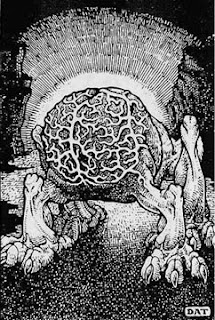
Intellect Devourer not only does this monster have the creepiest illustration in the original Monster Manual (see illustration above) but, like the Mind Flayer, it also has a discrepancy between attack modes listed by letter: "CE", and those described in the text: Ego Whip and Id Insinuation, which would read "CD". 

Thought Eaters don't actually have psionic ability but they do consume the psionic ability of others. Sadly, the MM doesn't tell us how they do it or at what rate, just that it can be done. But this is the first time anyone ever noticed because no one ever included a Thought Eater in an encounter.

Yellow Molds, are similar to grey oozes in that when they form large colonies they can become psionically active. If such a colony senses psionic beings within 120' they can blast them with "the most powerful form of id insinuation." The most powerful Id Insinuation turns any psionic-folk in a 20'x20' area with a Psionic Strength below 260 into a Robot controlled by the victor. That means that a yellow mold could take over each head of Demogorgon at once! It makes one wonder, though, what would it mean to be a robot in service to a mold colony?  [Thanks for the assist, Grodog]