Tuesday, October 23, 2012

Delving Deeper: Thar be Sample Dungeons!


So I just downloaded the (free!) Delving Deeper pdfs and I gotta' give it 5 enormous thumbs up for being the first OSR scion that I'm aware of that has bothered to include a Sample Dungeon in their rulebook.  Kudos to the Delving Deeply brain trust for that!  Also, I've heard rumors that the Sample Dungeon was lifted from an early draft of Paul Jacquay's Caverns of Thracia module.
Take that! Ya buncha old school mo fo's!

I haven't had time to read much of the rules, but they are pretty comprehensive, covering all the traditional stuff: halflings and saving throws and all that. Plus things like optional thief class, class-switching elves, and d6 hit-dice-for-all which make it pretty clear that this is an OD&D retrobot as opposed to a Holmesian or Advanced D&D rehash, but you probably already knew that.  What I haven't figured out in my cursory analysis is what innovations the Delving Deeper crew bring to the table. Or is this just a straight up re-packaging of the Old Game? I wish there was a "Here's what's new" section that hit on all the highlights so that I could get to bed at a reasonable hour tonight.   

Monday, October 22, 2012

Clericless D&D

As I may have mentioned, I'm running a campaign based on T1 Village of Hommlet which includes my own home-brewed continuation of the conspiracy of Elemental Evil.  One of the challenges has been that we drop-kicked clerics from our game.  You ever try running a D&D campaign based on an evil cult where there aren't any clerics?

It's actually kinda' fun. "Clerics," now freed up from the Christo-warrior-priest trappings of D&D's ecclesiastical class, are able to pursue much more interesting endeavors in the name of their chosen worshipfulnesses. Take T1's Lareth for example. He's too stupid to direct a diabolical cabal of any import, but with his commanding presence he's exactly the guy you want leading your troops onto the field against them tight-ass forces of Superfluous Good. So I've re-worked Larry the Hunkadelic as a sword-and-lance wielding bad-ass knight of evil chaos who is so awesome that not only is he shagging Lolth, she's seen fit to bestow him with some cool demonic powers. Rather than "praying" for new spells everyday--how lame is that?--he can use these spell-like powers--poached from his spell list in the module--a limited number of times per day:
  1. Command
  2. Hold Person
  3. Cause Blindness
As for his other spells, I don't see Lolth granting any touchy-feely sanctuary or cure light wounds type powers, and know alignment and protection from good are nearly useless in my game since most of humanity--including demi-humanity and humanoidanity--are not aligned in any particular way.

Fabricating a cool NPC is fairly easy to do in this manner; I can mix and match powers, poaching from spell lists at my leisure without having to meet the parameters established by any particular character class.  NPCs are whatever I want them to be.  This also keeps the players on their toes, since NPC MUs also live by different rules than their PC brethren.

But can I reverse-engineer a religion-based player class that incorporates the motivations of a divine/malign force or alignment or what-have-you into a progressive character class that is also somewhat balanced with the fighters and the MUs and such?*  Only if there were a very limited number of deities/divine forces to choose from, 'cuz each cleric dedicated to each otherworldly force would, in essence be like re-making the druid class.  For the time being--especially since none of my players are clamoring for a cleric--it's best I leave the godly powers in the hands of NPCs.

* Yes, some old schoolers will try to tell you otherwise, but ever since mail-clad fighters and robe-wearing spell-jockeys started teaming up to pillage underground hobgoblin condos back in the 70s there have been efforts to balance the character classes.


Saturday, October 20, 2012

Homer on poison

"Odysseus... was looking for a deadly poison to smear on the barbs of his arrows.  The man would not give him any, for fear of the everlasting gods."  --Homer, The Odyssey (Rouse, W.H.D., trans.)
You hear that?  For fear of the Everlasting Gods.  That's why we leave poison to the assassins, kids.

Thursday, October 18, 2012

Roman Polanski, the Sample Dungeon and the Cult of Cuthbert

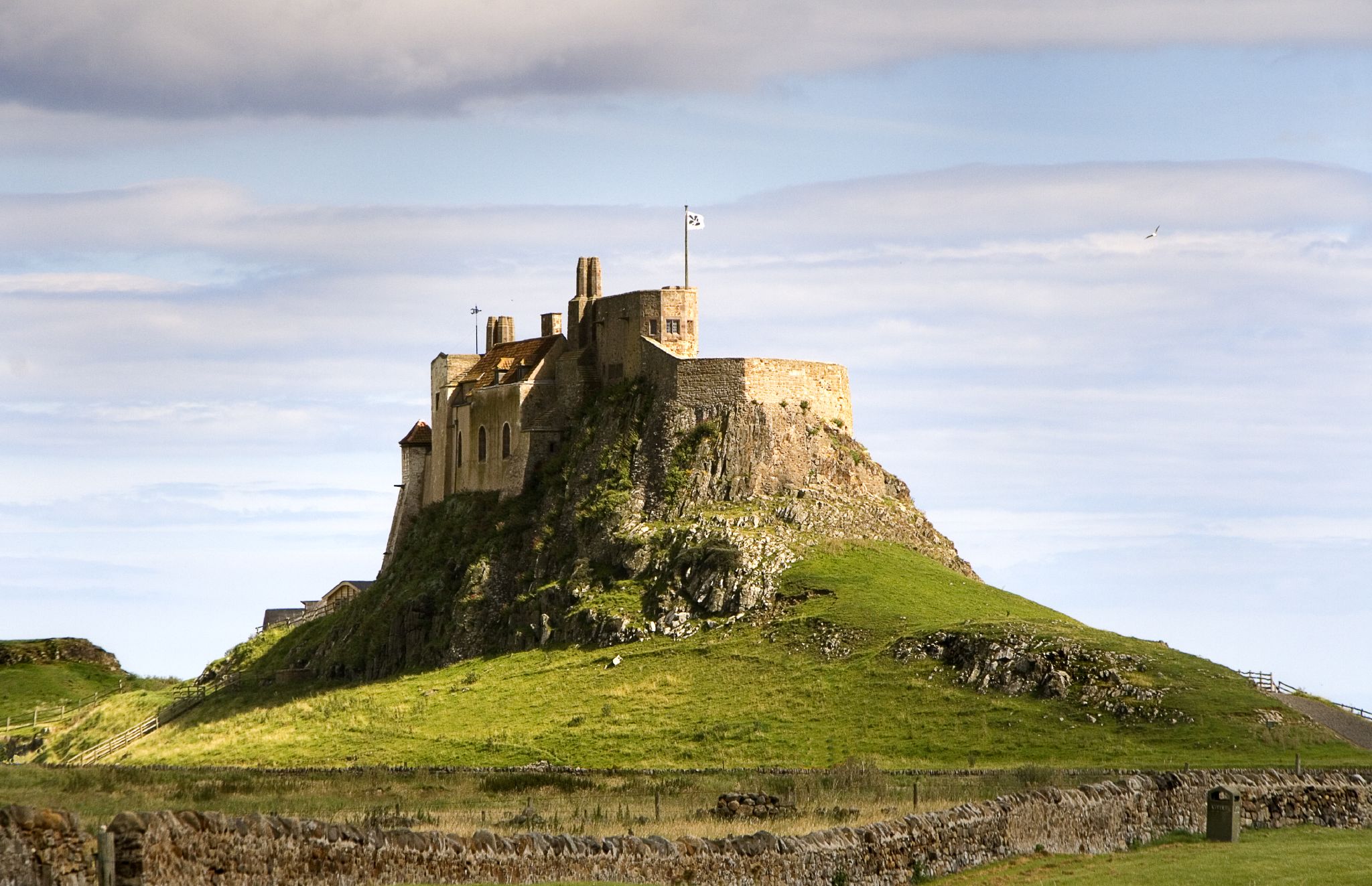
Ever heard of the Polanski flick Cul de Sac?  I didn't think I had either when the DVD showed up at my house the other day.  But there it was so I must have requested it, right?  Not knowing what possessed me to request this movie, I plunked it in the DVD player and gave it a whirl.  I fell asleep about 20 minutes into it--it had been a long long day; I should not have started a movie at midnight--but I did manage to see enough to figure out why it had made it to my queue: it was filmed on location at Lindisfarne, England--home to a monastery that has two claims to fame of interest to the likes of you and me:
  • Back in 793 AD, it was the site of the first recorded Viking raiding activity on the British Isles, and 
  • It was named after its former abbot, an Anglo-Saxon monk-turned-saint named Cuthbert.
The movie reminded me of another bit of information relevant to the Hommlet-Sample Dungeon milieu; the real world Monastery of St. Cuthbert, which was pillaged by ferocious raiders from across the water, is on the island of Lindisfarne which is accessible from the mainland via a causeway.  The monastery in the Sample Dungeon--likewise pillaged by raiders of unknown origins sometime in the past--was built on an island of sorts in a swamp which was accessible via a friggin' causeway.  Gygax was no doubt well aware of the history of the real St. Cuthbert and his monastery; could it be that the sample dungeon was intended to be a visit to St. Cuthbert's former earthly abode?

As for the flick, despite its name it has nothing to do with suburban street layout.  And despite its setting, it has nothing to do with monasteries or vikings.  Released in 1967, it's an arty flick about a gangster on the lam after a botched heist who forces a mismatched married couple who live alone on an island to keep him company while he waits for Godot. Hilarity ensues.

Friday, September 28, 2012

Etymology of the word "crit"

So I just got the DCC RPG rulebook--I know, last one on the bandwagon yet again.  As you're probably already aware, they use the term "crit" to describe exceptional wounds sustained in combat; a fairly common convention amongst gamers.  Many of you probably believe the term comes from the term "critical hit."  While you shouldn't be mocked for this misunderstanding, the truth is far more sinister.

In fact "crit", as anyone who attended art or architecture school will tell you, is actually short for "critique"; an event wherein students present their work for comments from their elders; sounds harmless enough.  But, for those fortunate enough to have avoided the experience, a crit is actually a most unholy ritual which involves sequestering a group of initiates in a single room called a "studio" for several days (d6+1) and purging their souls and bodies via total sleep deprivation and a diet limited to the output of the nearest vending machine.

After the mind and body are thoroughly purged of any wholesome, life-sustaining elements, the initiate--incapable of meaningful communication and exuding a most offensive reek--is subjected to a protracted self-immolation involving forced pubic speaking before a jury of fashionably dressed sadists wearing angular spectacles.  Through a most thorough and malevolent analysis of the initiate, each member of the jury proceeds to verbally humiliate the prostrate student until catatonia sets in.  The process is repeated 1-3 times per semester for 3-5 years.  

Survivors of a crit are occasionally rewarded with free snacks.

What, pray tell, has any of this to do with the gushing axe wounds delivered to the necks of kobolds?  I'll tell you. 

Throughout the agonizing crit ritual initiates are prone to fantasies involving any number of ghastly bodily injuries they might sustain which would, hopefully, excuse them from completing the process.  It is these febrile imaginings which became the source of the first "crit tables" when, back in December of 1976, an aspiring architect at the Harvard Graduate School of Design who, in the midst of the 'cleansing' portion of the final--and most intense--crit of the semester, compiled a comprehensive list of these masochistic fantasies on a scrap of vellum.  When tending to said student, a young EMT saw the list on an adjacent drafting table and, intrigued by the heading which read "Crit Injuries," pilfered it.  Being an avid D&D player who was always looking for lists to randomize, he knew he'd struck gold.  He immediately put it to use in his Friday night gaming group, word got out and, after 30+ years of proliferation throughout the gaming community, DCC published a book laden with "crit" tables in silent homage to the suffering of design students everywhere.

Wednesday, September 19, 2012

12 Irritating Magic Swords

I broke into the Dungeon Dozen's house last night and stole his his schtick.  I figure I've got maybe a day or two before he tracks me down, so here are 12 quirks for magic swords:

  1. Sword increases its density making itself too heavy to lift
  2. When it's annoyed, Sword goes inert, functioning only as a normal weapon
  3. Sword refuses to allow you to pick it up, scooting a few feet out of reach each time you reach for it
  4. Sword charms you into being its servant
  5. First chance it gets, Sword will jump into the hands of a better fighter
  6. Sword gets jealous of your other weapons; cuts your bow string when you're not looking
  7. Appalled at your chickenly methods, Sword yells out to enemies when you try to use stealth to gain surprise or circumvent combat; insults opponents when attempting to parley.
  8. When facing overwhelming odds, Sword refuses to leave the safety of its scabbard
  9. After its first taste of blood, Sword starts eyeballing your colleagues like they might be its next meal.
  10. Sword is pining for its old flame, the Rapier of Stabbiness.  Whenever you enter a new town, Sword coerces you into visiting armories, swordsmiths, and mercenary halls in search of news from its one true love.
  11. Sword insists on getting the final say; will always take the last blow of every combat, whether it's necessary or not
  12. Sword has a horrific case of halitosis.  Elves and other fey folk within 12' of you must save vs. nausea or vomit into their hats whenever Sword is drawn. 

Monday, September 17, 2012

Moathouse Monday: Structural matters

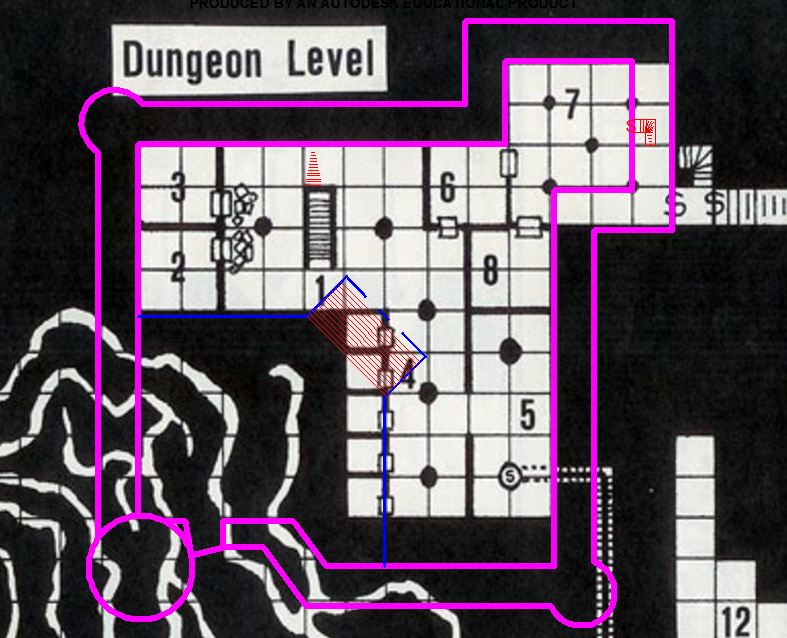
A while back I was doing some excavation over at the moathouse for my revised T1-2 Moathouse of Hommlet/Sample Dungeon of Evil Chaos.  As my crew dug out the rubble and cleared the stairway down to the dungeon level, I began to notice that things didn't line up quite right.  For instance, the stairs at 13 run smack into the curtain wall.  And the doorway to the stairs at 8 opens not to the hallway where both the number and the arrangement of the risers would seem to indicate an opening should be but, rather, it opens to the side into room 6 at the mid point of the stairway, by which point the steps are presumably several feet above the floor level.

ABOVE: Curtain walls outlined in magenta, bailey walls in blue
Now we all know that, back in the day, the cartographers of TSR were gleefully insouciant when it came to practical considerations of underground construction, so none of us gave them any grief over these sorts of quirky inconsistencies of structure.  Yet, oddly, the Dungeon directly beneath the moathouse seems to be excessively concerned with structural matters, as manifested in the forest of big, fat, presumably load-bearing columns arranged throughout the level.  There is nary a span of ceiling greater than 20' that is fearless enough to refuse the support of one of these pillars.  And yet, once you descend to the sub-dungeon level, accessible via the secret doors in area 7 and 5, the columns are no more; even though this portion of the dungeon supports a vast and sodden fen on its roof.   

Intrigued by these subtle clues, I decided to pry a bit further to see what other oddities I might find. So I had my CAD guy draw the outline of the curtain walls and the exterior wall of the moathouse (above) and transpose them to the dungeon level below. 

BELOW: Moathouse outlines transposed onto dungeon level
First off, notice that the stairs don't match up.  The stairs from area 13 Above that butted into the wall have now turned completely around in area 1 Below; a much more sensible arrangement to be sure.  And the stairs in the wall of the tower of area 7 Above seem to drop you into the room below from the ceiling of the strangely enlarged area 7 of the dungeon level.  And I'm not even going to get into the wide staircase from the bailey up to the Black Chamber (6 Above).

Although it seems pretty obvious that the dungeon level was intended to fit snugly into the footprint of the moathouse, for some reason the 5 zombie cells in area 4 and Lubash's quarters in 7 have expanded outward.  Why is that?  Could it be because Gygax wanted to make the secret door hidden in the south column of the torture chamber (5) that much harder to find?

Hear me out: If the columns in area 5 were the first columns encountered in the whole place, it wouldn't take an elf to smell something fishy; every old school gamer worth his beard would know something was up and spend the next several rounds/turns/days looking for traps, secret doors and lost lunch money around those pillars; resorting to mining operations if such were necessary.  So he made sure that PCs approaching from either access point to the dungeon level would already be inured to the presence of structural columns; pillars went up roughly every 20' through the level and what once stood out like a sore thumb became just one more finger in a pair of ordinary-looking gloves.

But pillars would look pretty suspicious in a 30' x 30' room (7) and downright tacky in a 10' wide corridor, so in order to accommodate these structural elements in an inconspicuous way, the dungeon engineer expanded  room 7 Below to a 40' x 40' square and widened the zombie corridor to a voluminous 20'  wide hallway at area 4.  The result: a much more pleasing pillar arrangement, but the curtain walls have been undercut and the zombie cells protrude out into the bailey. But, thankfully, fantasy adventure gamers are not too particular about these sorts of things, and no one ever noticed. 

Also of note: the east wing of the dungeon level does not extend all the way to the south curtain wall.  Too bad, because if it had gone that extra 10', there would have been exactly enough room for a sixth zombie cell to accommodate the last, homeless pair of zombies from area 4.  For those not in the know, the encounter at area 4 involves 12 zombies who are lurking in pairs in the chambers off the west side of the corridor.  Of course, anyone familiar with basic arithmetic will quickly notice that there are only enough cells for 10 zombies so arranged.  Some bloggers have taken this misstep and extrapolated vast and exaggerated conspiracy theories regarding the provenance of the V. of H. and other Gygax-penned dungeons, but we shan't deign to acknowledge those wingnuts here.