Showing posts with label Trampier. Show all posts

Monday, September 28, 2015

Long Arm of the Outlaw: Thief-a-palooza Continues


Look at the reach on that dude!  He can stand perfectly straight and scratch the back of his knee without bending.  He can pick a pocket from the other side of the street.  He can open a trapped chest from the next room.  Who needs to climb walls when you can just reach up and haul yourself over the parapet?

I always wondered though, what's the deal with that little ringlet around his right bicep? Is it the captain's armband for some thieving competition? The last remnant of his shirt--the rest of it having been lost, along with his shoes, in a game of dice?

Friday, September 25, 2015

Furthermore... It's Thief-a-palooza '15!


Following on yesterday's thief-related post, here are a few more of my thoughts on thievery in D&D:

I'm totally in line with Hill Canton's "bonus skill levels" as I understand them: rather than improving skills in all thief abilities uniformly with each new level--essentially all 5th level thieves are equally good at all thief abilities, before racial and/or dex adjustments--the player is allowed to allocate which thief abilities they want to improve and by how much.  So a 5th level thief might actually still pick locks as well as he did when he was a 1st level thief but be as stealthy as a mo fo and read languages with remarkable literacy.  HC and I differ in that whereas he doles out 2 Bonus Levels per thief level I'm handing 'em out at a rate of 6/level.  But then you consider that 1 bonus level for HC thieves represents +1 on a 6-sider for a 16.667% improvement while one level for Dice Chucker thieves reflects a mere 5% improvement.  We're looking at 2 x 16.667 = 33.3% vs. 6 x 5 = 30%, so, dang, I actually look kinda' stingy by comparison.

I'd actually take the process one step further allowing first level thieves to divvy up 6 levels amongst their abilities, meaning that some of their abilities are going to be 0-level (+0) to start.

Other oddities of Dice Chuckerian thieves:

Read Scrolls: Rather than being linked to the character's overall thief level, i.e., you can start reading scrolls at 9th level, reading scrolls would just be a Very Difficult read languages roll: you're rolling d20 + level against 6d6.  You can try it at first level--or even 0-level--just don't expect a good result.

Hear Noise and Detect Traps: While the PC may declare his or her intent to use one of these abilities as per usual, the DM should also roll automatically against these anytime a trap or noise is worth noticing, though the challenge should be bumped up a few dice. 

Thursday, September 24, 2015

Thief Ability Redux: Piles of Dice

Riffing on Hill Canton's post on thieves yesterday (or whenever, given the incubation period of posts around here, it may well be December of 2176 before these pixels see the light of day) I decided to post my own rant on thief abilities.

What are the odds, buddy?
One of my many grievances with thief abilities is that success is almost never influenced by conditions. That is, no matter how well concealed the trap is or how alert/inert the guards are, your chance of detecting it or bypassing them remains the same.* Sure, the DM can modify a trap or lock and say "your -20 to open it" or whatever, but it's so specific and granular that it becomes a nuisance and only dickheads ever use this method except in the odd extreme circumstance.

In an ideal world, conditional difficulty should be part of the system so the DM doesn't feel like s/he's rewording the Old Testament just so that the lock to the crypt can be a little tougher to open than the lock on your sister's diary.  It should be easy for the DM to assess difficulty without taking a lot of time, rather than trying to decide whether it's a -22% penalty or a -24% penalty, it should be broad enough that the DM can make a decision quickly and we can all get to the matter at hand: slaughtering orcs and stealing their treasure.

So...
Here's how it goes: the thief (or the Maestro del Dungionni, depending on the circumstances) rolls d20 and a pile of six-siders at the same time.  If the 20 sider + thief's level are equal to or greater than the total of the pile of 6'ers: Success! How many six siders in a pile, you ask? Good question: depends on how difficult the DM feels the challenge is. Here's a handy table to use as a guideline:

Table IX.A.2.d(17): Dice Piles and Difficulty of Thieving Abilities


Avg. Success Rate for a Thief of:
Dice Pile   Difficulty Rating  Description 1st Level 5th Level
1d6 Super easy  Fail this and you're out of the Guild  
92% 95%**
2d6  Easy Only a newb would screw this up 75% 92%
3d6 Modestly difficult   Still, you better succeed if you want  to earn your keep  58% 77%
4d6 Difficult   We have faith in you!  40% 60%
5d6 Pretty Difficult   You might as well give it a try...  24% 43%
6d6 Very Difficult  Better have a Plan B just in case  11% 26%
7d6 Fat Chance  Give us a minute to back up a ways before you try that  4%*** 13%

Pretty fancy, right?

Some guidelines on how I'd adjudicate this:****
Picking a lock on a typical dungeon door: 3d6
Picking a lock to the King's treasure room: 5-7d6, depending on the wealth of the king and his security measures
Sneaking past a guard who's chatting with his buddy about the Misfits show he went to last night: 2d6
Sneaking past a guard who's on high alert: 4d6
Sneaking past a guard who just saw you a minute ago and knows that you're trying to sneak past him: 6d6
Climbing a craggly wall with ample hand/foot holds: 1 or 2d6
Climbing a rough hewn yet slick wall: 3 or 4d6
Climbing a sheer, polished, monolithic wall: you're a thief not Spiderman.
... and so forth

Some of you who are more statistically gifted than I are probably thinking "Why not just tell the dudes they've got a 75% chance to defuse an Easy bomb or 40% chance of deciphering a Difficult language or whatever?" You could do this if you have a good idea of the odds of success for every thief ability under a wide variety of circumstances. I don't have that info handy, nor do I trust myself to make up reasonable odds for such on the fly.

The beauty of the Pile o' Dice system is that as a DM I don't have to think very granularly about the odds of success, I let the dice do the dirty work. Yes, on average a 1st level thief has a ~58% chance of hiding in a 3d6 shadow, fine.  But, as DM, I don't actually have to say that.  Instead, I'm saying "your odds are somewhere between 20% and 95%, but are most likely somewhere in the middle, so let's just see what happens here..." This is probably just my laziness but I find it much easier to assign a range of probability than a single, precise value.


* The exception here being picking pockets of leveled characters, of course. Which clearly was a reaction to those dickhead players who insist that it is their thief's moral obligation to steal from his colleagues mid-dungeon, yet get indignant when their moronic character finds himself hogtied and naked while his erstwhile colleagues offer his carcass to a band of gnolls in exchange for free passage through their domain.  
** Assumes 1 is a fumble, otherwise 100% chance of success
*** 5% if you abide by the 20 always succeeds rule.  I know, I'm being inconsistent here.
**** I loathe the word adjudicate as used by gamers--though I don't deny it's usefulness. Still, I hope you appreciate the personal pain I am subjecting myself to in order to deliver this post to you.

Tuesday, September 1, 2015

Emirikol the Neurotic: Through the Ages

Apropos of nothing, I've been perusing the pages of various Tomes of Guidance for Masters of Dungeons, Games, and Other Assorted Things Which Require Mastering.  You can't look at too many of these without noticing some similarities between the various rules, most notable being the presence of Emirikol the Chaotic.

We all know the scene: back in '79, the eponymous, deathray-wielding wizard aligned himself with chaos and blasted his way through the city streets, leaving a trail of corpses in his wake.  Fortunately, TSR's best crime-scene illustrator Dave "Tramp" Trampier was on hand to capture the event in ink; the result earned itself a full page in the original DMG.

Fast forward a couple of decades and all of a sudden people are feeling sentimental for a time when the city streets were rife with Chaotic madmen running amok.  Numerous retro-gaming publishers commissioned artists to provide tribute to Emirikol's last ride.  Or was it his first? Third? Does anyone know anything about this guy?*

Since the original there have been no less than four versions published in various fantasy gaming tomes.  While the details vary between iterations, what is constant is chaos surrounding a horseman racing through the city streets, an archway in the background, and various swordwielding do-gooders emerging from public establishments usually located on the right side (stage left) of the street.  Here's a rundown on the sequels, remakes, and knockoffs:


2001 Hackmaster: GameMaster's Guide. p. 153 In this version, Emerikol himself seems to be the victim, harassed as he is by a mob in close pursuit.  He appears to be out of death rays for the day, and indeed, a bystander has beaned him in the head with an apple [EDIT: obviously, it's a rock] while another appears to be dumping their slops on him from a window above. No respect. This mostly decent reinterpretation is somewhat marred by the bizarre method of rendering the swift movement of feet that the illustrator chose to utilize. Several short quick action strokes give the impression of rapid movement but it's as if the lower extremities of the horse and swordsman-exiting-the-tavern are vibrating back and forth, not racing to action.  Not sure what the illustrator was going for but it failed.

2010, C&C: Castle Keepers Guide. p. 97**  Peter Bradley's rendition of the fateful Flight Through the Archway has a gleefully buxom witch in the role of Emerikol, this time racing through the night-shrouded streets and tossing coins--or are they flower petals?--to... no one in particular.  There is a pedestrian lying in the street in the background, but he is clearly better off than the flaming corpse lying in the foreground of the original.  In further departures, the requisite samaritan who sticks his proboscis out the door on the right side of the street is bereft of a blade while the "public establishment" has moved across the street and is now a brothel named the Scarlet Pillow. This one is also unique for being in full color, cuz Bradley don't do black n' white.

2012, DCC RPG. p. 63  Emirikol--here renamed and re-aligned as "Lokerimon the Lawful"--has been forced to reign in his racing steed to avoid trodding on a conjured fiend summoned by the "samaritan" swordsman.  The tavern in this version is called the "Smoking Wyrm" and depicts a dragon who closely resembles Tramp's Wormy character of Dragon Mag fame. If one could view this image without the baggage of the original illustration, one might assume that the samaritan demon summoner is the protagonist of the scene, or perhaps even the demon itself, though the "Lawful" sobriquet doesn't support that.


* Until now I didn't even know how to spell his name; I've been spelling it Emerikol in my head for decades. As I will continue to do for the rest of this post.
** Sadly, a halfhearted inernet search yielded no useful image of this drawing.  Unless you're more ambitious than I--or have the tomes handy--you're stuck with my description. 


Thursday, June 27, 2013

Tramp on Combat Recuperation


Combat makes a body thirst.

Friday, June 21, 2013

Art of the Monster Manual Part II

Other Things I learned from playing Dis or Dat:

  1. DCS drew all the freakin' dragons!  How did we not get even one iconic dragon illustration out of Tramp?  DCS also did all the Dinosaurs and most of the Demons--with the exception of Juiblex.  Tramp, on the other hand, got all the devils except Asmodeus.  Man, the D section is loaded.
  2. Dispater (Arch-devil) has mismatched feet: one human-seeming foot and one cloven hoof.
  3. The doomed fighter in the Violet fungi drawing looks like he might actually have detached his rotting right arm.
  4. Another DCS trait: screwing with the frame.  See the rust monster, right, but also leprechaun, hippogriff, fire elemental, dwarf, chimera, and probably a few others.
  5. The knight fighting the hobgoblins (p. 52) might very well be the Paladin in Hell from p.23 of the PHB.  And possibly the same dude who's watching his friend get chowed by giant ants back on page 7.
  6. Has anyone ever made any sense out of the illustration on p. 57 showing the ki-rin tangling with Quetzalcoatl? 
  7. TSR re-used the satyr drawing from the MM on page 187 of the DMG, next to the "Faerie and Sylvan Settings" random encounter table, appropriately enough.
  8. Rakshasa: Suave-ass Mofo.  Not a revelation, but it's still worth saying. 
  9. DAT's elves, p. 40, are sufficiently weird looking.  DCS's elves on the previous page are too uptight for my tastes.
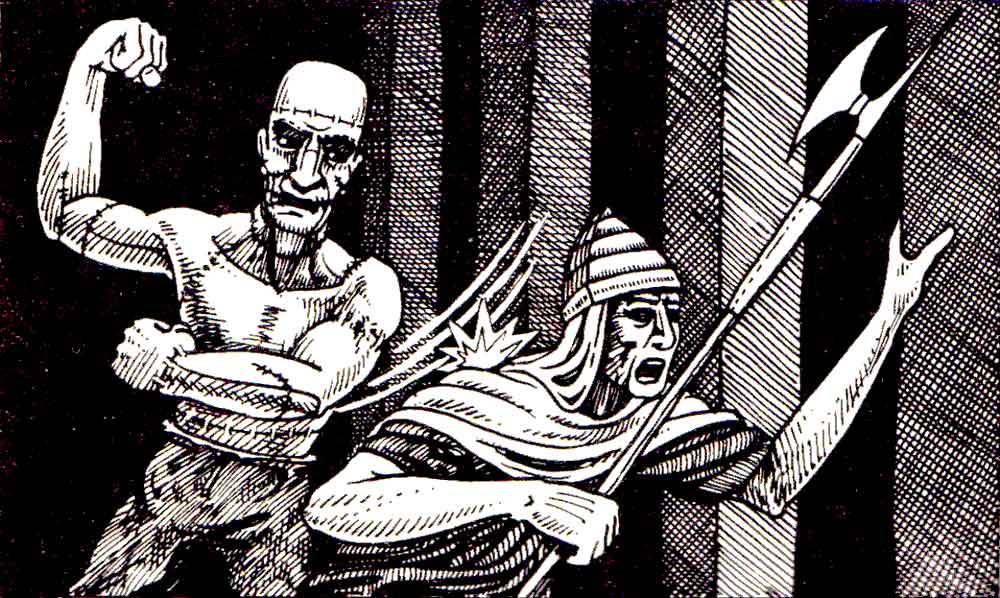
  10. The flesh golem is an enigma.  It's clearly the work of Tramp--just look at those metacarpals!--but the columns in the background lack the confidence typical of his work.  Note the wobbly lines and the clumsy hatchwork of the pillars compared with the smooth curves of the halberd blade and the dude's forearm.  I'm wondering if Tramp drew the foreground but, pressed for time, handed it off to another artist named Dave to help finish it up. The blotchy hatching of the Golem's pants are also more typical of Dave S.

Thursday, June 20, 2013

Art of the MM: DCS Black Leg Syndrome

So I was looking through the Monster Manual the other day playing a game of DCS or DAT (pronounced "dis or dat") wherein I look at all the illustrations in the MM and guess whether each was drawn by Dave Sutherland (DCS) or Dave Trampier (DAT).  Anyone familiar with the artists in question probably knows that this is not a particularly difficult task.  [The works of DCS and Tom Wham--who also has a number of illustrations in the MM--on the other hand, are actually much harder to discern.]

You play this game a few times and you begin to pick up a few traits of each of the artists. Trampier hands, for instance, have long fingers and prominent metacarpals, while DCS, well, is no Tramp.

One distinctive feature of Sutherland's work is that he often drew the far leg of people and critters in silhouette.  See the troll on the left below for an idea of what I'm talking about:
 

Indeed, while DCS does this all the freakin' time, Tramp--the master of fine hatching--never uses this technique.  Nor does--to the best of my knowledge--Tom Wham.  From Baluchitherium through Yeti, if you see a leg, wing, arm, or other extremity filled in completely in black ink, it might as well have "Sutherland" written across it in flaming letters.  Check out everyone's favorite pig-faced orc, below; he gets the silhouette treatment over the entire right side of his body:


But right there on the facing page of the orc you'll see Jean Wells' Otyugh illustration featuring a fully blackened rear leg as well as a mostly blackened hind tentacle. 

Now I know with absolute certainty that this is a Jean Wells drawing because none of her illos appeared in the earliest printings of the MM, and the copy I had as a kid was, apparently, one of those early printings, cuz whenever I see the violet fungi or the giant rat or that bellicose otyugh I'm still taken aback by these newcomers.  Fortunately for the DCS Black Leg Theory, a not-too-close inspection quickly reveals that the femur sticking out of the muck-pile is signed "Jean & Dave" so, presumably, DCS had a hand in this after all.


Thursday, July 12, 2012

So what did come of Tramp?


Thanks for the ride, Dave.

Yes, I know; back in the late 80s, he dropped his ongoing Wormy cartoon mid-storyline and disappeared without a trace.  Then in the early 00s, thanks to the Saluki student newspaper, he briefly resurfaced as a cab driver in Southern Illinois and has remained out of the public eye ever since.  But really, his vanishing act started long before that.

With only my admittedly incomplete collection of early D&D products to go on, it seems that Tramp came into the TSSR fold in ~1977, when he contributed a few drawings to the Holmes Basic D&D book and then split up the bulk of the artwork for the Monster Manual with David Sutherland.  They teamed up again for the PHB in '78 and the two of them handled most of the early module art as well--notably, Tramp did all the artwork for the original T1 Village of Hommlet (1979), with Jeff D's cover art showing up only with the later printings.
Head of a rat, hands of an artist

Also in 1979 came the DMG, the third core rulebook of the Game.  But rather than another tag-team effort between the two Daves, this one features more of an ensemble cast.  The artist with the greatest visual presence in the DMG is probably Darlene, followed by the numerous single-panel cartoons of Will McLean, though DCS also made his mark.  There are some early Erol Otus, DSL and Roslof pieces as well.  Tramp's contribution was limited to about 5 or 6 new illustrations and a rerun of his Satyr drawing from the MM.  It is, however, the venue of one of his most iconic drawings: the full page Emerikol the Chaotic.

But by 1980, Wormy notwithstanding, Tramp is pretty much gone.  His name is listed as a contributor in the Deities & Demigods cyclopedia, but, to my eye, no illustrations in it are obviously his. [EDIT: As it turns out, several of the drawings in the American Indian Mythos and at least one in the Central American appear to be Trampier's.  Thanks to ClawCarver's sharp eye for catching these.]   And the Moldvay Basic rules are completely bereft of the Trampier touch.  His only presence in the TSR-verse from 1980 on seems to be the Wormy cartoon from Dragon magazine.  Indeed, this article about life at TSR verifies that by 1981 he was no longer contributing to the "gaming side" of D&D.

I'm guessing that he couldn't have been living too high on the hog on the proceeds from Wormy alone, and I've never seen any works of his published outside of TSR; some old school reprobate would surely have dredged up something by now if he'd been, say, contributing work to a competitor--Lord knows Judge's Guild could've used his help.  So perhaps even back then he was driving a cab or some other anonymous vocation to put a table under his bread.  Which is to say, one foot was already planted outside the rpg art bizness.

What is astounding to me is that virtually everything we came to know and love about Tramp was drawn (or at least published) between 1977 and 1979.  Two or three years this young man--Wikipedia says he woulda' turned 25 in'79--had to influence the imaginations of millions of gamers, and man did he take advantage of that time.   Thanks Mr. Trampier.


Wednesday, June 27, 2012

Tramp's Lizardman

Man that dude is bad ass.  Back in the summer of '81, I meticulously copied this drawing from the Monster Manual for the character sketch of my second-ever AD&D character, a chaotic good Lizardman Ranger/Assassin named Krazgul or something along those lines. 

My older brother hated him and, as DM of Lizardman's first dungeon, quickly killed him off.  Krazgul dove into a pool of water only to find out it was acid.  RIP Badass Lizardman.  My brother was just jealous that I thought of making a character based on this dude first.

I especially like that Tramp drew this guy in defiance of the description of lizardmen in the MM, which basically says that they are uber-(neder?)-primitives, and only the most sophisticated amongst them will use a club as a weapon and yet here's this guy with a bad ass sword and a gleaming metal shield that's so awesome Captain America would've fellated Perseus to get his hands on it.