Showing posts with label Greyhawk. Show all posts

Monday, November 13, 2023

Dark Greyhawk: Why didn't I think of this?

Somebody came up with an incredibly cool idea that I really wish I'd thought to do: they've made a map of Greyhawk that illustrates the consequences if the PCs had failed at all the classic modules. Awesome, right? 

Side note: when showcasing someone else's work, I like to direct readers to the artist's site whenever I can, but for whatever reason, the direct link doesn't always connect from Bloogle. You can try it, click below:

https://inkarnate.com/m/dwJQEe-dark-greyhawk/ 

If that doesn't work, copy the text into your browser:

https://inkarnate.com/m/dwJQEe-dark-greyhawk/

If all else fails (or you're just lazy) click on the image here.

The source of the Land of the Elder Elemental God where Veluna once stood is fairly obvious. Explicticus's Defile is awesome (N1). The Witch Queen has got to be Iggwilv of S4 fame. And we've got the giants and drow kingdoms from the G and D series in the Hellfurnaces and Sheldomar valley. That said, I'm not actually familiar with a lot of the other references: because it's in the Pomarj, I'm assuming the Earth Dragon has something to do with the Slaver series though I don't recall any reference to such in the original modules. The Kingdom of the Efreet brings to mind the cover art from the original DMG, but I'm guessing there's a module out there that explains this more fully. And I'm not sure why the Lendore Isles are now the Lost Isles and not something more assassin-y or Bugbear-y. And why are the Sea Barons now the Hold of the Sea Pirates? Anyway, neat idea. 


Saturday, July 10, 2021

Dicechucker's Greyhawk Canon

Since loads of you haven't got any interest in asking me which TSR-published tomes make up the Dicechucker's Greyhawk Canon, I'll save you the trouble. Below are the sources which I require and/or accept as part of my Greyhawk-ian canon, as well as some that seem canon-y but that I don't put much stock in.

Fundamental:
The World of Greyhawk Gazetteer, this is the 32 page booklet that came with the 1980 Folio edition. Since it predates the boxed set by 3 years, and since the boxed set tended to introduce errors--Invoked devastation of Colorless Fire anyone?--it's probably more accurate.

T1 Village of Hommlet If you've ever read the Gazetteer, you already know that no module is more intrinsically linked to the WoG than T1. Not only is this one of the only modules mentioned by name in the Gaz, the events described in T1 also get a paragraph write up in the Chronology plus further treatment under the Verbabonc heading. 

S3 Expedition to the Barrier Peaks As discussed elsewhere, this one establishes the origin story of the Oeridian people. 

U1 Sinister Secret of Saltmarsh Thanks to this one we learn that the south coast of Keoland = Southern England.

L1&2 The Secret of Bone Hillenford. You knew it was coming. I like that Len Lakofka took on the role of humanizing the modern day Suel culture. That said, because my campaigns are always left-map-centric, I've moved Restenford and its environs to the Flotsam Jetsam Islands off the coast of the Hold of the Sea Princes.

Supplemental:

C1 Hidden Shrine of Tamoachan I was obsessed with this module as a youth, and I credit it as the primary inspiration for my decision to go to Mexico for a semester abroad when I was in college. Provides excellent campaign inspiration for adventuring in Hepmonaland. I may one day move this up to Fundamental status if I ever get over my left-map-centrism.

C2 Ghost Tower of Inverness While the dungeon itself can be located pretty much anywhere, the backgrounds provided for the pre-generated characters allude to the intriguing state of affairs in the Duchy (County?) of Urnst.

A Guide to the World of Greyhawk, from the 1983 Boxed set, provides some additional information on the setting, particularly the deities and various ethnic groups of the Flannaes. Though I generally appreciate most of the additional info provided in this version, there are things about it I choose to ignore. For instance, there's some mention of a tunnel that the Suel built to escape the Rain of Colorless Fire. In my mind, that event was so sudden and complete in its destruction that it put a fairly immediate end to all Suloise migration in any direction. Maybe the Invoked Devastation left a few people standing, but the Rain of Colorless Fire reduced an entire kingdom to dust! You are not straggling out of that wasteland a few months later.  

Undemental:  Books you might think are essential but I have completely disregarded

S1 and S2: Despite their pedigree, there's nothing about Tomb of Horrors or White Plume Mountain that ties them in any essential way to the WoG, and that's fine. You can port these bad boys to your own game world, or Middle Earth or freakin' Narnia if you want and they'll fit right in. In fact, the second biggest shortcoming of Keith Francis Strohm's disappointing Tomb of Horrors novelization was that the author spent two thirds of the novel shoe-horning the Tomb into the geopolitical context of latter day Greyhawk instead of investigating a creepy, death trap-laden dungeon and defeating a powerful undead mage. [The biggest shortcoming of the book is that he spent the final third of the book failing to make the investigation of a creepy, death trap-laden dungeon seem at all creepy or dangerous--unless you were one of the dozens of unnamed red-shirts the main characters brought along to walk into all the traps for them.] 

the new blogger format has some glitchesS4 The Lost Caverns of Tsojcanth With this module, Gygax really started nailing down the mythos of Greyhawk, and there's some really good stuff in it. But it never grabbed me the way Hommlet did. It's got cool magic items, an interesting backstory, and Erol Otus's excellent cover illustration. That said, I feel like it set the table for the sort of epic power-gaming that begat Dragonlance.
Man, this cover sucks.
Snakes and Wizards anyone?


Though WG4 The Forgotten Temple of Tharizdun also lays substantial groundwork for the Epic Greyhawk mythos and came out at around the same time as Tsojcanth, it lacked the prestigious S- prefix and was largely overlooked by gamers at the time. I have no idea if that statement is substantiated by reality, but I do know that the gamers in my circle (a small sample size to be sure) held the S- modules in high regard, while no one thought much of this, the first 2-lettered TSR module. Also not helped by the pale lavender cover, the weird cover art depicting a faceless wizard surrounded by bulbous and equally faceless snake-worms, or the fact that lead-in modules WG 1-3 do not exist. I remember the lone copy of this module loitering in the D&D display stand in the store in town for about 3 years before one of my friends finally wiped off the dust and bought the thing.

T1-4 Temple of Elemental Evil I was of the generation that played T1 long before this follow up hit the shelves and found the publication of this continuation module to be a nuisance because we'd already made up our own conclusion to the Elemental Evil saga.


.


Friday, May 5, 2017

Iron Rangers of Stonefist: Hockey in Oerth

I'm just sayin'...

Coat of Arms of the Iron Rangers, a semi-professional hockey team based in the upper Midwest during the 1970s
Coat of Arms of the Hold of Stonefist, a nation of the World of Greyhawk, created in the upper midwest during the 1970s .


Thursday, September 29, 2016

Linguistics in the Flannaes: Oeridians are still from outer space


Over on Canonfire I found this cool article An Alternative Linguistic History of the Flanaess  written by someone identified only as Ullmaster [EDIT 12/21/16: Actually, Ullmaster is just the dude who uploaded the post, Joe Chevalier is the actual author of the piece.].  If you're a Greyhawk weirdo like me then you'll find that it's definitely worth your time.  Here's a highlight:
"I subscribe to the theory that they arrived on Oerth from another world, and brought their language with them." Ullmaster, An Alternative Linguistic History of the Flanaess
Anyone who remembers my bit on the Oeridians being extraterrestrials based on linguistic and spaceship crash-site evidence will think I've found my soulmate here, except that the "they" that the author is referring to in this case is the Olman people who occupy the jungles to the south of the Flannaes, not the Oeridians.  Ullmaster, offers no justification for why the Olman (Olmen?) might be from a galaxy far, far away, and yet by his very name he should know damn well that the Oeridians landed their starfleet in or near Ull some 1200 years ago. As the Oeridians are very secretive about their origins, it's only natural that Ullmaster--indubitably an Oeridian himself--is trying to deflect attention from UFO seekers to a point as far from Ull as possible.

To further demonstrate the lengths to which the Ullmaster is willing to go to mask Oeridia's true origin, s/he has this to say: 
"Oerid:  This people came from a land to the northwest of the Suel, in a coastal land ruled by dragons." 
Only by tacking the words "and unicorns" to the end of that sentence could it be made into a more blatant fabrication. We're on to you and your alien-people, Master of Ull.

All kidding aside, it is a pretty fascinating read wherein the author compares Greyhawkian languages to earthly ones. I highly recommend it.


Thursday, September 1, 2016

Nortonian Greyhawk Part III: The Quag Keep Companion

No way did I think it would take an entire month to get around to this, but here it is September 1 and I still haven't put that friggin' map together. So I'm moving on without it. That's right, we're skipping the map and going straight to Part III of the Nortonian Greyhawk series: The Quag Keep Companion, my heavily researched reference guide to the Land of Greyhawk as depicted in Andre Norton's groundbreaking novel Quag Keep.

I intended to keep this thing a straight-up reference work, using only info gleaned from the book. But, alas, too many items were only mentioned by name with no further details given or inferences made, so I started applying a little of the ol' blogger's license. It made the thing a lot more fun to write though it'll be a bit more irritating for you to read.

Remind me to scan that friggin' map and I'll put it up soon.

Yours,

Yngrge


Quag Keep Companion: A Guide to Nortonian Greyhawk

A note on abbreviations: I use two abbreviations prominently throughout this guide
  • CoG referring to the City of Greyhawk, and
  • LoG referring to the Land of Greyhawk, which encompasses the entire continent on which CoG resides.
And a note or five on page citation symbology:
  • Page numbers are given in parentheses following statements which are lifted directly from the text or can be reasonably inferred from it.  
  • Page numbers coincide with the first Tor trade paperback edition: May 2006.
  • Where a number sign (#) is given, the preceding statement is derived from the book, but the cataloger is just too damned lazy too look up the page number for you at the moment. 
  • Statements which are not followed immediately by a page citation are fabrications of the cataloger and should not be trusted.
  • Statements followed by the word (Map) are inferences made based on the Olde Thyme Map of Greyhawk (Figure 1), not the Darlene maps published by TSR in 1980. 
  • Other symbols are just there to sow chaos.
eg. the first entry below indicates that the word Blackmoor appears on pages 28 and 47 of my trade paperback edition of Quag Keep, the bit about it's location is based on the map, and the rest is just made up stuff.

Blackmoor (28,47) A barren land on the western shores of the Great Bay. (Map) Home to many peculiar locales including the Pinnacle of the Toad and other oddities.

Brethern A band of mercenary-adventurers responsible for armed incursion into some of the most notorious regions of LoG in search of legendary treasure hoards.

Castle of Kyark Citadel of the great wizard Kyark, built in the outskirts of the City of Greyhawk (CoG), the place is believed to induce madness in those who visit. (71) First built centuries ago, it is believed to be so enchanted that it has continued to build and reconfigure itself ever since, an ever-growing labyrinth of constantly changing chambers and corridors populated by an ongoing influx of monsters, tricks and traps; all of which keep adventurers returning time and again.

Dom A discipline of eldritch magic named after Dom, a mage of antiquity who developed much of the body of knowledge upon which the school is founded. It concerns itself primarily with the summoning and abjuring of demons and other beings of Chaos.

Druids Members of a “close knit, secretive fraternity” (p.23), often aligned with the dark forces of chaos, who have some ability to use magic. (#)

Dry Steppes Vast, arid plains on the western extreme of the Land of Greyhawk (LoG). What few watering places there are within the Steppes are considered the hereditary property of the Nomads of Lar. (#) See also Kalastro.

Elves A race of humans who have mastery over communication with all animals and birds (p. 21, 28). They are also possessed of Power Lore, a body of insight into the machinations of the world about which most humans are not capable of giving a damn. (51)

Faltforth the Sun Crown Deity of LoG mythology represented by the sun.(#)
Figure 1: Is this the map Gygax showed Norton?

Fane of Wings Ancient temple of unknown provenance. Noted for its unique architecture, it predates all current civilizations in LoG. (88)

Faraaz A land to the west of Greyhawk between Geofp and Verocunby. (Map)  It is comprised of loosely affiliated city states, each run by a “Holy Lord.” Also known as “Holy Lords of Faraz” or “Land of the Holy Lords.” They use copper coins in the shape of a cross, and half moon silver coinage.(52)

Fon du Ling One of the “Holy Lords” of Faraaz. An adventurer and collector of rare and fabulous animal species. He is rumored to have found and explored the secret Temple of Tung. (65)

Foreteeth of Gar An epithet (#) referring to the prominent mandibles of a minor deity with no small following in Narm. Also refers to two prominent peaks which stand guard at the headwaters of the unnamed river that separates the lands of Geofp and Narm.

Ganclang Lesser deity of LoG, noted for his (or her) brazen voice. (192)

Gar A deity heeded primarily by mountain tribes in Narm and Geofp. He is seen as a protector of the mountain people and is noted for having large tusks and for belching lightning from his mouth.

Gar-Eagle A very large bird that resides in mountain regions, roc.(#)

Geofp Region of Greyhawk in the foothills of the Western Mountains which separate the Sea of Dust form the fertile eastern lands. The Grand Duke rules the land as a stronghold of Chaos. And yes, there is a “p” on the end. Obviously it's a typo, but they were diligent in repeating it throughout the book, so it's now canon. (#)

Great Kingdom A realm to the north of Urnst along the southern shores of the Great Bay. (Map) It comprises five legendary cities which pre-date current history. (88) The lands of Blackmoor, Parth, and the Wild Coast have at times been considered a part of this realm, though citizens of those lands rarely acknowledge the sovereign. (𝞯)

Greyhawk, City of (CoG) A free city with no master where the struggle between Law and Chaos often plays out its drama.(#)

Griff Cat griffin (😼)

Han-gra-dan A wizard of legend, the “mightiest of Northern Adepts” lived a millennium ago or more. His scholarship in arcane knowledge is unsurpassed and artifacts of his creation are still highly sought after by wizards and sages alike.(#)

Harrowing of Ironnose Bardic saga regaling the epic battle between Lichis the Golden and Ironnose. (#)

Harvel's Axe, Sign of An inn of dubious reputation on the edge of the Thieves Quarter in CoG frequented by wereboars and druids. (#)

Hither Hills Hilly region to the north of Narm. (map) The tribesmen of these hills are known to be adepts of some renown though it is often said that they are descended from the intermixing of men and demons of chaos. (67)

Kalastro, Empire of Land of legend located in the area that is now the Dry Steppe. (#) Kalastro was a vast and powerful empire that fell to decadence and depravity before turning to Chaos entirely. In what has become known as the Plague of Fire, Lichis the Golden lead a flight of dragons over the land and scorched it to the barren waste that it remains to this day. (🙊)

Keoland The largely depopulated lands to the south and east of CoG. (71) Made up of dry plains in the south and west. (#)  Most of the remaining population of Keoland lives in a hilly region to the east of Greyhawk which is sometimes referred to as Keo Major when differentiating it from the dry plains to the southeast, aka Keo the Less. See Rieving of said land for more info.

Kyark Legendary wizard who built a stronghold on the outskirts of CoG. It is widely believed that  any who enter his stronghold will succumb to insanity or worse. (71) Nonetheless, adventurers flock to the stronghold in search of treasure and glory.

Landron of the Inner Light A deity who serves the forces of Law. His disciples are known to carry nought but a knife to defend themselves. (#)

Lar Region of land on the fringes of the Dry Steppes inhabited by warlike nomadic tribes who engage in raids on their neighbors for resources. Noted for their steeds, see Steppe Mounts. (#)

Liche A form of undead, much like a zombie but possessed of greater quickness and intellect. If severed into pieces, its parts will continue to fight on independently of each other.(#)

Lichis Legendary golden dragon who supported the side of Law through thousands of years of struggle with the forces of Chaos. Was the adversary of Ironnose in the legendary battle that became the subject of the “Harrowing of Ironnose.” Has retired form the world and no longer interacts with humankind. Resides in the Southern Moutains which divide the fertile east from the arid west. (#)

Loice, Mirror of This artifact of the great queen Loice is a flat stone of a shimmery, reflective rock that is said to have mystical properties. As with the Standard of King Everon, it is said to be lost in Troilan Swamp, though a group of mercenary adventurers known as the Brethern claimed to have acquired it in recent years.

Loice, Spectre of The ghostly embodiment of Loice, legendary queen of Troilan who reigned over the land before it sunk into a swamp, is said to rise from the mire and command its denizens in defence of her soggy domain should it be threatened by outsiders. (#)
Lyra Gems (65) Low quality gemstones that are often crafted into cheap jewelry and hawked in shoddy merchant stalls throughout the LoG.

Maritiz An island nation noted for its coinage made of mother of pearl and incised with the “fierce head of a sea serpent.”(52)

Narm (61) Region to the north of Geofp in the area labelled "Neron March" on the map.

Never-fail Shield Shields of legend purported to have magical powers. (65) Vendors of dubious reputation are known to offer counterfeits for sale to gullible adventurers. They originally were used by certain elite regiments of the lost Empire of Kalastro. They were round shields of light weight yet impregnable steel with a silver star in the center and could, in the hands of a skilled soldier, be thrown as a weapon and would return to the hand of the wielder.Very few of these are known to still exist. (♘)

Northern Bands Matriarchal society that inhabits the land of the far north. Its women are fierce warriors referred to alternately as amazons and Valkyrie. They are ruled by the High Horned Lady and fight under the banner of the Unicorn. During a time of famine some years ago a regiment of amazon warriors of the Northern Bands went south to offer their services as Mercenaries in order to provide for their starving families. In the employ of the Regor, Lord of Var, they were on hand for the Rieving of Keo the Less. Great numbers of these proud warriors were not merely killed but tortured, defiled, and dismembered in unimaginable fashion.(#)

Om The pattern which maps all human activity, no matter how insignificant such activity may seem. The pattern is invisible to men and their "earth-tied" senses. (217)

Oszarmen Desert nomads of indeterminate provenance. (209)

Outer Dark source of mystical powers available to adepts aligned with Chaos (23)

Parth Seafaring nation (178) located on a peninsula at the mouth of the Great Bay.

Paynim Nation in the northwest of WoG. (map) Wine from this region is widely regarded as among the best in LoG.

Plague of Fire A cataclysmic event that breathed forth from the from the Southern Mountains destroying the Kalastro Empire (192) in what is now the Dry Steppes (Map). Lichis the Golden lead a host of Dragons over the decadent Empire, burning and laying waste to its cities, which had turned to Chaos. (🎱)

Prim Lizard A lizard that appears to be made of stone.

Regor of Var🎰oubles a generation ago. Their names were added to the death toll during the Rieving of Keo the Less. (74) It is not known whether it was he who was responsible for calling down the Rieving or if the opposition took that tragic step or another party entirely, but it is certain that everyone involved met a grievously horrible end.🎯

Rieving of Keo the Less Described as “a treachery so black that it blotted the dark pages of Chaos's own accounting—death so hideous a man might retch out his guts if he thought too long upon it.” (#) This horrifying event took place during the wars that wracked the lands of Keo a generation ago. During the siege of Var, someone called upon a force so dark that the entire city was razed, everyone in the vicinity--including all inhabitants as well as the besieging army--was slaughtered, their tortured, twisted corpses were found in a fetid stinking heap.  Sounds bad, right? It effectively ended the uprising and left Keo as a derelict state. 🎳

Rockna the Brass Dragon residing in the Sea of Dust. Possibly aligned with Chaos. (207)

Salzak the Spirit Murderer A menacing demon who committed 96 sins, at least one of which was murdering souls. (35)

Sea of Dust A fatal trackless wilderness of fine dust so shifty it is impossible to walk on it without special equipment (49). Dunes of shifting dust sweep across this land much as waves of the ocean. An ancient civilization once plied these dunes on sailing vessels, the remains of which—along with their valuable cargoes are said to litter the “Sea.”(#)

Seven Swamps Homeland of the Lizardfolk and their reptilian steeds(#), this large Wetland complex lies between Faraaz and Geofp. See also Troilan Swamps.⚄

Sign of the Pea Stalk An inn and provisioner located in the City of Greyhawk. Noted for providing good value on merchandise to the adventuring class. (#)

Song of Far Wings Enchanted shanty which, when sung by a skillful bard, summons gar-eagles and/or other winged critters to the aid of the songster. (139, 143)

Song of Herckon Soul shredding tune played by expert bards which will temporarily reduce certain spirit forces to pools of quiescent liquid. (137-8)

Southern Mountains Mountain range which holds the Sea of Dust at bay from the LoG to the east. Inhabited by Lichis the Golden and other dragons.(#)

Standard of King Everon Banner of the afore-named monarch, last king of Troilan. Under this banner, Everon led his people against an invasion but was overwhelmed and met his end on the field of battle. At his death, the land of Troilan sank into a mire into which his banner was lost. Just as the meadows of Troilan sank into a dismal swamp, its people morphed into a lizardlike breed which holds drylanders with contempt. This item was captured by a group known as the "Brethern" [sic].

Stranger's Tower A prison tower in the CoG primarily occupied by drunks and brawlers.(66)

Steppe Mounts These light horses are bred by the Nomadic tribes of Lar on the fringes of the Dry Steppes. They are known for their endurance. They are trained to answer only to the call of one master. Strangers caught riding on a Steppe Mount by Laric nomads are likely to face serious sanctions. It is said that an elf or were-being can influence such steeds to allow someone other than their trained master to ride them. (59-62)

Sword of Seven Spells Enchanted sword (65) that reputedly allows the bearer to cast one of seven spells. Such a sword may once have existed but those on sale in the markets of Greyhawk are unexceptional frauds in every way.௹

Temple of the Frog Sacred temple believed to be at the heart of Troilan Swamps from whence malignant creatures are spawned. Few who have seen it have survived to tell of it. No one is known to have entered it and returned to pass on their tale. (221)

Temple of Tung Legendary temple believed to be filled with treasures of great value. (65) It is thought to be located in the Hither Hills. Many adventurers claim to have found it and made off with booty from its crypts. It is believed that doing so bears a horrendous curse.🌝

Thera “The Maned Lady” Lesser deity of the LoG, aligned against Chaos. The tribes of Lar are known to pay heed to her. (61)

Toad, Pinnacle of the Located in the northern reaches of LoG (107), perhaps in Blackmoor, the Pinnacle is an enormous, grotesque obelisk dedicated to the Toad God. It is said to mark the “navel the world” and the gateway to the realm of the greater beings. It is central to the worship of a malignant cult of festering chaos called the Fellowship of the Toad.

Toad, Fellowship of the A cult dedicated to the worship of the foul toad god. (107) Though their agents are hidden throughout lawful society, their territory is located in a fen on the northern fringe of Blackmoor. (𝞫)

Troilan Swamps A forested wetland that is home to several tribes of lizardfolk. (85) It lies between Geofp and Faraaz and is also known as the Seven Swamps.(Map)

Two Harpies A tavern in CoG noted for its inexpensive and potent fortified wine. It is a favorite watering hole of caravan guards (66), possibly due to its proximity to the municipal stables. The place is notorious for brawling. As such, the furniture is quite stout and fixed to the floor to prevent its use as weaponry. The cups, on the other hand, are cheap wooden affairs that break quite easily, providing a satisfying spray of splintered wood and cheap wine while causing relatively little damage. Patrons of this establishment often find overnight accommodations at the Strangers Tower.

Ulik (#) A mage of great power who spawned a discipline of magic that bears his name.

Urnst Province to the north of the free city of Greyhawk. Currently ruled by a Grand Duke. (47)

Var (#) A devastated city located on the arid plains of Lesser Keoland. It was razed during the Rieving of Keo the Less and remains a cursed and ruined place to this day.

Vold A river originating in the foothills of the Southern Mountains which flows northward from the plains of Keoland, eventually becoming a mighty river as tributaries feed into it. (77)

Wild Coast Coastal region over which Ironnose was at least partially harrowed by Lichis the Golden. (#)


Wine of Pardos Legendary tipple with healing properties. (192)

Yerocunby Land to the west of CoG. Other possible spellings include Yerocundy, Yerocanby, and Verocunby. (#)

Wednesday, June 22, 2016

Olde Greyhawke Mappe

Great Kingdom Map, Gary Gygax, 1971, Territories of the Great Kingdom
Check out this early version of what would eventually become Gygax's World of G'hawk. Grodog sent me a link to it because, I suspect, he wanted the wingnut perspective on this thing. As you most likely recall, I ran a piece on the origins of the Oeridian people way back--seems like only yesterday, eh?

Anyway, my initial thought: See that valley in the mountains between Perunland and Neron March? Impact crater from the Oeridian mother ship, obviously.


Wednesday, June 11, 2014

Greyhawk: The Iron League


Reggie Dunlop: The Iron League, huh? Lotta' fights? 
Jack Hanson: Nah.
We all know that the Iron League was formed when a handful of small provinces broke off from the southwest corner of the Rauxes-based Overkingdom.  How this was achieved is not obvious until one remembers that the Hanson brothers of "Slapshot" fame were Iron League natives.  Though Jack, Jeff, and Steve had little else to say on their land of origin, one can assume--given their reputation for goonery--that Jack's statement that fighting was not prevalent there must be understood that these sorts of things are, indeed, relative.

Against these dudes, the overking never had a chance.
The brothers, despite their youth and myopia, were big, tough warriors who foiled up their fists before each foray, never backed off from a brawl, and did not hesitate to deliver a low blow to gain the upper hand in a melee.  Sounds like the perfect combination of traits you want in a peoples if your intent is to break away from the largest, most powerful, and most criminally insane regime of the era. 

Tuesday, June 3, 2014

Oeridi-centric Bias in the Gazetteer

You don't have to read too much of the Greyhawk Gazetteer--or the later Guide edition for that matter--to realize that the thing was written by Oeridians.  And not just any Oeridians; more specifically, the author was most probably a member of the Aerdian clan that pushed eastward into the vast plains of the eastern Flannaes--though he or she is not too happy with the current state of affairs in the once Great Kingdom, he or she clearly takes pride in the past achievements of the Aerdi.  Below are a few of the more obvious indicators as to where the author's loyalties lie.

  • Dates are given in CY (Common Year).  This is only done within the current confines of the Great Kingdom.  Most former G.K. states reverted to Oeridian Reckoning--if they ever adopted CY in the first place, beyond "official" ceremony--once they achieved independence from the Overkingdom and non-GK states never adopted the CY reckoning to begin with.  In fact, oddly enough, the Oeridian Reckoning is dominant throughout the eastern Flannaes outside the GK.
  • Chronology begins at year 160 O.R.  Ignoring several millennia of history compiled by the Suloise, Olven, Bakluni, and Flan peoples, the chronicler chose a date very near to the Oeridian people's dubious beginnings as the point of origin of the Chronology and Brief History.
  • Refers to the Realm of the Aerdi as The "Great" Kingdom.  Outside the current borders of said kingdom, it is rare in the extreme to find someone willing to use that conflated descriptor.  Scholars might refer to it--at best--as the Great Aerdian Kingdom or similar.  In Keoland, the term "Large Kingdom" is used mockingly, stripping the name of its grandeur and also including connotations of excess, as in "portly" or "bloated." The wags of Greyhawk take it a step further, referring to the Aerdian realm as "The Overkingdom" which is a knock on the hubris of the monarch's chosen appellation while also implying that the kingdom has surpassed its date of expiry.
  • Assumes that the Suloise migrations into the Flannaes happened over land.  Only the aquaphobic Oeridians would overlook the significance of the sailing culture of the Suloise and assume that they traveled from their southern empire throughout the Flannaes on foot.  In fact, the Suloise had a vast maritime empire for millenia before the Oeridians crawled out of their termite hills in the Steppes or wherever they're from.  Though certainly some large scale movement of peoples occurred through the passes of the the Crystalmist, most major transit of Suel peoples throughout Oerth was by ship.  Certainly the only survivors of the RCF were those lucky enough to escape by sea as only a very small number managed to reach the safety of the mountain passes on foot before being swept up in the conflagration. 
  • Implies that the Common Tongue is a product of the Great Kingdom.  While it is true that the Common Tongue is the official language of the G.K., and it is widespread throughout most of the Flannaes, it is not an Aerdian invention, as the Gaz author(s) would have you believe.  Rather, as the Oeridians moved eastward, their spoken tongue was heavily influenced by the Flannish and Suel languages of the folks they met along the way.  What emerged was a Lingua Franca that is an amalgam of the various tongues and cannot be claimed by any single people or nation. The GK claiming ownership of the common tongue is sort of like St. Louis claiming that it is the source of the Mississippi River. 
  • Aerdians portrayed as conquering hoard. In fact, they merely occupied the vast, empty plains of the central Flannaes which had been passed over by the Suel and Flannish peoples.  The Flan, being agoraphobes, prefer forests, hills, and mountain valleys to the prairies, and the Suel were, early on at least, leery of settling too far from the sea.  
  • Suel portrayed as malevolent slavers. Well, they're not actually wrong; this was true of the old Suloise Empire.  But most of the Suel settlers who came to the Flannaes were refugees fleeing the oppressive regime; a not insubstantial number of them being themselves escaped slaves, and thus, did not carry on the tradition of enslaving others. Often these people were Suel in speech only, having been members of oppressed ethnic groups during their time in the Suloise Empire.


Thursday, May 8, 2014

Greyhawk: Guide vs. Gazetteer Discrepancies

From the chronology in A Guide to the World of Greyhawk (1983 Boxed set).  Years are Oerid (O.R.):
187 Oerid migrations east of peak point.
223 Invoked Devastation of Rain of Colorless Fire strike
Compared to the original Gazetteer (1980 Folio edition):
187 Oerid migrations east at peak point.
223 Invoked devastation and Rain of Colorless Fire strike.
These kinds of printing errors are great fun for historians trying to discern past events from copied texts, but anyone who reads "A Brief History of Eastern Oerik," which accompanies the timeline in both editions, will quickly learn that the Invoked D. and the Rain of C. were separate cataclysms, not a single, verbose event.

However, the item regarding Oerid migrations is a bit more of a conundrum.  While the terminology in the old Gaz is a bit ambiguous--it could mean that the volume of eastward migration of the Oerid was at its peak or it could also mean that peak point was a place that the migrants had reached--replacing "at" with "of", as some well-meaning but unknowing typesetter did for the Guide, makes the statement unambiguous: a literal translation of the Guide, as printed, insists that "peak point" be a place which Oeridian refugees were stumbling past sometime in the year 187 O.R.

That said, have any Greyhawkers who grew up on the Guide ever pondered where on the map this fabled Peak Point might be located? 

Where's Peak Point on this thing?

Thursday, September 19, 2013

Great Mysteries of Greyhawk: The Invoked Devastation

It has long been known that the Rain of Colorless Fire was wrought upon the Suloise in return for the Invoked Devastation which befell the Baklunish.  And all along we've assumed that it must have been the Suloise who Invoked The Big D, but if you read the histories, this conclusion is far from certain.  Check out the actual quotes on the matter of the Devastation from the World of Greyhawk Gazetteer (Gygax, 1980).


From the Brief History:
“When the Invoked Devastation came upon the Baklunish, their own magi brought down the Rain of Colorless fire in a terrible curse” p. 5
From description of the Dry Steppes:
“Once the area of was well-watered and fertile... but it was destroyed by the Invoked Devastation in the war with the Suloise.” p. 21

From the description of the Sea of Dust:
“In return for a terrible magical attack, the Suloise lands were inundated by a nearly invisible fiery rain...” p. 26
And that is all that the Gazetteer has to say on the matter.

What's clear is that a not-insignificant portion of the Baklunish lands were devastated by a terrible curse, and that the Bakkies* let loose an even more thorough and complete devastation on the Suliemen in the form of the Rain of Colorless Fire.  But nowhere is it definitively stated that it was actually the Sulies who Invoked the Devastation that started the Great Cataclysm Race, leaving open the possibility that a third party was responsible for The Big D.  But who?

*Is it racist to call them Bakkies?

Well, how about the Oeridians; they were also victims of Bakluni expansion, the turmoil of the war having forced them to flee their lands and head east into the Flannaes.  As there is no mention of the Oeridian homelands in the gaz, could it be that any evidence of their native lands was wiped out by the Devastation?  Perhaps Oeridian mages left a curse upon their fertile homeland which was triggered by the departure of the last Oeridian peoples.  And, not wanting to incite a rain of colorless fire on their own asses, they decided to keep mum on the topic.

Or was it the Flann?  They too suffered heavily from Bakluni expansionism as their once peaceful lands were stampeded by refugees of Oeridian and Suloise stock alike.  Perhaps Flannish devastationists teamed up with dwarven demolitions experts, gnomish telemarketers, and elven poets to unleash the Devastation in hopes of stemming the flow.

Or even the Bakluni: The text from the Brief History in particular seems to lend itself to the interpretation that the Devastation was something that the Bakluni may have brought on themselves.  Perhaps while developing their apocalyptic technology they accidentally unleashed the Devastation on their own lands.  Undeterred, they sharpened up their game and let fly the Rain on their enemies. Or maybe it wasn't an accident; maybe they went all Guernica on some minority population in their realm--like the Oeridans--and then took it a step further, blamed it on the Suel, and used it as provocation for unleashing the Rain del Fuego sin Color, sort of like how Poland provoked Nazi Germany into starting WWII. 

Or, indeed, it might have been the Suloise all along.  The cataloguers of the Gazetteer may have been restrained in ascribing the Devastation to the Suloise because the RoCF was so thorough and widespread in its destruction that no Suloise who were in-the-know about the Big D survived to take credit for it.

Bibliography:
Gygax, E. Gary. World of Greyhawk Gazetteer, 1980. TSR Hobbies, Inc., Lake Geneva, WI

Monday, September 16, 2013

The Rain of Colorless Fire

Everyone's familiar with this famous photograph taken by one of the only survivors of the Rain of Colorless Fire on his way out of town:
What have we wrought?
Look at this dude's posture: he seems calm, one hand resting on the battlements, the other covering his downcast face.  Is this the posture of a man in shock or horror at the holocaust he is witnessing?  To me, his demeanor has always suggested that the Suel people knew that they'd earned this fate.  After the centuries of exploitation and tyranny and the Devastation they'd just Invoked, this dude's demeanor was evidence that the Suel knew that the time of reckoning had finally arrived.

Wednesday, March 20, 2013

Celebrate the Feast of St. Cuthbert

As all you hagiophiles already know March 20th marks the feast day of St. Cuthbert who died on this day in 687.  Greyhawkophiles will know St. Cuddy as one of the original deities of EGG's home campaign.  But here are a few things you might not have known about the patron saint of quality head-wear:

Banner of St. C: Where's the cudgel?
  • Good ol' Cuddy was probably ~53 years old when he died of an unspecified illness in his hermitage in Northumbria.
  • He began his monastic career only after serving in a war against the King of Mercia.  
  • After the war, Cuthbert arrived at the monastery of Melrose bearing a spear, not a cudgel.
  • In 664 he was named prior of the monastery at Lindisfarne which would later bear his name.  
  • Though he ultimately returned to Lindisfarne as Bishop, he spent much of the last decade or so of his life living as a hermit--not unlike a certain mad man in the environs of the Keep on the Borderlands.
  • His monastery would gain fame in 793 for being the first known location in the British Isles to be raided by Vikings.  Whether this event inspired the sacking of the monastery in the Sample Dungeon of the AD&D Dungeon Masters Guide cannot be known for certain.
  • St. Cuthbert's Gospel, based on the Codex of Grandior, is the oldest extant example of a "western binding."  Awesome, right? 
  • There are two caves in northeast England that bear his name.  Possibly they are named such because his sanctified remains were hidden in one or both of them to keep them safe from the Danes who continued to ravage the area for centuries.
  • Cuthbert's aforementioned gospel was also stashed in his coffin for safekeeping.  On a somewhat creepier note, so was the head of poor St. Oswald.
  • Once, after praying in the ocean, otters breathed on St. Cuthbert's cold feet to warm them up.
  • Two more Cuthberts were later canonized but, as is often the case, the sequels were not as cool as the original.
  • The Cuddy Duck is a species of waterfowl found in the vicinity of Lindisfarne. 
  • The "Liberty of St. Cuthbert's Lands" was a political entity in Northumberland that operated as a sovereign entity--a Palatinate--run by the Bishops of the vicinity.  According to Wikipedia, the people here were known as the haliwerfolc, meaning, rather literally, "holy man people", and it was believed that St. Cuthbert was "fiercely protective of his domain."  Inspiration for the See of Veluna?
  • An eagle once brought him some fish n' chips, which he shared with the eagle.
  • The Venerable Bede, a saint himself, wrote two hagiographies of Cuthbert.
  • Bede failed to mention Cuddy's affinity for hats in either tome.
  • St. Cuthbert's horse once interrupted his prayers to point out a delicious packet of bread and cheese stashed in a nearby roof.  Animals, apparently, couldn't help but give ol' Cuddy a hand.
  • It might just be a coincidence that the hermit in B2 K. on the B'lands had a protective pet puma.
  • Welsh Anglicans prefer to celebrate his feast day on Sept 4 while Episcopalians in The States pay their respects to ol' Cuddy on August 31.   Y'dey, Canoness of Hommlet, took it a step further instituting a 5 day celebration that spanned both dates.  

Thursday, March 7, 2013

Greyhawk: Origins of the Oeridian People

Can you guess where this is heading?
We know from the history of Eastern Oerik that the Oeridian peoples came to the Flannaes from the west, sweeping across the eastern portion of the continent, pushing aside Suloise and Flannish peoples alike to dominate the region politically (The Great Kingdom), linguistically (Common Tongue), and even calendrically (C.Y.).   It's possible that their dominance even gave name to the continent (Oerik) and the planet (Oerth) of which the Flannaes are a part.  But we don't really know for certain where these fierce peoples came from.

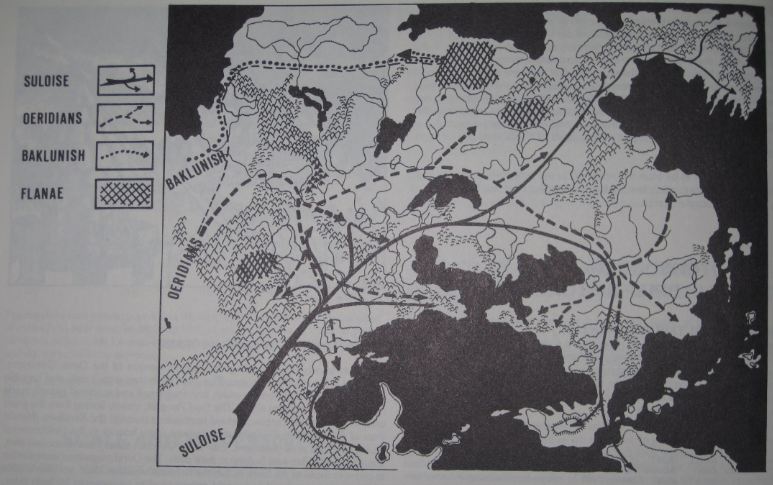
We do know that, harried by the humanoid mercenaries employed by the Bakluni in the Baksulian Wars, the Oeridians began migrating eastward from their homelands somewhere west of the vast mountain chains that separate the Flannaes from western Oerik.  Thanks to the chronology in the Gazetteer, we also know that this migration peaked in 187 O.R. (Oeridian Reckoning, subtract 644 to determine C.Y dates). But official sources are somewhat vague about the actual source of the migrations.

If we take the map of migrations in the Gazetteer as accurate, see figure 1, it would appear that the Oerid people originated in the environs of the Dry Steppes.  However, the text describes the Dry Steppes as the once-fertile homeland of the Bakluni peoples, rendered inhospitable by the Invoked Devastation.  No mention is made that Oeridians ever occupied this area. 
Figure 1. Map of migrations to Flannaes, Gazetteer (1980)

Perhaps addressing this very concern, the map of migrations in 1983's  A Guide to the World of Greyhawk moves the label of the Oeridian migratory arrow to indicate that maybe the Oeridians came not from the Dry Steppes, but from Ull [see figure 2].  The Guide describes the area as being the homeland of "a strong tribal clan of Paynim nomads."  Again, no mention is made of the Oeridians ever having lived there.

Figure 2. Guide map (1983)
It is conceivable that the Oeridians were completely uprooted from their "native" lands.  But the question it raises is why wouldn't the cataloguer who compiled the Guide and Gazetteer--who betrays an Oeridi-centric worldview elsewhere in the tomes--have mentioned the significance of these lands to the Oeridian people when the map indicates that the two are inextricably linked? 

To further obfuscate the matter, the Old Oeridian language is described as:
"A younger language, totally free of outside influences until a few centuries ago.  As a result, its linguistic components are unique and translation into any language except Common is all but impossible." (p. 8, Gygax 1980) 
This works well with the chronology which sets the Oeridian Reckoning of years as the most youthful calendar in Oerik--other than the Aerdian Empire's conflated "Common Year" of course--by 1500 years.  But how could a people whose homeland was in such close proximity to another, older culture--the Bakluni--develop a language so alien from their neighbors?  And what happened 1220 years ago that made these people start a new calendar? 

On our planet this would be a mystery indeed.  But Oerth is, happily, a fantasy setting where all sorts of cool stuff goes down.  It's entirely possible that the Oeridians were gated in from another plane; possibly by some deity or even the powerful wizards of the Bakluni; these were, after all,  the same dudes who brought down the Rain of Colorless Fire.

But there's another, more bizarre, explanation for how these foreigners arrived in the Flannaes; an explanation that has its roots in the body of Greyhawk literature: they came from space, Battlestar Galactica style.  There is, after all, a history of alien landings in the area: remember the spaceship that crashed into the Barrier Peaks near the land of Ull?

That's right, the Oeridians came from outer-freakin-space.  At least one of their ships crash landed in the mountains, many, many others apparently landed safely on the fringes of the Bakluni lands. And perhaps they melted down their space ships to make swords and plowshares.  Or they are still hidden somewhere; perhaps in an incomprehensibly vast underground hangar--I smell a megadungeon!

Anyway, the new arrivals established commerce with the nearby Bakluni peoples and, in order to facilitate such, a mutually agreeable language developed.  This language would provide the basis for the Common Tongue that would be spoken throughout the Flannaes in centuries to come.  That they call themselves Oeridians and  inhabit the continent of Oerik on the planet Oerth is either an attempt on their part to fit in by adopting the name of their new home, or it's the great irony of the Greyhawk saga: the planet is named after its alien infiltrators.
Take that you Suloise mo-fos!

Bibliography
Gygax, Gary. The World of Greyhawk Gazetteer. Lake Geneva: TSR Inc. 1980
Gygax, Gary. Expedition to the Barrier Peaks. Lake Geneva: TSR Inc. 1980
Gygax, Gary. A Guide to the World of Greyhawk, Volume III: A  catalogue of the land Flannaes, being the eastern portion of the continent Oerik, of Oerth. Lake Geneva: TSR Inc. 1983

Thursday, February 14, 2013

Ethnology of Greyhawk: Racial Purity in the Hold of the Sea Princes

"In a few places the [Suel and Oerid] racial stocks intermixed -- notably in the Sheldomar Valley where, except the Hold of the Sea princes, the peoples... are mixed Oerid-Suel stock." -- Gary Gygax, The World of Greyhawk Gazetteer, 1980.

From this statement found in the Brief History of Eastern Oerik (p. 5) we are made to understand that the people of the Hold of the Sea Princes are not racially intermixed--or at least not of Suel-Oeridian mixture--but of which stock are they?  Suel, Oerid, or another race entirely?

Given the Hold's close proximity to the former grounds of the Suel empire and that slavery is practiced in this land,* it would seem a rather safe bet that the Hold is comprised of a predominantly Suel population.  Furthermore, the Sea Princes are described as the strongest naval force of the region, and have a long history of piracy and other maritime activity--hence their name.  As the historically landlocked Oerid peoples are described as being "indifferent sailors," only taking to the sea when the Great Kingdom sought to expand to the Islands off its eastern shores, the evidence clearly favors a Suel occupation over an Oerid one.


Contradicting this, however, is the map of migrations (right) which clearly shows that both the Suel and Oerid peoples managed to find their way to the lands of the Hold.

Furthermore, A Guide to the World of Greyhawk Volume III--the later edition of the Gazetteer published in 1983--includes a table which uses a symbology of letters to indicate the racial mixture of various regions of the Flannaes.   The entry for the Hold reads thusly:
 "Sea Princes -- SOf" 
This encryption indicates that the people of the Hold are comprised of a heavy mixture of Suel and Oerid peoples, with a bit of Flan thrown in for good measure.  Which is to say, the Hold is no different in its racial make up than the rest of the Sheldomar Basin; so why did it get called-out in the Brief History as being somehow distinct from the rest?  A rational mind would say that the author either thought better of the notion of racial purity in the Hold, or forgot that he'd ever mentioned it at all.  An irrational mind would link this oversight to the human skull in the crayfish encounter in T1.  I always prefer the latter approach but haven't come up with anything good yet.

*Greyhawk enthusiasts will know that the Suel people were the sole practitioners of slavery in all of Oerik. Bastards.

Tuesday, August 24, 2010

Greyhawk Realty: Looking to buy in the Flannaes

I used to thrill at the sight of above-ground structures in D&D adventures, and only partly because of the claustrophobia I felt when we ventured under the earth to get our adventure on.  The great beauty of those supraterranean dungeon locales was that they offered the greatest treasure of all--real estate!  As soon as I was done clearing out the baddies, I was sending in teams of the most stylish architects, skilled contractors, and beguiling realtors in all of Oerth to transform these lairs of evil into pleasure palaces.

Bottomless was my desire for new real estate to develop, and though I turned many of my gaming colleagues home-brewed settings into garden estates and townhouses, I preferred the name-brand recognition provided by the official TSR-published adventures.  Indeed some of the most posh addresses in the Flannaes are laid out in those classic modules.  Here are just a few:

First off was the moathouse in T1 Village of Homlet.  When I was done with it, it had become a lovely 7 bedroom, 5 bath cottage with a spacious ballroom and extensive wine cellar.   I even drained the swamp--had to get rid of those murderous giant frogs somehow--and started a vineyard.  I've also put an offer on Rufus and Byrne's little hilltop chateau closer to town.  They've apparently grown bored with the rustic setting of Homlet and are thinking of moving to a more exciting and open-minded burg. 
 
U1 Sinister Secret of Saltmarsh: It took some work to overcome it's "haunted" reputation, but I finally tidied up the mansion on the bluff and sold it for a nice profit.  The private beach access was a huge selling point.  The smuggler's ship is available separately.  Serious inquiries only.

UK3 The Gauntlet has the fabulous Keep of Alderweg, a rugged mountain getaway with stunning vistas and exquisite stonework.  Ease of access makes it a great spot for a B&B during ski season.

B2 Keep on the Borderlands:  A quaintly rustic tree house in a grove of stately oak trees close to both the eponymous Keep and the adventure-laden Caves of Chaos, the Mad Hermit's lair is perfectly located for a weekend retreat.

A3Assault on the Aerie of the Slave Lords  Buy in the Pomarj?!  Ridiculous, right?  Actually, no other neighborhood on Oerth offers such a great investment opportunity.  Centrally located, close to numerous shipping lanes, adjacent to the always-happening Wild Coast and speckled with bucolic hilltops, the Pomarj is a neighborhood on the brink of greatness.  Though gentrification is already underway, a townhouse in Suderheim can still be had for a song.  You won't have to wait long for this transitional neighborhood to give you a nice return.  The amount of house you can get for your copper will make this a very enticing place to start a family.

X2 Castle Amber: Located in a parallel dimension, this eccentric chateau is far, far off the beaten path.  Comprised of enormous, lavishly furnished chambers complete with an expansive indoor garden, it's definitely worth consideration if you're thinking about retirement or if you're needing a secluded getaway in which to lay low for a while.  At this price, it won't be available for long!

But not all castles are equal, and several promising locales have failed to make an impact in the real estate market.  A prime example: I could barely contain my excitement when I set out to exorcise the ghosts from C1 Ghost Tower of Inverness and convert the place to condos.  You can imagine my disappointment when I discovered that the tower itself was the ghost.  Completely worthless as a development property. 

L1-Secret of Bone Hill While Len Lakofka's quirky L-series modules are among my favorites, it's not for the fine architecture.  The structures of Restenford are particularly lacking in charm.  Have a look at the Baron's squat, cramped, little abode; the master bedroom suite is the same size as the servant's quarters--tiny!--and completely windowless.   Look to Pelltar's rental tower* or the castle atop Bone Hill--a definite fixer-upper but with panoramic views of the surrounding countryside--for a better investment.   

* Strangely, the lease terms of the tower are actually included in the module. 

L2 Assassin's Knot The Lord Mayor's castle down the coast in Garrotten, though a vast improvement over L1's dreary domiciles, was still too cramped and utilitarian to inspire the hominess most buyers look for.  Add to that the reputation of the aptly named town and this place was too tough of a sell to merit pursuing.

N1 Against the Cult of the Reptile Gods: Another of my favorite modules, but alas, I couldn't drum up any interest for the temple.  If anyone wants it, you can buy it from the Town of Orlane for back taxes.  Might be a good spot for a night club one day.

If anyone out there has their hands on a promising property in Greyhawk (pre-war structures only, thank you; there's just no market for those over-stylized newer properties) let me know if you're looking for an agent with experience selling in the area.