Showing posts with label hommlet. Show all posts

Friday, September 12, 2025

Another Hommlet Podcast

A Hommcast? Anyway, the latest is from the folks over at Mighty Deeds, which is, I believe, a DCC actual play podcast. Season 3 of which sees our heroes venturing into Hommleton. They continue on to the Temple of Ephemeral Edicts, but they spend about 16 episodes in the village/moathouse.

Strangely, even though they're using DCC rules--published by Goodman Games--they seem to be using the 4e Version of Hommlet, not the Goodman Games reprint. Probably because they didn't want to take a out a second mortgage to get the Goodman Games tomes. But the DM--or whatever they're called in DCC--keeps dissing Uncle Gary's flavor text even though the text he is reading is often not from the original T1. 

Linked here:

Mighty Deeds: Hommlet podcast 

Tuesday, February 25, 2025

Greatest Hommlet Blog Post of All Time and Space

While this blog isn't exclusively a Hommlet hagiography, I have certainly written more words about it than any other single topic. And while I am far too humble (and attractive) to claim that any of my posts are the best blog post on the topic, I have identified the single greatest blog post about Hommlet--and it was not even written by a blogger. Rather, it wasn't written on that writer's blog, it was posted in the comments section of the old UnderDark Gazette.

Remember the UnderDark Gazette? Precursor to Dreams of Mythic Fantasy by the late (yes, sadly) James Smith? Remember when ScottsZ usurped James's Hommlet post with a lengthy dissection of  The Temple of Elemental Evil?

James's initial piece went up on June 28, 2011 and was mostly a splat post of different maps of Hommlet and its vicinity. But then, in the comments section, ScottsZ--a dude who had a pretty awesome blog of his own back in the day (Cold Text Files, though no evidence of it remains [EDIT: evidence found! See comments below])--proceeded to provide an in depth analysis of T1-4, posting hundreds of words on a near-daily basis before tailing off in August. He came back for one final post on September 24th but then he disappeared from the internet entirely, never to be heard from again.

Read the whole affair here: 

http://underdarkgazette.blogspot.com/2011/06/village-of-hommlet.html?showComment=1309342335705#c5108633311901958138

Other noted OSR blowhards such as Malishefski, G'hawk G'nard, and even yours truly make appearances in that comment section--just hoping to ride ScottsZ's coattails to glory. His sagacious words outclassed us all. I miss the guy, he had some great thoughts on adding richness to your game setting using deep knowledge of real world history and mythology. He even posted comments on my stoopid blog back in the day, though that should not be counted against him.

Wednesday, December 2, 2020

More Hommlet Podcasts!

Every now and then I lower my Gillnet of Knowledge-Gathering into the depths of the internet to dredge up new Hommlet content. My latest trawling efforts have yielded not one but two recent podcasts. 

First up is Open Dice Night, an ongoing game-play podcast wherein a gang of PCs known as the Party Folk are using actual 1e rules (descending AC! D6 initiative!) to take on Hommlet. The gang are not old timers, but curious youths (relative to old creeps like me) going back in time to see what AD&D was all about. I always like to see what other folks do with Hommlet so this is pretty fun for me.

Next: Dungeon Master of None A couple of dudes, one a mere whippersnapper and the other an appropriately seasoned gamer, shine some loving attention on the greatest 16 pages of D&D ever printed.


Friday, November 27, 2020

Your Druid broke my Moathouse!

It took a societal lockdown but, at last, I took the now-teenaged [barely] progeny to Hommlet. He seems to finally have achieved the requisite maturity to handle a [simplified] character sheet, so he actually rolled up characters for the first time; though he did complain that "it took like nine hours". He was off by a factor of 12 but nonetheless I took over once it got to equipping the newbs mostly because I wanted to break out my old quick n' dirty PC starting equipment rules.

Once in town, he recruited a few NPCs at the inn--wisely shunning Zert's advances but taking on the wily Furnok, the drunken Elmo, and the pedantic Spugnoir instead. At the moathouse he got past the frogs outside the gate and the huge spider in the tower without much trouble. Then the kiddo wandered straight to the giant lizard encounter where his druid does the ol' Animal Friendship thing. So now he has an awesome giant lizard friend. He even has the MU cast a sleep spell on it so that he can remove the obstruction (a shield) that's stuck in it's craw. (See/listen to GGNoRe for an explanation of this situation)

D&D's Scariest Monsters (1977-1983)
Blogspots new insert image function really sucks.

This screws up--in a good way--the entire upper level of the moathouse. The bandits in room 7 are smart enough to know that they are just maybe up to taking on a small gang of novice adventurers, but are going to get slaughtered by a party of six accompanied by a voracious giant lizard. So they parley for their freedom and skip town. Two encounters out of the way thanks to one 1st level spell. 

But we're not done yet. Now the PCs wander toward the pantry where a herd of giant rats are waiting to feed on them. Maybe you can justify giant rats hungry enough to see a smallish anthropomorphic creature like a halfling or a gnome as food, but are rats  gonna attack a voracious, 25' long lizard? Hell no! They fled in terror, running down the stairs to the undercroft and triggering both green slimes hanging out on the ceiling. By the time the PCs catch up, the lizard has eaten 3 rats while 3 more are turning to slime and the rest have disappeared into the garbage heap. Two more moathouse encounters eliminated without an initiative roll.

Technically, this shouldn't have worked because the Giant Lizard is a 3 Hit Die creature and Animal Friendship, by Ed. 1 rules, only allows a 1st level druid to befriend a critter of 2HD or less. But, because I didn't have my 1e PHB on-hand, we were using the Castles & Crusades rules (basically 1.75 ed AD&D for those unfamiliar) which are not entirely clear on the matter. 

That all happened two months ago and we've been playing almost non-stop ever since. It's a lot more fun playing in person than the online game I've been involved with since society broke down and we moved into our Omega Man bunker. But that's another post.

Thursday, August 27, 2020

Demographics of Hommlet: the Spreadsheet


My trusty colleague Rear Admiral D. Osgood III once again noticed that the ol' blogomatic device was out of gas so he wired a shipment of fuel over to Dicechucker Towers in hopes of restarting the boiler. And what form did this fuel dump take you ask? Why it's a spreadsheet detailing all the inhabitants of everyone's favorite town that nerdiferous pedants will tell you is actually a hamlet. 

Osgood has pored over the text of the Village of Hommlet (I understand he is using the Hommlet portion of T1-4 Temple of Elemental Evil as his base text rather than the original, stand-alone module) and developed a thorough census of the population. If you're just here for the handy spreadsheet, here it is. Use it in good health. Or poor health; I won't discriminate against the infirm.

If you want some analysis--or you're just killing time until the pandemic is over--stick around for further reading:

The Male:Female ratio is 7.7 men to 1 woman. This is made more significant when one considers that just 10 years ago the region was at war; you'd expect at least a few widows in this town. Or perhaps it was the women of Hommlet who cleared the moathouse, thus leaving the menfolk to step in and fill the gaps in the militia in the years hence.

The write-up on the Inn mentions that "when the season arrives there will be one or two "likely lasses hired on". What exactly is a "likely lass"? And what season is it that brings more bustle to the burg of Hommlet? Fall foliage? Hunting Season? Hockey season?

Over at Rufus and Burne's tower, the 16 mercenaries share a 20' d. room at the top of the tower for their lodgings while their capt and lieutenant get tiny yet private chambers on the floor below. But there are two 2nd level fighters posted as guards in the tower who do not appear to be affiliated with the mercenary posse that sleeps up in the turret. Since there are no other 2nd level fighters at the tower to relieve them, it must be assumed that they are always on duty and therefore have no need for a place to sleep.

Scale mail: Good enough for Thor

Also, those two guards have AC 5 and carry shields which means they must be wearing scale mail. No one in AD&D ever used scale mail. Leather and chainmail are prevalent, obviously, but studded leather and even ring mail--studded leather's disfigured troglodytic half-brother--occasionally make appearances, but no scale mail. And this despite it's cinematic appeal.


Tuesday, June 23, 2020

Scarabs of Hommlet Continued

T1 has this to say about Rannos Davl's famous TZGY scarab:
"The [TZGY scarab] is a pass in an area of the Temple of Elastic Underpants but there is only a 20% chance that even a sage would recognize it as such."

Or, to look at it another way, 20% of sages are likely to know that the ToEE has used these scarabs as passes. Since the rebirth of the temple is still a secret at the time that your characters are wandering through/pillaging Hommlet, it must be assumed that this sagely knowledge is based on the old Temple. Which is to say, the new Templonians have revived the practice of using scarabs as passes as they did in the old Temple.

We want our names on the scarab too!
In my last post I pointed out that the four letters on the scarab--TZGY--are not a misspelled abbreviation of Zuggtmoy but, rather, they indicate Rannos's four co-conspirators in Hommlet: Terjon, Zert, Gremag, and Y'dey. Rannos (10th level thief), as the highest level baddy in all of T1, is head of the Hommlet Task Force. His underlings are the aforementioned Gremag (7th level assassin) and Zert (2nd level fighter) who we already know about, as well as Y'dey, Canoness in absentia of the church of St. Ebert, and Terjon (6th level cleric), who is standing in for her. It is not made explicit in the module that these two are Templers, but it is now apparent that that is the case.

The scarab "pass" is really more of a badge indicating to other Templonians that Rannos is a member of the Black Scarab unit, and also notes his underlings. These four, and only these four, may accompany Rannos to the Temple. Zert, however, does not know that the traders are part of the Temple Conspiracy; clearly he must be taking his orders from Terjon.

Meanwhile Calmert, the rector of the church--for such a small parish, this joint sure commands a lot of hierarchy!--is obviously too low-ranking to know that the Church of Cuddy is really a front for the New Temple. However, he has seen Terjon meeting surreptitiously with Zert and the Traders, who he has determined are unsavory characters.

Knowing that Terjon is up to no good and having uncovered evidence that a band of brigands is forming in the area to, he believes, harass the population, Calmert has decided to put his trust in Rufus and Burne to defend the growing flock here in Hommlet. This is why he's embezzling church funds and sending them to the tower construction fund. Unwisely, he still trusts Y'dey and is looking forward to her return so that he can let her know about Terjon's sinister doings.

Of course, things aren't quite as lawful good as they appear over at the tower either: guess who else has a scarab? Rufus does, that's who. Rufus's scarab is carnelian (a red gemstone) and lacks any glyphs, which suggests that he has no underlings and has not been activated as an agent yet. But we do know that he has, upon achieving 8th level (he's currently a 7th level fighter) been ordered to report for duty to the Viscount of Verbabonc who will indoctrinate him in the Red Scarab Division at that time. He is as yet, a sleeper agent. Note: now the Viscount has been implicated in this plot as well!

Rufus's scarab also confers resistance to poison on him so clearly he gets more love than Rannos. Not surprising when you consider what an A-hole Rannos is.

And yet there is another member of the conspiracy at the tower: a 2nd level fighter hired by Rannos to pose as a laborer and spy for him. This dude is just a hired hand, not actually a Templonian, which is why he doesn't rate a glyph on Rannos's scarab--or even a name for that matter. But his presence their indicates that Rannos is not getting intelligence on the castle project. So either Rannos has taken it upon himself to gather intelligence or he has been ordered to do so by the Black Scarab Division leader--not realizing that its construction is being overseen and funded by another division of the Temple!

Wednesday, June 3, 2020

The Scarab of Hommlet: The Conspiracy Continues, part XVII

I recently received an email from Darrell, Director of Research down at the Home Office of Dicechucker Enterprises. He kindly delivered up an impressive pile of demographic stats on the villagers of Hommlet that clearly need to be published on this here blogsite. Inspired by his handiwork, I dug out my old Hommlet notebooks to compare his findings with my own research and came across a drawing amidst some notes I wrote approximately 4 years ago:

I admit that the sketch is a bit shoddy but Hommlet loons the world over might hopefully recognize it as a rendition of the Scarab of Rannos Davl, one of the evil traders cum devotees of Evil most Elemental. Said loons might also likely remember that the scarab is known to be a hall pass for certain portions of said Temple.

Now I understand that for many/most/all of you TZGY is just an abbreviation for Zuggtmoy goddess of fungus, which makes sense when you realize that her name was once spelled Tzugtmoy, which might not even be true but too late, I just said it so now it is. But for those of us who were barred admission to T1-4 The Temple of Elephantiasis of the Esophagus we had only the text of T1 to go off of. And in T1 there is only one deific entity mentioned in association with the Temple of Elevated Estrogen and her name is Lolth, not Zuggtmoy. For folks like me, TZGY was some sort of code used by Lolth worshippers, sort of like how folks of a certain persuasion will immediately recognize INRI as a signifier of Jesus Christ without necessarily knowing what the letters stand for.

"Ok, but what's your point, D-Chuckles?" you ask? Here's my point: if you live in a world where Zuggtmoy doesn't exist--as most of us did until 1984-ish, then what does TZGY stand for? Well, on the same page in my notes as the above referenced scarab drawing is a list of four names:
Terjon
Zert
Gremag
Y'dey
Holy Crap!
While some of you are probably thinking "why is this jackass lumping two clerics of St. Cuthbert in with two known Culstists of Evel Knievel?"* Those conspiracy wingnuts amongst you will remember that years ago some internet nutjob posited that the coincidence of Y'dey's sabbatical from the Church of Cuthbert and Lareth's arrival at the moathouse was no coincidence at all. If you don't feel like clicking that link, I'll give you a brief summary: Y'dey = Lareth.

Terjon knows that Y'dey was sent off to live in a dank dungeon under a swamp with a squadron of brigands and he's jealous. If you would rather live in a dank dungeon under a swamp with 16 unbathed brigands as your roommates than hang out at Cuddy's posh new church in Hommlet then obviously you too are a devotee of the Temple of Eloquent Eros. I'm aware the logic here is circular but bear with me.

And if Terjon is in on it, it stands to reason that the Arch Cleric of Veluna--who assigned to Terjon the task of covering for Y'dey while she assumes her alter ego (Lareth)--is also in on it. This Cabal goes clear to the top of the Cuthbert hierarchy! 


*And for those who are wondering who those 4 names refer to:
  • Terjon, interim canon of the Church of St. Cuthbert  while Y'dey is off "adventuring."
  • Zert, Inn resident and known agent of the Temple of Erectile Enhancement. 
  • Gremag, Rannos Davl's colleague at the Hommlet dry goods depot; also a known Temple associate. 
  • Y'dey, absentee Canon of St. Cuddy, Hommlet diocese.

Monday, November 26, 2018

"They weren't very good merchants I guess," a Hommlet Podcast

I've gone on record as being a dude who doesn't care for adventure logs so I'm probably twice as surprised as anyone else that I've found myself listening attentively to GGNoRe*.  It's a podcast wherein a posse of gamers--who exhibit an array of southern accents ranging from full-Gomer Pyle on down to the guy who occasionally throws a "y'all" out--take on a bunch of modules and games from all around the RPG-verse. Of note to a crotchety old loon like me is their sojourn into everyone's favorite adventuring town: le village d'Hommlet.

This place? Again?
Before we go any further, I should warn you that the G'Gnore whippersnappers have an unabashed insouciance when it comes to TSR history, telling us with conviction that "the T [in T1] stands for tournament"--it obviously stands for Tamarack--and even asking listeners to write in if they have any info on how those tournaments played out. In their  defense, there is a disclaimer in the text of the website indicating that the DM might have been wrong about this.

There are no disclaimers about these other factual errors:

  • The DM proclaims that the module came out in 1980 even though a quick glance at the title page will reveal a 1979 pub. date, with a later edition in 1981. Perhaps because Jeff Dee signed his famous jacked-halfling cover illustration "D. '80"?
  • The DM also points out that the module, despite being labeled "for ADVANCED D&D Game" came out before AD&D was even a thing. It seems likely he reached this conclusion from his belief that the Moldvanian rules, published in 1981--apparently he did look at the title page of this one--were the first Basic D&D rules to be published and it presumably follows that a game called Advanced D&D would not precede the basic version onto the market--except of course that it was the 1977 Holmes basic rules that set the table for the advanced game.

Impressively, the gents are aware of Dave Trampier and his legacy--including his abrupt, unexplained break from TSR--though they are unable to discern whether the art in the book is his or Dave Sutherland's.

Anyway, the G'Gnoré dudes run through V of H using 5er rules (actually it could be 4th or even 3½th for all I know) and very nearly got their butts kicked on a few occasions--just like everyone else who's ever ventured into the ol' Heap-in-the-fen. I'm not actually sure how they didn't bite it in the crayfish hut; I think hit points must be handed out pretty liberally in 5ed.

What I like most is how the DM played up the Cuthbertian vs. Druidic conflict quite a bit, even going so far as to create a flow chart for determining potential actions the agitated Hommletians might get up to. Also positive: the PCs putting on drunken scheming "montages" when developing plans for achieving their mischievous goals.

What I liked least: the frequent use of the term "Yolo."

I won't spoil the action for you so if nerdy podcasts are something you're into by all means go have a listen. Also notable: if your kids wanna listen along with you the fellas, being good Southern gents, keep the language clean--other than the "yolo" thing.

And if you're wondering about the title of this post, kindly refer to this incident.


New Terms Learned:
Decrement: I think it means something like "incrementally decrease", as, at the end of every turn, the DM calls out "Decrement torches!" It's a pretty handy piece of vocab, even if I can't imagine that I'll ever bring myself to say it out loud. 
Mudbug: The first hundred times they said this it sounded like "Mudblood" to my non-southern ear.  Without any Harry Potter characters at hand, this was somewhat puzzling until I eventually figured out they were talking about the crayfish.


* I confess that, being a geezer, I had to google this term and now I can't unlearn it. Henceforth, I'm pronouncing it Gignoré.

Monday, October 29, 2018

The Lareth Conspiracy Cont'd

Image result for lolth laveth
Dark Hope Jr...

Breaking News from the obnoxious jerks in the "I Told You So" dept. here at Dice Chucker Enterprises: according to an ancient tome my minions recently unearthed called Fiendish Codex I: Hordes of the Abyss, Lolth, Queen of the Demonweb Pits, has a daughter named "Laveth". Big whoop, you say? Well check out this quote from a highly esteemed and learned Greyhawk Scholar/Crackpot on the topic of Lareth in T1 Village of Hommlet:
"[O]n meeting the Demoness [Lolth], Lareth succumbed to her feminine wiles, casting aside his vows in favor of the indulgent life of the darkside." --Yours Truly
...and Sr.
Well, Laveth is only one letter removed from Lareth--less if your handwriting is like my friend Gordo's whose lower case 'r's are easily confused with 'v's. The aforementioned crackpot must have been onto something as it is now quite clear that Lolth conceived a child during her dalliance with Lareth and named her offspring after the father, the charismatic and well-endowed "dark hope of chaotic evil." Remember, she was so heartbroken at his death that she dispatched a 10th level assassin to murder the gang of low level PCs that killed him. Now we understand why. 

It should be noted that the Fiendish Codex misleadingly credits fatherhood of Laveth to a "handsome drow wizard." That was the official story passed off by the rabidly racist drow community down in the demonweb pits, but Lolth and I--and now you--know the truth. 

It should definitely not be noted that the very same crackpot has elsewhere endorsed the notion that Lareth and Y'Dey, Canoness of Cuthbert are one and the same. That scenario would certainly make conception rather problematic. But I'm sure Lolth could find a way.

Friday, March 16, 2018

Olde Timey Hommlet Map

Renowned cartographer R.R. Calbick--whose work has been featured on such highly acclaimed sites as The Restenford Project--has proven that he and I have more than one town in common. He's drawn up a John Quick style map of Hommlet as well. Check this out:


 And let's not forget that town down the river, Nulb:

Hopefully Monsieur Calbick is madly at work on maps for Garrotten or Orlane as we speak. Or Saltmarsh even!

Thursday, August 3, 2017

Dice Chucking in Hommlet: A campaign gone awry

[This essay was written ages ago but deemed unworthy of publication by the DiceChucker editorial Board. Given the lack of content lately, they've relaxed their standards significantly. It's essentially a summary of the Hommlet campaign that has inspired much of the fodder for this blog in the years since. -- D. Chuck] 

That's me lurking in the tree behind the party.
Back in the winter of 2012, I was hard at work on a semi-home re-brewed T1-4 which I christened TR 1-5 Against the Cult of Superlative Evil (I don't remember why it was "TR" instead of just "T", just roll with it) wherein I was using existing--though heavily re-worked--Gygax penned modules to complete the T series.  Using as starting point a relatively intact V. of H., it was going to diverge into a wholly different experience from there.  A quick synopsis of how I planned out the campaign:
  • TR1 V. of H.: Logistically pretty similar to the original T1 except Lareth and his storm troopers are in the late stages of preparations to launch an attack on Hommlet.  Thematic changes involve the old timers of Hommlet expressing their irksomeness about the recent influx of Cuthbertians which they see as the Velunafication of Hommlet.  Also, the Temple of Elemental Evil has, as yet, never risen its head--the moathouse is an ancient frontier fortress from the Great Kingdom days--and Emridy Meadows is actually a big ol' swamp and not the locale of a recent battle.  Also Lareth=Y'dey, but everyone knows that now. Intelligence gathered here would unearth the first kernels of a malevolent Cult acting in the region.
  • TR2 Monastery of Cuthbert: The PCs head over to Nulb which, in my altered G-hawk is not a particularly evil place, where they hear of a ruined monastery--a fleshed out DMG Sample Dungeon--that may be harboring a particularly valuable Fire Opal. Evidence gathered here begins to indicate that the Cult of St. Cuthbert is not what it seems. 
  • TR3 Citadel on the Borderland: The players find themselves in a citadel of oozing malignancy-the KEEP from B2 Keep on the Borderlands, except heavily influenced by my recent reading of Franz Kafka's The Castle--giving them the chance to experience everyone's fantasy of clearing out the KEEP.  Unless the players are dunderheads, they will realize that the Cult runs pretty deep in these parts.
  • TR4 Caves of the Unknown: On the run from the Cult, the players head for the hills, where they meet a motley assortment of rebels holed-up in a cavern-riddled ravine not far from the ol' keep.  Of course, the evil empire finds them out, and a hard fought battle ensues.
  • TR5 Prelate of Elemental Evil: The conspiracy goes all the way to the top as the players discover that the See of Veluna has become a mockery of all that is beneficent in this world.
I never sourced an existing module to rip off for TR5, but it didn't matter because what actually happened was this:
  • Session 1: Players loiter in Hommlet recruiting a party.
  • Session 2: Players get their butts kicked by frogs, bandits, and skeletons before they even set foot in the moathouse proper.  Return to Hommlet toting the corpses of half the party.
  • Session 3: Players loiter in Hommlet recruiting a new party.
  • Sessions 4-6: Players finally head back to the moathouse but decide to bypass it and follow the track through the swamp instead.  Since TR 2 was nowhere near ready for them, I started rolling furiously on the random encounter tables--resulting in the sudden appearance of an abandoned shell keep.  What followed were several sessions of semi-random dungeoneering. My players and I come to understand that the swamp is actually some sort of portal of chaos where things don't function like normal. As an example, we used the DCC RPG magic rules in the swamp.   
  • Session 7: Cancelled when half of my players moved to Australia.
None of my backstory machinations really came into play--at least not the way that I had originally planned.  Every time I had a cool explanation for something that would lead the gang into the clutches of my malevolent plot, the players ignored them and went somewhere else.  Every time I left a clue, the PCs passed it over--or even willfully destroyed it--without ever noticing it's significance.  And it was pretty sweet.

Thursday, November 3, 2016

The Loquaciosness of Hommlet

"Hey Coverdale, 'loved you in Whitesnake."

Last week my longtime nemesis Patrick of Renovating the Temple fame dared slander Hommlet, and called me out in so doing. You don't need me to tell me that the poor fellow is delusional, but he does raise a point about the verbosity of Gygaxian prose; or at least I think that was the point he was making. The dude can certainly veer to the prolix. As evidence check out the first three sentences from the background of T1:
"The Village of Hommlet--Hommlet as it is commonly called--is situated in the central part of the Flanaess, that portion of Eastern Oerik which is known and "civilized." The village (actually hamlet-sized, though local parlance distinguishes it with the term "village") is located some 10 or so leagues southeast of the town of Verbobonc. It is at a crossroads." --Gary Gygax, T1 Village of Hommlet
That's a whole lot of words--60 to be exact--for very little information.Compare it to the following sentence:
"The village of Hommlet is located at a crossroads some 10 leagues southeast of the town of Verbobonc in the central Flanaess."*  --Dicerod the NunChucker, This here blog.

Pretty much the same amount of information in 67% less words. And we pass the savings on to you, dear reader.
 
*Is Flanaess really spelled with two esses**? I've always spelled it with just one. 

**And how do you write out the plural of "s"?

That said, there is a certain genius in the way he divulges information in his dungeon write ups--or at least in V of H. Though he takes the time to describe the homes and occupations of everyone in the village, except on rare occasions he doesn't bother telling us the interconnections of the villagers though certainly such a small, isolated populace must be rife with cliques and extended families and the various rivalries and feuds that these sorts of groups tend to engender.

As I've mentioned before, he also fails to indicate any sort of social rift that might occur between the native, tree-hugging farmers and the yuppie, hat-wearing newcomers. Indeed, one gets the impression that the locals are glad to have their company. Sure, having a tailor in town is a boon--though his obsession with knives and crossbows is a little creepy (see below). And sure people probably feel safer with that castle going up on the hill than they did couped up in the Elder's pigsty. But you start to throw newfangled religions into the mix, noses are going to get bent out of shape. For evidence, see the Old Testament, Northern Ireland, the partition of India, Palestine, the Spanish Inquisition, etc.

As evidence of EGG's disdain for tying down the narrative of the village, he doesn't even bother telling us what the various evil cultists are up to beyond they're desire to monitor and disrupt the PC's endeavors. Rannos and crew are tasked with aiding "any and all evil creatures who come in Temple service," not too specific, eh? Furthermore, it's not made explicit whether any of the town-based cultists has any knowledge of Lareth or vice versa.

Likewise, we learn that Zert, 2nd level fighter who resides at the 'Wench, is "actually a spy for the temple" but has no agenda other than screwing with the PCs, regardless of whether they go to the moathouse or not. He doesn't know about the traders so obviously he isn't taking orders from them; at least not directly anyway--we are informed that they know about him. Presumably he doesn't know about the spy working on the castle either, as that dude reports to the Rannos crew. Is Zert aware of Lareth and his cronies under the moathouse? Is he aware of the moathouse at all? Or is he just a free radical tasked with sowing chaos wherever he deems it worthy of sowing?

Similarly, we don't know what the relationship is between the bandits up in the moathouse and Lareth's shock troops down in the basement. It seems catastrophically unlikely that Lareth would be unaware of the bandits's presence even if he (or she) isn't the smartest "dark hope" that Chaotic Evil could hope for. Do they work for him? Did they just wander on the scene or did he set them up in their sweet digs? Gary is mum on the topic.

Despite all that we don't know, we do know a lot of unique details that allow us to sew a tapestry of intrigue all our own. For instance,
  • The tailor, a frail man worthy of only 2 hit points, attacks as a 7th level fighter when firing a crossbow or throwing a knife. We can reasonably assume, therefore, that the door of his outhouse is riddled with knife-holes and that he can frequently be seen carrying his crossbow out to the woods for a little practice.
  • Calmert, officiant at the Temple of St. Cuthbert  "... is anxious to give a sum to the builders of the fortress under construction, and although it would seem otherwise, most of the miscellaneous money he collects for 'the church' from characters will go to wards building the castle." Does he have some secret knowledge of the ToEE's return that is spurring on this need to fund the castle? Or has Burne put some sort of geas or charm on him? Does he believe that Terjon and/or Y'dey might not approve of supporting the castle construction? What might that reason be?
  • Rannos Davl has a scarab with the letters "TZGY" inscribed on it which 1 in 5 sages will recognize as a "pass" of some kind used in the Temple of ED. What do the letters refer to? Remember, when this module came out in '79 no one had ever heard of Tsuggtmoy, and even if they had, there's no reason to assume that the two are connected. I mean, is it really all that wise to have an abbreviation of a demoness's name written on your secret hall pass?
  • Also, are we to believe that it is just a coincidence that Rufus also has a scarab?
  • When Rufus reaches 8th level (he's currently a 6th level Fighter) he has instructions to "return to Verbobonc for special service in the Viscount's behalf." What sort of service are we talking about here?
All these tidbits, and a few others, can be easily ignored or glossed over with banal explanations without influencing the outcome of the adventure in the least... or they can be used as the stepping off point of bizarre and elaborate conspiracies. That openness to interpretation is the genius of Hommlet, allowing the DM and players to use the details of the module more as signposts indicating where adventure may lie, but ultimately the players can cut across the landscape in whatever direction their imaginations took them. By the mid 80s, TSR's authors had learned to close these sorts of loopholes into tidy narratives that encouraged the PCs and DMs alike to stick to a narrowly defined course of adventure. Almost like a railroad.

I suspect that some of these loose ends and tidbits are the product of Hommlet's unique development as a module; as you'll recall, Gygax modulized Hommlet based on his experience running his chums through the adventure. This gives the module a degree of richness, as the NPCs have actually interacted with PCs; there's a history on which to base their personae. It makes for a very lush setting without handcuffing the DM or boring the reader with a static story line that they are expected to follow. Obviously, every group of players is going to make the module their own in some way, but no module encourages this sort of free-range action as well as Hommlet. With the possible exception of Restenford.

Thursday, October 27, 2016

4th Edition Hommlet: Bowdlerized for your viewing pleasure

So Reader Rick tells me that there's a 4th Edition D&D version of V. of Hommlet and he's hoping I'll rail into it for him. Since I'm pretty hard up for new material around here--as evidenced by my post-count for the year--I'm jumping all over it.

The Down Low
Hommlet? Is that you?
Back in 2009, the TSRs of the Coast sent out a revised-for-4th-edition-D&D Version of Hommlet to members of their D&D club. A few years later, that module was reproduced in Dungeon Magazine #212, which also happens to be the area code for Manhattan; coincidence? Anyway, thanks to Rick for helping me secure a review copy of the original, bookclub version of the module. 

Those unfamiliar with Gygax's original T1 may find this illustrated summary helpful, if not amusing.

Before we go any further, I'd like to point out that this is the closest I've ever come to a 4th ed. Big D product. My first impression: it looks an awful lot like Magic The Roleplaying Game. The statblocks are set up like a Magic the Gathering card what with the named attacks, the odd titles and creature types; "Zombie drake attacks with flying and lifelink!" That pretty much exhausts my knowledge of Magic the Gathering.

But I'm not here to review 4th Ed. Dung & Drag, I'm here to tear off a piece of Latter Day Hommlet and chew it up. So here we go...

General Impression
First, the artwork. The cover photo clearly was selected at random from a pile of fantasy clip art as it bears no resemblance whatsoever to Hommlet; maybe it's Minas Morghul? But later on there's a cool picture of a giant, bloated frog outside the moathouse, which, in my opinion, is the iconic encounter of this module; I fully approve. And there's Tramp's classic birds-eye view of the moathouse from the original, 'nuf said. The bookclub version also has extensive, large scale plans for the moathouse and other locations; these are not included with the Dragon Mag version.

Moathouse Roll Call: Giant Frog? Present.
The village description has been reduced to a few notable locations: the Inn, Temple of Pellor (who?), Trader's Establishment, etc., and denizens: mostly the occupants of the notable locations, while the rest of the town has been reduced to single word descriptions such as "Brewer," "Farmhouse," "Herder," etc. This contrasts sharply with Gary's original, wherein even the least significant locations in town got 10-15 lines of text describing, at the minimum, the structure, its occupants, their occupation, religious views, notable combat acumen, as well as the location and quantity of treasure they have inevitably stashed somewhere on their estate. Leaving out these details is going to make the DM's job a lot harder when the PCs decide to "clear out" the town rather than/after they've tired of the moathouse. Not showing a lot of foresight there, Wizards.

Over at the moathouse, the update is a fairly straight cover version of the original. The monsters have been updated for the current version of the game which is to be expected. And even though they failed to update the map of the dungeon level to make room for the last pair of zombies, they did at least get them all inside a cell. Sadly, the treasure is assigned in random "parcels" which apparently was a thing in 4th ed. D&D, no? I say sadly because the treasure in the original helps establish a link between the moathouse and the DMG sample dungeon, removing it isolates this version even further from the source material.

Since the greatest degree of variation appears, at first glance, to be in the village rather than the moathouse, that's where I'll focus for the remainder of this here review. Perhaps I'll delve into the moathouse some more in a future post. Anyway... 

The Village
Probably the most significant change in town can be found over at the Church of St. Cuthbert, now described thusly: 
"Ostensibly dedicated to Pelor, this temple welcomes worshipers of any good or lawful good deity."
That's right, Y'dey and Terjon no longer dispense the obtuse wisdom of St. Cuthbert. Rather, they labor at the temple of a deity who is made of toast so milquey that the clergy's primary job is apologizing to parishioners for running out of gluten free communion wafers. And since the villagers no longer get their 15 lines of infamy--and thus their religious affiliations are undeclared--none of them is required to attend his tepid temple. Hoser.

I know nothing about Pelor--I assume he's the patron of something incredibly insignificant like elbow-patch-less tweed jackets or low-VOC mayonnaise--and the module provides no insight into the values his cult adheres to other than their openness to non-adherers. Contrast this with T1 where Gygax lays the groundwork for the hardheaded and venal doctrine of Cuthbert--if you visit the Church of Cuddy, the clergy won't even acknowledge your existence until you toss a few gold pieces in the ol' collection basket. Hommlet sure seems a lot less interesting with Pallor around. Why did they change it? Did they lose the rights to Ol' Cuddy in the divorce? Did Pellor the Homogenized somehow mastermind a hostile corporate takeover?

Here's a summary of other changes from the original. Many are innocuous, others not so much, and some, dare I say it, might actually represent an improvement on the original.
  • Gary's pedantic and pointless distinction between villages and hamlets has been removed from the background. I admit, I've always found this trivial tidbit to be inordinately annoying but now that it's gone I miss it.
  • Spugnoir, 2nd level MU and resident of the Inn, has changed his name to Spugnois--which is too bad because that doesn't rhyme with Guy Noir. 
  • Furnok of Furd is now a dwarf.
  • Kobort the Moron and Turuko the Malcontent, roommates at the original Welcome Wench, have made their way to the cutting room floor in the updated version.
  • So has almost every other villager including the likes of Black Jay and the family of infidels with the bossy but attractive daughter that lived by the mill. 
  • The village elder is now a woman named Hesta. 
  • Calmert reprises his role as officiant at the temple but rather than secretly diverting church funds to the construction of Rufus & Burne's tower, now his point of interest is that he's hot for a barmaid over at the 'Wench. 
    • The PCs get bonus XPs if they pass a note to the barmaid during study hall on Calmert's behalf. This juvenile set up is in keeping with the church's change in denomination from St. Cuthbert of the Cudgel to Pelor the vacuous glow worm. 
    • There are maybe one or two other innocuous side quests such as this planted in town; it's all very reminiscent of 90s computer games.
  • Rufus and Byrne's castle is being funded by unnamed "royalty" rather the than the Viscount of V'bonc and the Arch C. of Veluna as in the original. Not very significant except perhaps in establishing that this Hommlet is only precariously linked to the World of Greyhawk.
  • There's a shrine to Avandra on the edge of town. Mysteriously, there is no priest or following for this deity in Hommlet. The Ostler at the 'Wench has his staff maintain the shrine, which I suspect is done more out of civic pride than devotion to Avandra, otherwise he'd tend to it himself, no? The shrine adds a bit of mystery, which I appreciate.
  • Dannos Ravl still has the TZGY scarab, but its significance is distinctly left to the DM--it is no longer necessarily a pass to the T of EE. Nor do 1 in 5 sages understand its significance.
  • Rannos Davl and Gremag are much more amiable characters than they were under EGG's regime, which is smart. In T1, Gary portrayed them as such unlikable dickheads that no one would ever bother to deal with them, which is not very good for business if you're a merchant trying to make a living and possibly even less good if you're a spy who's trying to gain the trust of the locals.
    • Aside: Rannos Davl is obviously another near-anagram for Dave L. Arneson--as you may recall, one of the giant chieftains in G1 was named "Nosnra." But the best I can make of Gremag is Mare Gg which could maybe possibly be an abbreviated pseudo-anagram for Mary Gygax, EGG's first wife. Or maybe it's "Gamer G," a reference to Gary himself? Or maybe it's just Gremag, a cool sounding name.
In Conclusion...
The whittling away of many (most) of the details in town certainly makes 4th ed Hommlet a less lush setting than the original, removing the nooks and crannies that crazed loons like me--and, if you've made it this far, likely you as well, dear reader--thrive on, sinking the talons of our imaginations into them, kneading and prodding until we've rendered a more fully formed image in our minds. But most people who've gone through T1 never put most of the village into play, so they're not likely to notice the lack of information--other than the demise of the cult of Cuthbert of course.

As an adventure for your gang to go through on the odd Friday night, does it suck compared to good ol' T1? That's not really my area of expertise but I would say that the new version is so close to the original in terms of actual action that any attempt to malign it on these lines would likely risk smearing Lord Gary's original as well. I think for 96.83% of people, this is likely a perfectly adequate rendition of a classic. Where it differs is in the softening of the details, and for me, and others who like to obsess over minutiae, the new version's glossiness is a strike against it.

Friday, April 4, 2014

Moathouse Friday: The Lareth Conspiracy

A few things we know about Lareth:
Figure 1.  The vizor brings out the chaos in your eye.
  1. Lareth is never seen without a full-vizored helmet [Figure 1].
  2. Lareth is known to some within the Temple as "The Beautiful"--not an adjective typically preferred by men, who find terms like "handsome," "studly," or "well-endowed" more descriptive of their virility
  3. Shortly before Lareth arrived in the Hommlet vicinity, Y'dey vacated the Church of C'bert on her mysterious quest.
If you haven't already figured this out, I'll make it real simple for you: Lareth and Y'dey are the same friggin' person.

Furthermore: It is therefore almost certain that there is a deep-seeded and nefarious connection between the Temple of EE and the Church of St. C., perhaps running as high as the Prelate of Almor him(her)self!

Bonus Lareth Trivia:
"Lareth" is most likely an Oeridian bastardization of "Larix" which is the genus of the larch tree, also known as the tamarack.  It has been established that tamaracks grow in close association with chaos; see the K on the B-lands, as well as V of H, and Sample Dungeon of Evil Terror.


Wednesday, March 20, 2013

Celebrate the Feast of St. Cuthbert

As all you hagiophiles already know March 20th marks the feast day of St. Cuthbert who died on this day in 687.  Greyhawkophiles will know St. Cuddy as one of the original deities of EGG's home campaign.  But here are a few things you might not have known about the patron saint of quality head-wear:

Banner of St. C: Where's the cudgel?
  • Good ol' Cuddy was probably ~53 years old when he died of an unspecified illness in his hermitage in Northumbria.
  • He began his monastic career only after serving in a war against the King of Mercia.  
  • After the war, Cuthbert arrived at the monastery of Melrose bearing a spear, not a cudgel.
  • In 664 he was named prior of the monastery at Lindisfarne which would later bear his name.  
  • Though he ultimately returned to Lindisfarne as Bishop, he spent much of the last decade or so of his life living as a hermit--not unlike a certain mad man in the environs of the Keep on the Borderlands.
  • His monastery would gain fame in 793 for being the first known location in the British Isles to be raided by Vikings.  Whether this event inspired the sacking of the monastery in the Sample Dungeon of the AD&D Dungeon Masters Guide cannot be known for certain.
  • St. Cuthbert's Gospel, based on the Codex of Grandior, is the oldest extant example of a "western binding."  Awesome, right? 
  • There are two caves in northeast England that bear his name.  Possibly they are named such because his sanctified remains were hidden in one or both of them to keep them safe from the Danes who continued to ravage the area for centuries.
  • Cuthbert's aforementioned gospel was also stashed in his coffin for safekeeping.  On a somewhat creepier note, so was the head of poor St. Oswald.
  • Once, after praying in the ocean, otters breathed on St. Cuthbert's cold feet to warm them up.
  • Two more Cuthberts were later canonized but, as is often the case, the sequels were not as cool as the original.
  • The Cuddy Duck is a species of waterfowl found in the vicinity of Lindisfarne. 
  • The "Liberty of St. Cuthbert's Lands" was a political entity in Northumberland that operated as a sovereign entity--a Palatinate--run by the Bishops of the vicinity.  According to Wikipedia, the people here were known as the haliwerfolc, meaning, rather literally, "holy man people", and it was believed that St. Cuthbert was "fiercely protective of his domain."  Inspiration for the See of Veluna?
  • An eagle once brought him some fish n' chips, which he shared with the eagle.
  • The Venerable Bede, a saint himself, wrote two hagiographies of Cuthbert.
  • Bede failed to mention Cuddy's affinity for hats in either tome.
  • St. Cuthbert's horse once interrupted his prayers to point out a delicious packet of bread and cheese stashed in a nearby roof.  Animals, apparently, couldn't help but give ol' Cuddy a hand.
  • It might just be a coincidence that the hermit in B2 K. on the B'lands had a protective pet puma.
  • Welsh Anglicans prefer to celebrate his feast day on Sept 4 while Episcopalians in The States pay their respects to ol' Cuddy on August 31.   Y'dey, Canoness of Hommlet, took it a step further instituting a 5 day celebration that spanned both dates.  

Thursday, February 28, 2013

Hommlet: Heart of a Village

One of the coolest things about The Village of Hommlet is that it is not just a static village setting designed solely as a medium for PC activity.  There are things going on here--big things that may have little or no bearing on the actions of the PCs.  Things that are too big for your puny PCs to affect or too subtle for them to notice.

Obviously, there's the rise of the nefarious Temple of Elemental Evil.  But what about the concurrent rise of the Church of St. Cuthbert, as members of both cults infiltrate the village, each in their own fashion.  The Cuthbertines are generally lawful good artisans and craftspeople and seem intent on becoming a part of the growing community.  The Temple members are evil and secretive and presumably are trying to return to the era of oppression that precipitated the warfare of a decade ago. We don't know which of the two groups the Druidic natives of Hommlet find more objectionable.   Though the Cuthbertines are not outwardly malevolent, tight-knit, homogenous populations are, historically, not too well disposed to large influxes of new folks with different cultural values and beliefs. 

Then there's Rufus and Burne's castle under construction on the hill east of town.  Though it's not finished, the town map conveniently shows the ultimate plan of the structure, just so you know what the future has in store for Hommlet.  Is the castle a sign that Hommlet is already being subjugated to a higher power even without the Horde of Elemental Evil? How does the village elder feel about its  presence?  Glad for the safety provided?  Threatened by the assumed diminution of the traditional authority of the village?

And at the Church o' St. Cuthbert, Canoness Y'dey has "left unexpectedly and has not returned."  What sort of business is she tending to that it is accompanied by such mystery?  Terjon, the acting Canon--who would rather be off adventuring himself--believes that she is off "on a quest", but what sort of quest do churches send their Canons on?  

Furthermore, Calmert--the officiant of the church--is mysteriously diverting funds from the church to the construction of the new castle across town.  This suggests that perhaps the church does not officially support the new castle or its inhabitants, even though R&B are devotees of the Chapeau.  At the least, it indicates that Calmert's loyalties are somewhat misplaced.     

Many of these features are, I assume, further evidence of the palimpsestuous nature of T1.  As I may have mentioned in another post or two this module is unique in that it was created for play in Gygax's own campaign but then modified to incorporate many of the actions and characters--P- and NP- alike--from that original campaign into the final, published work.  Elmo and Lareth seem like they were probably members of that original party; likely Rufus and Burne were as well.  But was the Cuthbert Infiltration also a result of the original campaign?  Was the entire Battle of Emridy Meadows an outcome of their actions? Can I get a witness?

While T1 offers the opportunity to uncover clues to the second rising of the Temple of Elemental Evil, The death knell for Hommlet has already sounded.  Soon it will be overrun either by baleful Temple followers or the docile-yet-obtuse followers of St. Cuthbert.  Either way, Old Hommlet is dying.   Which is the one bummer about the village, one gets the sense that you've arrived at the party only to find that the keg is floating in a tub of molten ice. A new regime, as represented by St. Cuthbert's middle class followers and the imposing phallus rising on the hill east of the village, has taken over and it's only a matter of time before the Hommlites of old either assimilate or emigrate.  The battle for Hommlet's soul has already been lost regardless of what those dorks in Nulb have up their sleeve.

Monday, September 17, 2012

Moathouse Monday: Structural matters

A while back I was doing some excavation over at the moathouse for my revised T1-2 Moathouse of Hommlet/Sample Dungeon of Evil Chaos.  As my crew dug out the rubble and cleared the stairway down to the dungeon level, I began to notice that things didn't line up quite right.  For instance, the stairs at 13 run smack into the curtain wall.  And the doorway to the stairs at 8 opens not to the hallway where both the number and the arrangement of the risers would seem to indicate an opening should be but, rather, it opens to the side into room 6 at the mid point of the stairway, by which point the steps are presumably several feet above the floor level.

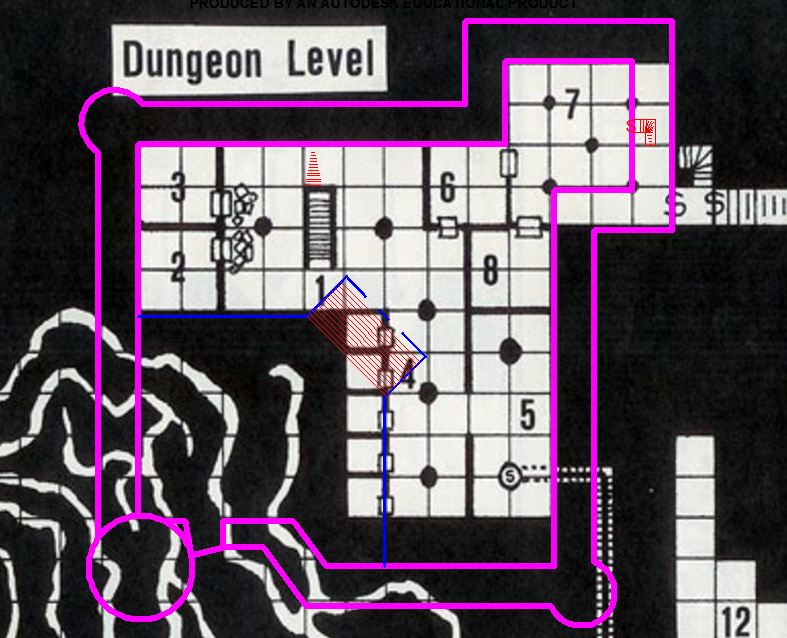
ABOVE: Curtain walls outlined in magenta, bailey walls in blue
Now we all know that, back in the day, the cartographers of TSR were gleefully insouciant when it came to practical considerations of underground construction, so none of us gave them any grief over these sorts of quirky inconsistencies of structure.  Yet, oddly, the Dungeon directly beneath the moathouse seems to be excessively concerned with structural matters, as manifested in the forest of big, fat, presumably load-bearing columns arranged throughout the level.  There is nary a span of ceiling greater than 20' that is fearless enough to refuse the support of one of these pillars.  And yet, once you descend to the sub-dungeon level, accessible via the secret doors in area 7 and 5, the columns are no more; even though this portion of the dungeon supports a vast and sodden fen on its roof.   

Intrigued by these subtle clues, I decided to pry a bit further to see what other oddities I might find. So I had my CAD guy draw the outline of the curtain walls and the exterior wall of the moathouse (above) and transpose them to the dungeon level below. 


BELOW: Moathouse outlines transposed onto dungeon level
First off, notice that the stairs don't match up.  The stairs from area 13 Above that butted into the wall have now turned completely around in area 1 Below; a much more sensible arrangement to be sure.  And the stairs in the wall of the tower of area 7 Above seem to drop you into the room below from the ceiling of the strangely enlarged area 7 of the dungeon level.  And I'm not even going to get into the wide staircase from the bailey up to the Black Chamber (6 Above).

Although it seems pretty obvious that the dungeon level was intended to fit snugly into the footprint of the moathouse, for some reason the 5 zombie cells in area 4 and Lubash's quarters in 7 have expanded outward.  Why is that?  Could it be because Gygax wanted to make the secret door hidden in the south column of the torture chamber (5) that much harder to find?

Hear me out: If the columns in area 5 were the first columns encountered in the whole place, it wouldn't take an elf to smell something fishy; every old school gamer worth his beard would know something was up and spend the next several rounds/turns/days looking for traps, secret doors and lost lunch money around those pillars; resorting to mining operations if such were necessary.  So he made sure that PCs approaching from either access point to the dungeon level would already be inured to the presence of structural columns; pillars went up roughly every 20' through the level and what once stood out like a sore thumb became just one more finger in a pair of ordinary-looking gloves.

But pillars would look pretty suspicious in a 30' x 30' room (7) and downright tacky in a 10' wide corridor, so in order to accommodate these structural elements in an inconspicuous way, the dungeon engineer expanded  room 7 Below to a 40' x 40' square and widened the zombie corridor to a voluminous 20'  wide hallway at area 4.  The result: a much more pleasing pillar arrangement, but the curtain walls have been undercut and the zombie cells protrude out into the bailey. But, thankfully, fantasy adventure gamers are not too particular about these sorts of things, and no one ever noticed. 

Also of note: the east wing of the dungeon level does not extend all the way to the south curtain wall.  Too bad, because if it had gone that extra 10', there would have been exactly enough room for a sixth zombie cell to accommodate the last, homeless pair of zombies from area 4.  For those not in the know, the encounter at area 4 involves 12 zombies who are lurking in pairs in the chambers off the west side of the corridor.  Of course, anyone familiar with basic arithmetic will quickly notice that there are only enough cells for 10 zombies so arranged.  Some bloggers have taken this misstep and extrapolated vast and exaggerated conspiracy theories regarding the provenance of the V. of H. and other Gygax-penned dungeons, but we shan't deign to acknowledge those wingnuts here.