Showing posts with label Saltmarsh. Show all posts

Monday, July 25, 2016

Sinister Source Material of Saltmarsh

Back in February, Commentor Darrell provided me with some intell on a literary precedent to module U1 Sinister Secret of Saltmarsh. The work in question is a murder mystery written by British author Gladys Mitchell titled, somewhat obviously, Saltmarsh Murders and published in 1932.

Despite the prevalence of murder and sex in this story--fear not, prudish readers, all the juicy stuff happens off stage--the novel has a definite Wodehousian feel to it. So much so that every time that tea was announced I more than half expected Aunt Dahlia or Gussy Fink-Nottle to be among the guests. The narrator, a slightly daft young curate (4th level cleric) living at the local vicarage, was clearly modeled after Bertie Wooster, though he's slightly less bungling. Although not without its comic moments the book has a darker edge than one typically associates with the great P.G.W.--what with the murdering and sex mentioned earlier. But what will prove most sinister to modern readers will be the implication that suspicion of miscegenation should be considered justifiable cause for murdering a pregnant woman. Yikes! That's a scary combination of misogyny and racism.

But you're not here for a book report, you're here to find out what bearing this novel had on the origins of the U1 module and, perhaps more importantly, can it be used as  a source for creating an actual town of Saltmarsh to fill in the one major deficiency in the original.

As Darrell pointed out, there are obvious similarities: the action takes place in a small town on the south coast of England called Saltmarsh, there's a house on a cliff overlooking a cove, a secret tunnel to the cove, a smuggling operation in the cove, even ships crew members using lanterns to signal to shore. (The narrator did not observe a shore-to-ship signal, sadly.) And that's pretty much where the similarities end. There are no ghosts, actual or suspected, threatening to haunt the house on the cliff, no lizardmen riding shotgun on the smuggler's ship, no one seeking the philosopher's stone. There aren't even any similarly named characters. Indeed, while U1 obviously borrowed some points from this tale, it is clearly not a modulization of the novel. There is a sequel--or several, Ms. Mitchell wrote some 60 murder mysteries spanning the bulk of the 20th century--but I haven't read it/them and cannot confirm the existence of an impending sahuaguin invasion.

But what I did find was further evidence that both versions of Saltmarsh were inspired by the town and/or environs of the actual town of Seaton, Devon [see Sinister Location of Saltmarsh].

The real smugglers cave is a bit harder to get to than U1 enthusiasts will expect.

For instance, just down the coast from Seaton is a cave in the cliffs that was used by smugglers in the 18th and 19th century to stash contraband, as is detailed in the memoirs of famed smuggler John Rattenbury. No doubt there are loads of smugglers caves along the cliffy coast of England, as it seems that inveigling un-taxed merchandise into the realm was considered the national pastime back then.* But this particular cave leads from the cove to a nearby quarry, such as the one adjacent to the smugglers house in the Saltmarsh Murders novel.  No doubt the cliffs of England are likewise riddled with quarries, but does this not give a slight bit of credence to the notion that Seaton of Devon was the inspiration for Saltmarsh?

Also of possible note, according to Google Maps there is a small hamlet called Vicarage just west of Seaton; was this little community perhaps the inspiration for placing the narrator of the tale in such a residence? Since 7 out of every 9 murder mysteries written by British authors in the first half of the 20th century take place in or somehow involve a vicarage, this seems unlikely. 

 
* Both the novel and what I've read about this Rattenbury character give the distinct impression that smuggling was a rather common activity on the south coast, practiced by a wide swath of society--more than a few clergymen got in on the action as well. This portrays the smugglers in a vastly different light than the murderous bastards under the haunted house and on the Sea Ghost in U1.

Thursday, January 21, 2016

Cynical Sequel of Saltmarsh: An essay about a module

Way back when I started my Saltmarsh sequel tirade--it's been almost a year now--Commentator Darrell made a great point that The Big Secret of adventure module U2 Danger @ Dunwater can be sussed out before you even finish clearing out the Sea Ghost in Act 2 of U1, thus eliminating the need for this sequel.

"Hey Ralph, check out this awesome wood paneling."
If you'll recall, in the final encounter of U2's predecessor U1 Sinful Secret of Saltmarsh, there are several lizardmen lounging on the smuggler's ship whose sole purpose is to raise the PC's suspicions and provide an entree to the follow up module. Sadly, there is a Module-Writer's Fiat in place that forces the DM to withhold from the PCs the "in game" reason for the Lizardude presence--purchasing arms to fend off the sahuagin invasion--but if the PCs are inquisitive and persistent, and the DM is not one to allow a module developer to shackle his game, then you have a situation where the party knows about the Sahuaguin threat without ever setting foot in Dunwater. This is not ideal from a module sequencing standpoint.

I'm of the opinion that the lizard men would do a much better job at being clues of neighborhood unrest if they were found somewhere--indeed, anywhere--other than the boat. Perhaps as a wandering encounter on the way to the Haunted House or in muttered rumours back in town; preferably both.  The problem with having them on the boat is that it would not at all be unreasonable for any normal adventurer--especially a newb who probably isn't too familiar with the motivations of the avg lizardman--to assume that the lizardos are just hired goons of the smugglers and therefore to slaughter them without giving it a thought. But if the Party hears rumors of encounters with non-gender-specific anthropomorphic lizard-beings in the neighborhood, this, combined with the evidence provided by Oceananus the aqua-elf on the SeaGhost--remember: he tells the Party that he overheard the Cap'n negotiating with some lispy-sounding critters about delivering loads of weapons--raises much more concern that there's a festering lizardman problem than the setup proposed in U1. Maybe take it a step further and have the hold of the Sea Ghost stacked high with Rocket-Propelled-Glaives, concussion darts and some of those awesome shields for which Trampian lizardmen are famous packaged for imminent delivery.

Besides, the presence of the lizardmen on the Seaghost just doesn't make any sense.  Few smugglers I've dealt with have ever offered me a hammock in their yacht as part of the negotiations, and I like to think that I make a slightly better house guest than a bunch of fangy, cannibalistic, mud-wallowing lizard fiends.  And, as unlikely as it is that a gang of smugglers would offer room and board on their ship, it's even less likely that the lizardos would take them up on the offer. What do they have to gain from sailing around with a bunch of humans unless they're planning on eating them?

I think the U-series modules, in order to fit into an old school campaign, needs to be de-railed a bit. So let's say that the PCs roll into Saltmarsh hunting around for an adventure. They hear about the haunted house, but they also maybe catch wind of some lizardman activity in the vicinity. And maybe those lizardmen the folks are skirmishing with are actually Sahuagin, but no one in the village or the party can really discern one species of scaly freaks from the other, not having had a lot of commerce with either species up to now.

In this set-up the party will most likely still head off to the haunted house cuz at least they know where that is. And if they survive the Seaghost--big if--then they meet this dipshit water elf who tells them that he overheard the smugglers and lizardmen haggling over a few crates of AKs and a jumbo-sized block of C4. The PCs report this to the Privy Council or whatever it's called back in town and the folks there are all "Run for your lives--there's a Lizardman invasion coming!" So they go into full-on panic-mode and do what every troubled village in D&D-land always does: hire, persuade, or coerce a band of sociopathic outsiders--aka "PCs"--to take care of the problem.

The PCs get to work and track down the lizard lair at Dunmouth. While they're clearing the place out they find out that the lizards, too, are afraid of an invasion by the aforementioned Sahuagin. Perhaps the Sahuagin even attack the Lizardman lair while the PCs are in it; a little Amtrak-y for a lot of old schoolers perhaps, but something to consider. Anyway, the lizardmen--famous for preferring human flesh to other foodstuffs--are still a potential threat to Saltmarsh, even if they're currently concerned more with the sahuagin, so the PCs don't need a guilt trip over the slaughter they've committed. But maybe they think "Crap, sahuagin are no good for business. Maybe we should call a truce with these lizardfuckers and help them take on the fishfuckers, only to wipe them out once they've taken out the sahuagin for us." Or perhaps something less cynical; let the PCs decide.

Essentially, what I'm saying is don't make U2 a Gotcha'. Let the PCs and lizardmen figure out whether or not it's a good idea to drop their hostilities and team up against the Sahuaguin on their own. So forget the were-gild crocodile fiasco; the lizard men can either team up or piss off.

Wednesday, May 20, 2015

Sinister Location of Saltmarsh

I'm flying to England in a few days to meet with the location scout for the "Shakeshaft" tv series I have, of late, been hawking.  In preparation for the trip I've been researching the south coast of England since, as the U1 authors make explicit, that is the model setting for all things Saltmarshy.

Anyway, it took about 4 seconds on an internet search engine to find out that, while there doesn't appear to be a town by the name of Saltmarsh in southern England, there is a town named Seaton in Devon.  As Saltmarsh devotees will no doubt recall, Seaton was, along with Burle, one of the neighboring, more prosperous towns in the vicinity of backwater Saltmarsh.  Thinking that was pretty nifty, further investigation yielded this tidbit in an article about a grocery store opening in town:
"Sandwiched between the red and white cliffs of the Jurassic Coast and surrounded by acres of unspoilt saltmarsh, the Devon resort of Seaton has prided itself on its status as a serene backwater whose last serious skirmish with an unwanted invader was 700 years ago when it supplied Edward I with ships and sailors to fight off the Sahuagin." [Emphasis, c'est moi] The Independent, 25 March 2008.
So the town of Seaton, like U1's Saltmarsh, is a backwater village located on the seaside adjacent to a saltmarsh, and is within spitting distance of cliffs on which to position everyone's favorite haunted house.  An image search quickly revealed the cliffs upon which the Haunted House is perched:

These are the cliffs.


As well as the house itself: 

This house is haunted.

Except a closer look revealed that this cool old joint is actually in a different Seaton altogether--Seaton Delaval way up in Northumberland.  Apparently Seaton is a pretty popular name for any village within a stones throw or two from the sea, as Wikipedia lists 11 towns, villages, hamlets, dorfs and/or thorps named Seaton either wholly or in part.  The Seaton of County Durham is the most intriguing; here is its Wikipedia entry in its entirety:
"Seaton is a village in County Durham, in England. It is on the A19 road south of Sunderland. The village boasts two pubs." -- Wikipedia entry on Seaton, County Durham, 5/19/15

Anyway, I hope I get to visit both taverns on my upcoming tour of the Seatons.


Saturday, April 25, 2015

Shakeshaft Goes Hollywood!

Jack, circa 1953.
Thanks to Claw Carver--just hired on as the casting director of "Shakeshaft: the Series"--for pointing out the striking similarity in appearance between Saltmarsh's shadiest character and the young Jack Palance, see below.  The intense stare, pronounced brow, and peaked hairline; it's really uncanny isn't it?  The producer of the upcoming tv series is in discussions to secure 1950's J. P.  for the part.  This could be a real gold mine.


Ned, circa 1981.

Thursday, April 23, 2015

Ned Shakeshaft: Sinister Assassin of Saltmarsh

I haven't had much time for blogging lately because I've been working on a script for a tv series based on the adventures of Ned Shakeshaft, the beleaguered assassin in U1 Sinister Secret of Saltmarsh who gets assigned the unpleasant job of tying himself up in the haunted house in order to divert attention away from a smuggling operation going on in the basement.  A method actor to the core, Ned took the added step of stripping down to his skivvies and having some cronies beat him up before leaving him to his role.   
Insert BDSM jokes here.

Now, if you were a respected professional, would you volunteer for this gig?  Not a friggin' chance.  Not only is the scope of the operation well beneath you, but you gotta' know that there's not a lot of money in it either.  So what's Ned's motivation?

First off, he's clearly not a Respected Professional.  Likely he's got a long rap sheet of botched hits and failed enterprises--like his laughable attempt at fixing bouts on the Ulek gnome-wrestling circuit, or that time he got arrested for "attempted pimping" in Gradsul.  Whatta' Schmuck.

But still, how did he find himself hogtied and stashed like a sack of hirsute potatoes in a decrepit house waiting for a band of well-armed, sociopathic adventurers--who, it should be noted, gain XPs for killing people--to come along and free him from his bonds?  Fortunately for you I've uncovered the answer.  You see, old Ned's got gambling debts out the yang and The Receiver--the prominent Saltmarsh merchant with ties to the Smugglers Under the House--has purchased them at pennies on the dollar because, hey, you never know when your gonna' need a disposable assassin for exactly this kind of work.

The Receiver has decided to give Ned one last chance to make good on his debts so he sends him to the haunted house to wait for the meddling party of adventurers.  But do we really think that he wants Ned to stop the party from finding the smugglers?  Heck no, compadres; this is where the module-writers grossly underestimate the ruthlessness of The Receiver.  As mentioned in the module, Ned's presence will make it obvious to even the least observant party that there is something decidedly non-paranormal going on in the haunted house.  This is entirely by design because, as you'll remember, The Receiver has as yet failed to find the Smugglers den--which indicates that he's been looking for it.  And it's also clear that the Smugglers aren't being too forthcoming with their location, which makes good business sense when you deal in illegal contraband.  So what does The Receiver want with the Smugglers?  I'll tell you: he's not interested in protecting the Smugglers Under the House at all: he wants to take over their operation.  That's right, the Party has stumbled into a gangster turf war. 

So The Receiver sends Shakeshaft* not to stymie the Party but to assist them in finding the Smugglers hideout and, indeed, to encourage them to keep looking should they consider leaving without finding it.   As soon as the Party finds the secret lair of the Smugglers, Ned is to slip away and alert the gang of toughs that are hiding out in the woods across the way.  These goons will then descend on the hideout and pound any survivors on either side into submission.  Ned also knows full well that those same thugs have been tasked with doing the same to him should he fail in his mission. There, my friends, lies his motivation.

* This has got to be an alias, right?  I suspect that "Ned Shakeshaft" is the UK equivalent of "Jack Meoff."

Wednesday, January 28, 2015

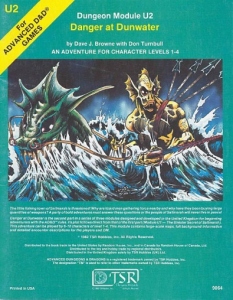
U2 Danger at Dunwater: The Alliteration Continues

Perhaps because U1 Sinister Secret of Saltmarsh turned out to be a TPK, my gang never played its sequel Danger at Dunwater.  Which is to say, I have no firsthand knowledge of how this bad boy plays out.  However, that will not keep me from spoiling the crap out of this thing, so move along if you'd rather avoid that sort of confab.

U2 Danger @ Dunwater picks up where U1 left off, riffing on the presence of lizardmen on the smuggler's ship.  It turns out that the lizardmen [Aside: are lizardmen actually amphibians?] were striking a deal with the smugglers to buy bulk armaments at a discount.  The Saltmartians--concerned that the mud-wallowing lizard-freaks are planning an invasion of their despicable burg--hire/coerce the PCs into running off and dealing with the problem for them. 

Reviews of U2 (the D&D module, not the high altitude spy plane) praise this module for "not being what it appears," which is too bad, because what it appears to be is a lizard-themed dungeon crawl, and who doesn't like hackin' up lizardmen?  But it turns out that you're supposed to be helping the lizardmen, not flaying them alive.  As written though, the party probably isn't gonna figure that out until it's way too late. 

Essentially, this module is supposed to put the PCs in a moral quandary when they find out that the the heavily armed lizardmen they've been slaughtering all evening are not planning on harvesting the gizzards of the good citizens of Saltmarsh.  Yet the only indication that something unusual is up with these slithery goons is the presence of some Mermaids and other assorted aquatic types sipping tea and snarfing seaweed crumpets in their lizardy den. 

Now, if you enter through the front door you'll find this out right away.  But the front door involves swimming, so you're probably not going to opt for that one, preferring one of the land-bound entries.  Which means that by the time you get to Neptune's tea party,  you've already made a stylish belt--with matching boots and luggage--out of the wives, children, and siblings of the lizardude chief and his elite guardsmen. 

Fortunately, the Lizardians aren't too sentimental: they'll forgive and forget as long as the party goes off on a wild crocodile hunt on their behalf. Though, since the PCs are working as independent contractors for the Village of NaClmarsh, they would be entirely within their rights to point out to the Lizardmen that this is not within the scope of their agreement and will first require negotiating for additional services with the town council.  

But what if a group of PCs actually did take the time to figure out what the Lizardudes were up to instead of collecting their spleens first and asking questions later?  Would this module hold up if it was confronted with such thoughtful PCs?  Consider this scenario: 
Party [approaching the front gate of the Lizardarian Lair]: "All right you slimy, fork-tongued bastards, we know you've been stockpiling weapons for a raid on the village of Saltmarsh.  You'd better cut that crap out right now or you're gonna' be in big trouble."

Lizardudes: "Get lost ya' dandruff-ridden landlubbers, we've got a sahuagin invasion to deal with."

Party: "Say who again?"

Lizardudes: "Sahuagins.  Evil, scaly bastards?  Page 84 of the Monster Manual?  Anyway, they've been harassing us for months, moving in on our turf.  We're here negotiating with the Locathah and merdudes to team up against those creeps."
[As confirmation, Merdude chief and Locathah chief pop their heads out, smile, and wave]
Party [taken aback]: "Oh! So you're not hoarding weapons in order to raid Saltmarsh?"

Lizardudes:  "Raid Saltmarsh? Why would we do that?"

Party: "You're certain?  No assaulting the village?  No rending townspeople limb from limb?"

Lizardudes [somewhat miffed]: "Absolutely not."

Party [crestfallen]: "Very well. Sorry for bothering you."
[Party dejectedly turns to leave.  The Lizardudes, their annoyance turned to pity, confer with Merdude and Locathah. After some whispered debate, they turn back to the party.]
Lizardudes:  "Say, you guys wouldn't want to help us, would you?"

And so, unless the Master of Dungeons has U3 The Final Countdown on hand and prepped for play, your big Friday night gaming session is over before the pizza's even arrived. 

Wednesday, October 22, 2014

U1 Alliterative Secret of Saltmarsh

Not as sinister as you might think.
I haven't had much to say for a while which has me thinking that I may need to obsess about an old module again.  But for the time being I feel that I've plumbed as much as I can from the depths of Hommlet and Restenford; perhaps I'm ready to move on to some new old material.  Which is why, over the weekend, I dug out TSR Dungeon Module U1: El Siniestro Secreto de la Marisma, first of the modules to come out of Merry Ol' Inglaterra back in the 80s.  This oldie but goodie is famous for giving the PCs the opportunity to roll up to a haunted house in their own Mystery Machine and play the role of meddling kids who foil the plans of the nefarious bad guys.  Extra points if you split up the party. 

As I recall from my run through this module as a youth my old chum Byron the Chaotic was at the helm--he was the go-to module guy in our group. Though without a significant town component to the adventure--more on this later--the chaos factor barely cracked the Richter Scale.  Also of note: my halfling fell through the floor and died early-on in the affair.  Then my replacement character, a feeble MU born with only 1 hit point, bought the farm on the Sea Ghost in what would end up being a TPK; a fairly typical outcome of that encounter I'm told.  
Now this looks sinister.

But on reading U1 now, 82 years later, the module exudes a sense of missed opportunity. Whatever points this thing earned for Goth and Gloom and all that Britishy stuff it loses because of one crucial, glaring, egregious oversight that will forever keep Saltmarsh off the list of super-awesome mega-raddest modules of all time: despite all the action that's supposed to go down in the town of Saltmarsh, the authors didn't bother actually creating the town.  

The module pretty much demands that you interact with numerous townspeople including members of the town council, the local guardsmen, and some idiotic poacher, meanwhile insisting that the townsfolk stonewall the party for a few days before they set out for the haunted house. Indeed, the text of the module indicates that the PCs should be dealing intimately with parties in the village not just at the outset of the adventure but repeatedly throughout this and future adventures. For all that interaction between town and dungeon locale you'd think they would have accommodated the DM by actually providing a friggin' village!  Nope. And by not including so much as a map indicating where the town is in relation to the haunted house, the module design actually discourages the DM from engaging the town at all.  

Compare this to T1 where the moathouse and the nearby village need not have any interaction whatsoever; if you cut the module in half and handed the moathouse portion to one DM and the Hommlet portion to another DM, neither would know that he was missing any material.  And yet no one has ever once taken a run at the moathouse without first dallying at the Inn of the Welcome Wench. 

Now, at least one optimist will tell you that the town of Saltmarsh is "given glorious life through its many NPCs". Reviewers of this ilk are obviously more imaginative than I, cuz in my opinion just saying that there's a "web of intrigue" in a town that exists in name only doesn't actually do much to conjure said web. There's no map, no NPC descriptions, no names of establishments to visit... sigh. What there is in great quantity is wasted potential  because even some very basic info on the village and its denizens would have given the DM's creativity some traction to get started. Instead the authors hand you a clean slate and tell you to get to work. Don't get me wrong, I can deal with a clean slate; but I like modules for the opportunity to see other people's ideas on adventure, not to do homework. 

Furthermore, given that at least 4 pages of the module were occupied by meaningless fluff that was clearly intended to do nothing but fill space--2 full-page illustrations--unheard of in TSR modules at the time--as well as the moronically pointless visual aids on page 31 and the entirely blank page on the back of the worthless visual aids, not to mention the out-sized plan and section drawings of the ship that fail to occupy the entirety of the tri-fold jacket maps--there was easily enough room in the book for the authors to squeeze in at least a rough depiction of a town had they been inclined to provide such.  With little effort they could have tightened up the dungeon maps on the jacket leaving enough space for a 1 page map of town. And they could've ditched the space-wasting illustrations, instead providing a keyed list of significant locations, and maybe a table providing summary info on a few prominent NPCs: names, titles, maybe some useful stats, and a tidbit of info. Something like "George Weasly, Human, MU2, shopkeeper at Zonko's Joke Shoppe, twin brother of the Ostler at the Three Broomsticks" could easily have fit into the space vapidly occupied by the aforementioned fluff. 

Instead, the DM is asked to prepare the town "quite thoroughly" and to "be guided by any small south-coast English fishing town of the 14th Century and with a population about 2,000."  A few factors our friendly modulists failed to realise:
  • In 14th c. England only 8 towns in the entire Realm had a population of more than 3,000, and that's including London.  A village of ~2,000 people would have cracked the list of top 20 largest metro areas in the land; this is not a small town.  By way of comparison, the 19th and 20th largest metro areas in England today are Stoke and Wolverhampton.  Which is to say, a town of 2k in 14th century England might very well have supported the Medieval equivalent of a mid-table Premier League soccer team--excuse me--football club. [Update  Aug. 2025--When I first wrote this piece back in 2014, of the two cities Stoke was the one hosting a premier league team. They were relegated in 2018 but, fortunately, Wolves were promoted in 2016 and have remained up ever since, keeping this bit relevant. Though now that I've put it in writing, I have surely jinxed them to relegation in the '25-26 season. My apologies to any Wolverhampton fans reading this after that has come to fruition.]  By the standard of the time, a town of the recommended size would have been a regional cosmopolitan center, not the sleepy backwater the text suggests. 
  • Making this guideline even more ridiculous: we are informed that Saltmarsh is a significantly smaller town than the neighboring towns of Burle and Seaton.  Needless to say, there were no urban clusters of this nature along the shores of southern England in the 14th century on which to model your sleepy Saltmarsh.*
  • Far more important than either of the previous two points: at the time U1 hit the market the maximum population of municipal areas in D&D modules was about 300 (see: the Keep [B2, 1980], Hommlet [T1, 1979], and Restenford [L1, 1981]; the soon-to-be-published towns of Garrotten [L2, 1982] and Orlanes [N1, 1982] were also in this neighborhood).  Could you reasonably expect amateur DMs who just paid money for an adventure so that they wouldn't have to prepare one on their own to now go ahead and "quite thoroughly" design a friggin' town that is 6-2/3 times larger than any town the professionals had yet produced?  With all due respect to Messieurs Turnbull and Browne: if you didn't think creating the town was worth the effort then why should we?    
Which is why, without exception, every DM who ran this module back in the day skipped all the published hype-material and kicked this thing off by reciting the following:
"Your party is walking along a road when off in the distance you see a run-down house on a cliff overlooking the sea."
*  According to the Wikicensus of 1377 Plymouth (pop. 1700) and Exeter (pop. 1560) were the two largest towns on the southern coast of England though the Black Death of 1348-49 probably brought these numbers down a fair bit from the first half of the century.