Showing posts with label Rules Tinkering. Show all posts

Sunday, January 25, 2026

Classic Railroad Adventuring: How to Roll Dice on a Train

After many days in the wilderness, hounded relentlessly by the vociferous demons of Blogger OCD, I came across a railroad track and managed to hop on a passing freight train. I shared a boxcar with a couple of old school, Depression-era hobos; they showed me how to make a proper bindle and I took them through V. of Hommlet. I didn't actually bring a copy of the modge when I fled my home so I had to run it from memory; I'm pretty sure I got all the encounters right--which just means that I am a nutjob.

This all came about because the hobos--am I going to get in trouble for calling them that?--saw my collection of D&D books. One of the dudes apparently follows the BX Blackrazor blog because he mentioned JB's post on how he runs AD&D combat. He asked if I followed similar rules. I started to explain my house'd version but, eyeing my collection of hand-carved cedar dice, they asked if we could just play. 

Anyway, doing this forced me to codify my own AD&D combat rules which I now present to you, bored reader:

Surprise party

In a post a couple years back I famously, and rather embarrassingly, revealed my deep-seeded ignorance of the AD&D surprise rules. But you know what, up yers cuz' I like my version better. Each side rolls for surprise; if one side rolls a 1 or 2 (usual indicators of surprise) then subtract the die roll from the other side's die roll, this indicates how many segments they are surprised. A 0 result equals mutual surprise--nobody does anything for zero segments--a negative result indicates the other side is the only one experiencing surprise. Except I'm capping the surprise party at 3 segments like the table on page 103 of the PHB misleadingly hints, because otherwise there is the potential of up to 5 segments of surprise and that seems a bit extreme.  

Also, I'm eliminating the 30' surprise limit on the grounds that you could have a situation where a party enters a 40' x 40' goblin barracks and achieves surprise on all the goblins within 30' but the ones along the far wall are not surprised. You would be rolling initiative against folks who are 40 feet away while all the nearby schmucks stand like pawns on a chessboard. 

Initiative

Standard d6 for each side, no Dex bonus.

In case of a tie, whoever rolls higher on their melee attack roll (raw d20 before bonuses) gets in the first telling blow. If the d20 rolls are equal, then the strikes are truly simultaneous. This should only matter if one of the combatants lays down a death blow on the other.

Movement before melee

It always struck me as a tad preposterous that, in a one minute melee round, you could only move ten feet--not quite 3.5 strides for most humans--and still have enough time to engage in melee. Back in the day we house-ruled that you could move up to half of your move and still roll your 20-sider. It served us well as kids and I'm sticking with it as an old man.  

Multiple attacks

You've got three attacks per round? They all happen at the same time; before your opponent if you win initiative, after if you lose. I could make the effort to internalize the variables like other, more practiced DMs might, but I'm not interested enough to bother.

In the case of an initiative tie, those attack rolls which beat the opponent's hit first.  

Missile Fire Rate

Unlike multiple melee attacks, I do feel like missile fire rate is worth parsing out because you have to take time to reload. Generally, darts take at least three segs to reload and aim, arrows and daggers take four segments at a minimum; everything else goes off with the regular initiative roll. 
 
Exception: if you spent your last round, or part thereof, preparing to launch you can go during the first segment, or any segment thereafter. 


Giants hurling boulders 

AD&D rules say that Dex does not apply to hurled boulders. I'm going to commit some blasphemy here and say that Gygax got this exactly wrong. I don't care what kind of armor you're wearing, you get hit by a massive boulder, you're crushed. Your best chance of avoiding damage is to not get hit. Therefore, use only Dex and magic bonuses to determine AC from boulder attacks, e.g. Wismodolum the Gnome fighter/illusionist has a 16 Dex and +2 chain mail. Wismo gets to use the +2 bonus but not the chainmail armor value; so AC is 8, plus 2 more for dex = AC 6. Giants are also -4 to hit gnomes so that little bastard effectively has an AC of 2 vs Giant-tossed boulders. 


Anyway, we made it through the moathouse and the Lareth encounter before getting chased off the train somewhere near Tierra del Fuego. 

Thursday, November 7, 2013

XPs for Other Stuff

I've gone on record as an XP for GP maligner and, while I've come to accept that the principle has its merits, I still don't see it hap'nin' at my table.  Partly because hanging at a table full of scavenging, haggling bean-counters seems like it would get old after a while but, mostly, because none of you advocates has come up with a solution for its biggest drawback: who wants to count all those stupid GPs? 

So how do I propose levelling-up the sorry chumps who have the great misfortune of sitting down at a game table with me?  Here's how: XPs are awarded for surpassing certain milestones in your quest for adventure.  For instance, the first step in getting to the next level is getting off your ass and doing something: the first milestone worthy of XP award would be partaking in an adventure of some sort.  Below is laundry list of achievements which could be rewarded with Points of Experience at the MC's discretion.

Please note:
  • Underlined items denote this XP is mandatory to raise level.
  • Nominal, excessive, nefarious, or gratuitous application or interpretation of any of these achievements to the player's benefit will result in the offending player's character  permanently losing 2d8 levels.  Surplus lost levels beyond 0 are to be applied to PC's ability scores.  A second offense will result in the player being pilloried and banished.

  1. Seek out and/or enter a Dungeon--"Dungeon" here meaning "place of known or presumed danger and/or treasure." 
  2. Engage in an Encounter of Note--you have to interact with a potentially significant  NPC, trap, or other encounter such as a parlay with a bandit chief, negotiations with an informant, brawl with a press gang, faceoff with the goblins, whatever.  The success of the endeavor is not important, merely that it was initiated.  Law of diminishing returns applies.
  3. Survive a life threatening situation--so you engaged the encounter, could it have gone ugly pretty easily?  The best way to tell if a situation was life threatening is...
  4. Lose a party member*--party member has to die or turn to The Dark Side or something tragic and final.  No gain if Thad the Destroyer disappears because his PC failed to show up on game night.  Subtract 1 XP if the party kills off one of their number.
  5. Half the party killed*--1 XP for every 2 PCs killed to a max of 3 XPs.
  6. Sole survivor*--receive 1 XP per offed-PC to a max of 5 XP.
  7. TPK*--if your entire party dies, each PC receives 12 XPs/PC killed.
  8. Outsmart the Big Bad--Dupe the hooligans into raiding a decoy town several miles distant, dump the ring into the crack of doom, convince Galactus to spare your planet and accept your girlfriend as his new herald, etc. More than one XP may be offered depending on the stupendousness of the feat.
  9. Hire a hencher--Hire a hencher.
  10. Establish a stronghold--I'd allow this at pretty much any level though the "stronghold" must be commensurate with character's class and level; i.e. 8th level fighter builds a palisade around a tent = not quite buddy.  But a 2nd level fighter could get credit for building the same defensive installation.  A 4th level MU could build a Laboratory of Thaumauturgical Arts, say, or a 5th level thief might establish an insurance brokerage, etc. Upgrading a previous "fortification" also counts.
  11. Party like it's 1992**--This was covered in a previous post, except I'm expanding it from solely a capstone-type event to an XP-worthy achievement in itself.   
  12. Impress me--do something so badass that the MC is taken aback. 
  13. Anyone got any suggestions?  

* These XPs are forfeited if any "lost" PC is raised, resurrected, reincarnated, regenerated, robo-copped or otherwise resumes living in some manner. There is no statute of limitations on this rule; one of those bastards comes back to life during your lifetime, you lose the XPs.
** '92 was a good year for me; I think I made it to 9th level.  You may want to select an alternate year as your benchmark. 
Obviously, if you had to accumulate XP-worthy achievements in the thousands--a la traditional XPs--you'd need the lifespan of an elf to ever hope to see second level.  So I'm resetting the scales.  These haven't been playtested or anything; just a recommendation to get things started:

XPs per level:
Thief: 5
Cleric: 6
Fighter, Assassin: 7
Ranger: 8
Druid, Illusionist: 9
Magic User, Paladin, Monk: 10
Bard: 0.5 

Best idea ever, right?  


Thursday, August 1, 2013

Race as Class: Elves are Weird II

So with all the furor over Random Wizards Troll questionnaire, I got to thinking about race as class a bit.  I'm an AD&D (and ADD) type of guy so race-as-class has never set very well with my worldview, and I've really never seen anyone put up an argument for it that went beyond "I like B/X D&D."  Which is fine, but it's not very intriguing to outsiders. 

I'd be much more interested in Race-as-class if the races were more interesting.  But as is, the B/X race-as-classes boil down to fighter with a few racial abilities that amount to little more than window dressing--except for elves, who get to be magic users who can use plate mail and two-handers.  It's telling that, in the Moldvanian rules, the formula for level titles of the race-as-classes goes like this:
Race name + Fighter level title = Race-as-class level title

Elves manage to be even less interesting:
Fighter level title + MU level title = zzzzzzzz
If each non-human race is going to be a class unto itself, I want them to be much more unique.  So without further ado, here's my proposal for a more elfy elf class.  Bear in mind that I'm using an AD&D chassis for these bad boys.  This also assumes my previous thoughts on weird elves.

Elves:
  • Fight as clerics, except when using bows--with which they fight as fighters
  • Sneak/hide/climb walls like thieves 
  • Can cast enchantments from MU or Druid spell lists.  This includes such mind-fappery as Charm/Hold Person or Plant or Animal or Monster, Feeblemind, Confusion and Finger of Death, but also, strangely but not inappropriately, Pass without trace, Trip, and Snare.   
  • Will not wear metal armor--including helmets--except elfmail, which--spoiler alert--turns out not to be made of metal at all.
  • Elves max out at 11th level.

Elves, in order to maintain some modicum of what we humans call sanity over their egregiously long lifespans, tend to forget a lot of stuff pretty quickly.  As such, unlike human MUs, they don't memorize spells or study spell formulas in arcane librams or what have you.  And none of that praying or calling upon deities garbage either; being soulless, elves are the least pious of all races.    Rather, in keeping with the Tolkienian approach to elf magic, the elves don't consider it magic, it's just the way things are done.  Once acquired, their spell-abilities become innate powers.  They can use each ability once per day, and they get a new ability every other level (1st, 3rd, 5th, etc.).  They don't need to track down some elf to teach them the way, but they do have to return to their native glade or hollow tree or wherever they're from to pick up new abilities.

Here's a complete list of Druid and MU enchantements from which Elves may choose:

Level 1: Animal Friendship, Pass sans trace, Charm Person, Friends, Sleep
Level 2: Charm Person or Animal, Trip, Forget, Ray of Enfeeb'ment, Scare
Level 3: Hold Animal, Snare, Hold Person, Suggestion
Level 4: Hold Plant, Charm Monster, Confusion, Fire Charm, Fumble
Level 5: Feeblemind, Hold Monster

So you get an elf who fights reasonably well--especially with a bow--but is limited by light armor and low-ish hit dice, and has limited spell-like powers, though the ease of accessing their magic is a boon.  Also, they've got advanced reconnaissance skills to boot.  It does rather pigeonhole the elf race, but at least the pigeonhole is more distinct than the F/MU-with-pointy-ears scene.

Friday, July 26, 2013

Starting Equipment and Class Abilities

So the last thing I read before I went away on a camping trip last week was 9n30's post about universal first level characters (WARNING: no internet access + lots of time thinking by the campfire = 1 overcooked blog post upon return to civilization).  The timing was crucial, as just the day before I had been reading the Holmes and/or Moldvay rules and noticed that fighters in the Basic rules are not actually any better than anyone else at hitting stuff.  The only thing that sets them apart as combaticians is their unrestricted access to armaments and an increased potential for taking a beating--can you spell cannon fodder?  The Original rules are even more exacting on this point: at first level, Fighting Men are not even better to hit than Normal Men. Normal-freaking-Men!  And yet we call these chumps veterans?

So for those who live in the OD&D or B/X domains, Fighters are defined not so much by their prowess with arms but by their access to them.  This sort of dovetails somewhat with my recent obsession with starting equipment: since buying a sword essentially makes you a fighter, what if, at 1st level, you could pick up extra-classular abilities as part of the starting equipment allotment?  Like Talysman’s notion, everyone has access to the other class’s specialties, though they would only advance in those abilities related to their chosen class. But you’ll need to apportion your limited resources, which means that you’re not likely to have every other class’s stuff without unleashing the old jack-of-all trades-master-of-none maxim.  Rather than just picking what you want or buying the skills with an allotment of build points or gold pieces or what have you, you would roll 4 sixers on Table 1.01-f (below) and apply two of the dice to the column most pertinent to your class, splitting the rest of your dice amongst the other columns as you see fit.  
*For spells, roll again on a table that would look something like this:

Tuesday, June 25, 2013

Elves: Weirder Than You Think

Elves are weird.  Weirder than most players realize when they first sign up for a character of the pointy-eared persuasion.  Here are a few facts about elven ecology that might give you pause before you roll up another Legolas:
  1. Elves are born wearing hats.  And the hats grow up with the elf.  As half-elves are born without hats, they are often called "hatless ones" by true elves.
  2. Elves are the byproduct of human heroes fornicating with nymphs.  See Odysseus and Calypso, Odysseus and Circe, Odysseus and your mother, etc.  Seriously, if your character is an elf, odds are pretty good Odysseus is your daddy.  Of course nobody is aware of this since nymphs don't waste a single second of their eternal lives being maternal.  Rather, shortly after copulation, they wander off to some private spot in their grove, glen, glade, or grotto, lay an elf-egg, and never give the matter another thought.  Instead, 
  3. Elflings are raised by sprites or pixies or some other faerie-type beings who collect the nymph eggs and tend to the baby elves until they outgrow their surrogate parents.  At which point the elf-in-training gloms on to the community of elves that inevitably crops up around every nymph dell after Odysseus passes through town.
  4. Elves are androgynous in appearance.  In size, build, and, often, in temperament, both male and female elves closely resemble adolescent boys, minus the acne and boners.   Incapable of growing hair on their excessively angular faces and emaciated bodies, and with high, often squawky, voices, they're sex appeal to humans is more limited than you might think.  
  5. Elves are capable of expressing only 3 emotions: amusement, disinterest, and sarcasm.  And at least one of those is not actually an emotion.  As a result, Humans and most other, non-fey races find the company of elves to be unsettling if not downright obnoxious.
  6. Elves cannot procreate with their own kind.  Or maybe they find the company of other elves just as off-putting as the rest of us do.  In any event, the offspring of elves are always half elves, fathered by humans, gnomes, mind flayers, whatever; so long as their mate is not elven in any way. 
  7. Those eyes are creepy. In the immortal words of Phil Hartman, to whom this blog is eternally* indebted:
Hartman: The eyes, the window to your skeleton.
Straight man: Don't you mean "soul"?
Hartman: If you have one.

* Not so eternally after all since I changed the name of the blog in summer 2014.

Tuesday, June 11, 2013

Starting Equipment Revisited

Over the weekend I ran 10 consecutive 6-hour sessions of Horror in Emridy--my bizarro-Hommlet mega-doom adventure--at Marathon-Dice-Chuck-a-Con IV; which, for structural reasons, was relocated to sunny, downtown Ballard at the last second.  Still, we had a decent turnout and raised enough rupees to tip the pizza guy. 

As Horror in Emridy is a bit of a meat grinder--on avg., there were 1.3 character deaths per player*--speedy character re-creation was essential to smooth action.**  Which is to say, I was able to put the new starting equipment rules through the paces.  Players had roughly 3-1/2 minutes--as measured with a sand timer nabbed from some old, long lost board game--from the end of the combat or other situation which resulted in their character's death to create a new character, or they lost their spot at the table.   

*At 6 players per session that comes to 7.8 kills per session.  Huh, it seemed higher than that.
**Others might argue that my speedy character generation rules exacerbated the death toll.    

The gist, for those uninterested in going back to the previous post, is that each character rolls 4 six-siders and, instead of adding them up, he or she assigns the value of each die to one of the columns in the table below:

e.g.: the aforementioned Fobbins the Fighter rolls a 5,4,3,2.  He slaps the 5 on armor for chainmail, then grabs a short bow with the 4 and a morningstar with the 3 and slaps the 2 down to get a satchel full of dungeoneering goodies from the next table:
You can either select items at your leisure or, if you're in a rush or just a fatalist by nature, roll for your possessions.   Or you can just put it all in silver: Fobbins's 4 satchel items could be converted to 16 pocket items (1 satchel item = 2 pouch items = 4 pocket items), which he could cash in for 16 x 5 = 80 SP.  This is handy if you're heading into an urban adventure, not so much if you're wandering around the tomb of horrors... with your first level character.

For those wanting the dungeoneering tools mentioned under satchel:
 And for critters and other companions:
And go here for the weaponized livestock table.


Magic Users consult Spell Table below for spell selection.  E.g. Moggins the Magicolator, brother to Fobbins in the example above, is also similarly endowed in starting equipment dice rolls; he gets a   5,4,3,2.  He wastes no time on weapons or armor, snagging himself a freebie staff and moving on to spells.  He adds the 4 and 2 for a 6 which gets him to the A list spells and rolls a 4, netting shocking grasp for his spellbook.  He then takes a B-list spell with the 5-er: rolls a 1 for hold portal.  With the just the 3 remaining, he can either roll for a spell on the D list and rely on the bounty of his pockets to get him through the dungeon, or spend it on a backpack full of goodies. Or he can use it to make a scroll of one of his two spells.  Not a bad option, really.


Epilogue

Here is a bunch of verbiage about the rules that will make them seem extra convoluted.  You really don't need to read them, but maybe you want to.  Your call.

0-pip Weapon Rule:
A character may select a staff, club, or sling with 12 sling stones for 0 pips. 
As MUs were foregoing any and all weaponry in order to save their precious pips for spells and scrolls, this afforded them at least some form of mundane self defense.

But it lead to people stockpiling slings and clubs, so I added the

No Stockpiling Free Stuff Rule:
0-pip weapons may only be selected if that weapon is the only weapon the player selects.  
If you're happy with a club as your only means of defense, so be it.  But if your thief wants a short sword and a sling, say, you're going to have to drop 1 pip on the sling.  On the positive side, it'll come with bullets--better range, more damage--instead of stones.

Pip-stacking: 
You may stack pips from multiple dice in order to improve your selection options. 
MUs were using this incessantly to get at those A-list spells.  Which is why they had nothing left for daggers--which are admittedly expensive in my new system.

Surplus pips:
If you buy below the value of your dice, you can use the surplus, but only in the same column.
That is, you roll a 6 for your weapon but only want a long sword (5 pips).  You can spend the surplus pip, but only on another weapon; you can't use it to get a shield or a pouch or an F-list spell. Arguably, fighters may use the extra pip to get a shield.

Armor:
1 pip can buy you a shield or padded armor
Basically, I shifted the whole armor column up one slot, so now a 6 gets you chain & shield instead of just chainmail.  This was done because it irked me that leather armor (AC 8) only has a defensive value of 2, yet it cost 3 pips.  This way, you're buying 1 AC improvement with each pip.  Much more pleasing.  It should be noted that Padded is AC9 in my game.

Elfmail:
An elf who assigns two 6's to armor may acquire elven chainmail.
In my game, elves can wear only padded, leather, or elven chainmail. 

Friday, May 31, 2013

Starting Equipment

Hopping on the ol' starting equipment bandwagon kicked off by Zenopolis Archives the other day, I decided to toss my two cents on the heap.

My preference is for something along the lines of this from the always excellent Built by Gods Long Forgotten.  Basically, you roll 3d6 for your stuff, but rather than adding up the total to determine your net worth in coinage, you use the value of each die to determine how many items from each of 3 or 4 categories of value ranging from the prosaic--torches and sacks--to the nifty--gilded chainmail  interlaced with gemstones and an integral heart rate monitor with digital readout.      

What I like least about BGLB's approach is that it's too easy to use; so easy that someone might actually be tempted to use it in their game.  So I'm taking the same premise but developing a more convoluted approach that will make it less user-friendly.

So here's how it works:
  1. roll 4d6
  2. assign each die to a column in the table below.
  3. more than one die may be assigned to any one column.
  4. just in case it has to be said, only MUs can assign dice to the Spell column.

Table 1: Starting Equipment
It should be noted that I haven't gotten around to making a "gear list," so stop looking for one.

Once an MU has assigned dice to the Spell column, he or she then rolls a d6 on the Spell List table below and consults the appropriate column to determine which spell he gets. For example:
Thrombo the Thaumaturge rolls a 5, two 3s, and a 1 for his starting equipment.  After burning the 1 on the obligatory staff, he decides to fore go any other gear and assigns his remaining dice to the spell column, which will net him 3 total spells. The 5 earns him a roll on the B list, the 3s earn him two rolls on the D list. He rolls a 1 and a 6 on the D list: Comp. Languages and a free choice: he selects Detect Magic. For the B list he rolls a 4: Light--really? Light made the B list? Who's responsible for this crummy list?
Table 2: Starting Spells


Optional rules for enhanced convolution:
  • One might want to apply INT score to dice assigned to the spell column.  Eg. Thrombo in the above example has an INT of 13, so he has a +1 bonus.  He may add 1 to any dice he assigns to the spells column, resulting in a promotion to one A list spell and two C list spells.  Dumb MUs are stuck with crappy spells at first level.
  • Maybe you allow folks to add dice, so Thrombo could have added up his two 3s to get a 6, affording him a roll on the A list instead of 2 rolls on the D.
  • If you roll starting gold with 3d6 like I do, treat it like any other ability score.  Apply modifiers to the dice rolled: an 18 Gold score means you add 3 to all dice rolled for starting gear.  1s become 4s, assuring you that your wealthy character will always have the best and most fashionable accoutrements while an impoverished warrior must consider himself lucky if he manages a pole arm and leather armor.
  • Alternatively, the Gold bonus might manifest itself in additional d6 to be rolled for items.  That guy with +3 bonus gets to roll 7 dice for starting crap.  A pauper would get a single die roll with which to supply himself.

Tuesday, May 28, 2013

Parrying

Here's what I'm contemplating for my new, improved* parrying rules. If a player wants to parry an attacker's blow, the defender must follow the ensuing procedure:

Step 1: Declare his intent to parry after an attacker has successfully rolled to hit--there's nothing more shameful than a premature parry--but before the ensuing damage die is rolled.  Once the die is cast, it is loo late for action.  Parrying takes quick wits.

Step 2: Once the intent to parry has been successfully declared, the parrier** must achieve a higher result on a d20 roll than the attacker rolled, adding combat level and other to-hit bonuses.  If the attacker rolled a natch 20 then put your dice away, the blow cannot be parried.

Step 2 Option B:  For those preferring the extra-convoluted approach, the defender can roll as if trying to score a hit using the attacker's weapon speed factor as AC.

Step 3: If the defender rolls successfully, he or she then rolls damage as if they had hit their opponent.  This is the total amount of damage the defender has deferred from their person. 

Step 4: The attacker rolls damage.  If the damage roll is equal to or less than that rolled by the defender in Step 3, the defender receives no damage from the assault.  Any damage in excess of the defenders damage roll, however, is applied to the defender's person.  Thus, a dagger-wielder is not likely to successfully stave off the entirety of a bardiche attack.

Exceptional Rolls:
20--Roll a nat'l 20 and all damage is blocked.  Other possible results of a criterical hit might  include: riposte--an immediate attack against the opponent; roll to hit as normal. Prise de fer--the attacker is disarmed.

1--The attempt to parry fails and no damage is blocked.  Additionally, a despicable die roll might result in the parry attempt leaving the defender in an awkward position allowing the attacker a second, immediate attack; the defender may find himself suddenly bereft of weaponry; and, indeed, his or her weapon might be decimated in the attempt to stymie the assault.  

Consequences:
  1. Regardless of the success of the parry attempt, the parrier loses any further attack this round (with the exception of the possibility of a riposte as mentioned above).  If they have already attacked this round, then they automatically lose initiative in the next round, should they survive.  They may, however continue to parry blows, though each successive attempt puts them further on the defensive.
  2. Anytime the attacker rolls in excess of twice the damage blocked, the defender is disarmed. 
  3. If the defender rolls max "dmg" when parrying yet the attacker's dmg roll exceeds that total, the defender must roll a saving throw for his weapon or it is sundered.

Synopsis:

Depending on which option you use, either the combination of skill and luck of the attacker or the swiftness of his weapon determines how hard a particular blow will be to parry.  The heft of your weapon is a significant factor in determining how effectively you will parry.  Parrying results in diminished offensive opportunity and a fairly decent likelihood of disarmament or worse.

Thoughts?  Comments?


*Regular readers of this blog will understand that "improved" in Caveman-speak generally means "Now more convoluted!"

** Sadly, this is not a real word. 

Thursday, December 13, 2012

Degrading Wands

In my eternal quest to eliminate bookkeeping from the gaming table, I will now turn my attention to magic wands and such.

Here's the deal, I don't want to be counting every time a wand is used.  Nor do I want the player to have any sort of concrete idea of how many more uses he can get out of the thing.  At best I'd prefer if they could, via spells such as detect magic or identify or whatever, get a general sense of how potent the magic in the wand is, which would help them determine the expected reliability of the wand.

Wand Potency
Rather than granting a finite number of charges for magical sceptres--a number which must be tracked each time the wand is used--I give it a potency level ranging from 0 (Spent) to 3 (Virile).  The number represents the number of 6-siders the player rolls against the DM's single 6-sider each time he/she uses the wand.  If the Player rolls higher than the DM then the wand works without a hitch.  If the DM rolls higher (odds ~ 1:86) then the wand is downgraded to WandCon 2 (Functional).  It still works, but, from now on, whenever the wand is used the player rolls only 2d6 to check for success. If (when) the DM's 6-sider beats the player's 2d6 (odds ~ 1:11), then the wand is degraded to level 1 (tepid).  Now rolling a single d6, this thing is on its last legs.  Another loss (odds ~2:5) results in the permanent dissipation of the wand's magic.


Tie Roll
A tie result in the wand wars could go either way; maybe your wand functions normally and nothing unusual happens at all.  Or a tie might result in massive degradation of its power or even bring about a zombie apocalypse.  Here's how it works:

If the wand roll results in a tie, another roll is immediately performed, this time at 1 level lower, i.e., a virile (level 3) wand would roll only 2d6 for the tiebreaker, a functional wand would roll 1d6, and a tepid wand would roll 1d3.  If the player rolls higher than the Cool J--who continues to roll a single 6-sider--then the wand is not diminished.  But if the DM rolls higher, then the wand is permanently downgraded.  Multiple ties can result in even lower degradation of the wand; if a virile wand ties on 3d6 and on the 2d6 tiebreaker before finally losing the roll at 1d6, then the wand is downgraded to tepid thereafter.

When the player is rolling a d3, odds are pretty good that the DM is gonna' win and the wand will be spent.  But things are even worse if they roll another tie, a tie with a d3 roll results in automatic wand malfunction.  I like to just make it explode, inflicting its magic on the wielder and anyone else within the area of effect.  Maybe make it a more potent explosion if the wand started the roll at 2d6 or 3d6.

Staffs and Rods
The AD&D rules stipulate that these guys have fewer "charges" than wands, so the formula is altered in this way: the DM rolls an 8-sider instead of a 6-sider against the players various d6 (as determined by potency level).  This obviously increases the likelihood of the rod or staff downgrading sooner, but also decreases the likelihood of tie rolls at the lower potency levels, thus reducing the likelihood of cataclysmic events.

Summary
This makes wands easier to track--you don't need to count every use of the wand, just the ones that result in downgrades.  Also, it eliminates the sense that a wand has a magazine packed with a knowable quantity of spell bullets.  There is the outside chance that even the wands first usage could be its last.  I like that kind of crap. 

Example of wand in use:

Thomas the Thaumaturgious fires off his Wand of Thunder Balls; currently rated Virile.  He rolls 3d6 and gets a 9, the DM need not even roll since she cannot roll higher than a 6.  The wand has functioned successfully.

Yes, that's exactly how it's used.  Why do you ask?
A few rooms later, Thomas calls upon the potency of his wand again, this time he rolls a meager 5 while the DM pops out a 6.  The wand is downgraded to Level 2.

Later on, Thomas fires up his Zeusian wand--now rolling 2d6 each time--for a 4.  The DM rolls a 4 as well.  Another roll is mandated, but for the tiebreaker Tommy is rolling just 1d6.  Another tie! Crom's Balls!  Thomas is sweating now as he rolls a 3-sider against the DM's d6.  He rolls a 2, but the DM rolls a 1!  Thomas unclenches his sphincter as the wand functions normally and maintains its "Functional" (2d6) status.

Had the DM, in the final roll, rolled a 3 or higher against Thomas's 2 on a d3, the wand would have fizzled into permanent uselessness.  But even worse, had the DM rolled a 2, Thomas would have been at ground-zero of Thunderbolt-o-rama 2012; which woulda' been awesome. Maybe next time.  


Wednesday, June 13, 2012

Associating Invisibility

Susan Richards goes
unnoticed while on the
prowl.
So there's been a lot of discussion of dissociative rules and all that Crap lately, which reminded me of one of my least favorite dissociated rules of D&D that I'm aware of.  I'm talking of course about invisibility.

More specifically, the rule that says that an invisible character immediately becomes visible upon initiating violence.

Why on earth would the forces of magic all of a sudden sprout a big hippie beard, fire up the patchouli-scented incense, and do their best yogi-pose as soon as an invisible character decides to garrote someone?  There's no similar rule for polymorphed beings entering combat, nor for the charmed, strengthed, featherfallen, etc.  Why the inconsistency?

Famous invisible people
of literature.
My assumption has always been that it's because our Founding Fathers considered remaining invisible during combat to be too much of an advantage, so they bolted on an external (dissociated) mechanism for leveling the playing field.  But it's a sucky one, especially when one considers the options available in literature, most famously in the writings of H.G. Wells and J.R.R. Tolkien.  Please read on:

If you really want to associate the effects of invisibility, our man H.G. is the way to go; only your body is invisible, anything which is not attached directly to your epidermis is going to be seen.  Which is why the invisible man walks around dressed like a mummy all the time.  That means that if your party wants to turn inviz to sneak past the guards, they gotta strip down to their goods, which might lead to this type of scenario:

Player:    I strip down and turn invisible to sneak past the guards to the Baron's bedroom. 
DM:       Once inside the chamber, you see a large, luxurious bed which is occupied by the baron and his wife who are sleeping soundly under a thick, cozy feather bed.  There is a fireplace, but the fire in the hearth has gone out and the wooden shudders on the windows do little to prevent the wintry drafts from chilling the room to near freezing temperatures. Your feet are icy from walking on the bare stone floors of the castle and though you are invisible, you don't need to see your naked flesh to tell that it is covered in goosebumps; you are beginning to shiver uncontrollably.   Did I mention that there is plenty of room in the bed for a third? What do you do next?
...which might lead to far different results than intended.

In addition, how far do you go with the associating?  Would an invizible Mr. Huge Ruined Pile look like a mobile, man-shaped mural?

In The Hobbit, Tolkien's take on invisibility is a bit more user-friendly.  Bilbo, thankfully, did not need to strip to his hobbit-sized giblets to take advantage of the invisibility conferred by the one-ring-to-rule-them-all, but when he whipped out Sting to slash the spider webs, the sword was fully visible.  And, as I recall, ring-wearing Bagginses were also said to cast a faint shadow, though I can't be bothered to look for the reference at the moment.

I think right here you have the beginnings of an effective leveling mechanism:
  • the presence of an invisible being is marked by a slight visual anomaly, and 
  • anything held in the hand is going to be visible.  

I think I'd take it a bit further and say that anything that extends beyond, say, 3 inches from the person's body, would become wholly visible i.e., that whole sword is visible including the hilt, not just the part that extends beyond ~3" from your hand.  Sure, this is a dissociation of sorts, but it's one that I can live with cuz it makes for a cooler image.

By this rule, any handheld item larger than a mid-sized link of sausage would become visible including swords, shields, staffs, but also non-handheld items like great helms, loaded backpacks, cloaks, wizard hats, pointy elf shoes, etc.    

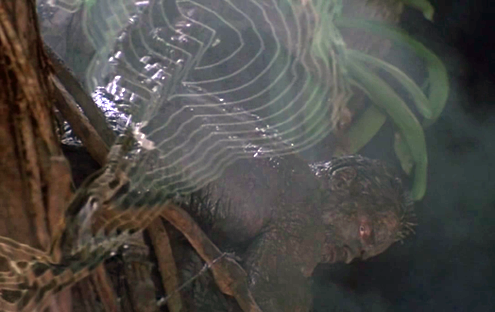
So you're fighting in combat, everyone can see your weapon and the aforementioned visual anomaly--which, in my mind, is somewhat akin to the shimmery distortion that was apparent when The Predator was hassling Conan back in '87.*  That makes invizzos a lot easier to nail down in combat; let's say attackers are -4 to hit, even less if invizzo-dude is fighting 2-handed, using a shield, or is fool enough to be wearing a cloak or a backpack.  If he's doing all three, then he's pretty much given it all away; give 'em a -1 to hit  and that's it.

*And, of course, invisibility would also be useless against infravision--unless you cover yourself in mud. 

But what about invisible MUs blasting off spells from the 2nd row?  What's to make them less "unfair"?  Well, beside the aforementioned wizard hat ruling, what about this: when casting spells, the interaction of the aura of invisibility with the incoming magic of the new spell combine to create a magical reaction which causes invisible spellcasters to glow for the duration of the casting time of any spell and leaves a faint after glow for the remainder of the round; any attacks made against them are at +2.

That's an invisibility rule I could live with.  You have to treat invisibility a lot differently; no more hiding an entire party in a bag of holding which the invisibled thief then picks up and sneaks out the dungeon with.  In order to remain invisible, a character is going to have to ditch a lot of gear, making it useful only in certain situations.

Wednesday, May 30, 2012

Gold vs. Abilities: Unintended Consequences

How much will it cost to make me smarter?
In my AD&D-ish game, characters roll 3d6 seven times in order for their abilities, the 7th being for Gold which is then multiplied by 10 to determine starting GPs.  However, before they do the multiplification, players may swap the Gold result with any one ability if they so choose; I call it the Gold Swap Rule.

The result has been most significant for fighters.  Not only have they taken a pay cut down from an average of 125 (50-200) GP to 105 (30-180), but they're going to trade a 6 Con for a 13 Gold every freakin' time.  As a consequence, PC fighters are wearing scale mail and wielding voulges and spetums for the first time in recorded history.

Gone are the mail-clad rookies bristling with armaments for every occasion, and I like it.  The penurious paladin in my recent Hommlet campaign couldn't afford a sword so he settled for a morning star as his sole armament; Nice!  And the elven archer often has to use that long bow he sprung for--really, why does anyone bring a long bow into a dungeon?--as a handheld weapon too, since his only other weapon is a dagger. The Swap does seem to make 1st level fighters a bit more vulnerable, which is maybe not something AD&D fighters really need to be.

Spellcasters have also been significantly affected because I've also enacted the Holmesian Scroll Rule--any MU can make a scroll for 100 GPs and a week in the library.  Now magicusers are doing anything in their power to get a Gold score of at least 11 so that they can have an extra sleep spell in their back pocket before they head into their first dungeon.  This is a 100% increase in a prestidigitator's spell capacity, but it can result in a lot of insolvent spellcasters.

Thieves seem to benefit the most, financially, from this system.  Not only do they get a substantial pay raise--up from 2d6x10 GPs per the PHB--but their low startup costs allow them to swap or not to swap their Gold score at their leisure.  The shakedown is that we're having some very well equipped thieves, which seems appropriate for a class whose purview is, nominally speaking, illicit commerce.

It also reinforces the notion of the thief as the expert treasure finder, because now s/he's pretty much expected to provide for any equipment necessary for the retrieval of treasure--including sacks and rope and the like, but also food, pack animals, and hirelings.  This allows the fighters and spellcasters to focus on their jobs and gives the thief a more administrative role.  Indeed, the thief is generally in charge of negotiating fees, procuring supplies, managing NPC personnel, and even finding the next gig, on top of his traditional duties such as opening the occasional lock or backstabbing the odd hobgoblin.  If the party were a band, the thief would be the bass player and the manager.

When I enacted the Gold Swap rule, I assumed it would eliminate some egregiously low ability scores from character sheets at the table, but never really considered what consequences the diminished seed money would have on party structure.  Starting fighters definitely look more like poorly armed beginners should in my mind, 1st level spellcasters have more to contribute, and thieves have shed their roguish image and become invested--literally--members of the party.  The surplus cash generally available to thieves has also introduced hirelings into the game in a way that I never anticipated--though my encumbrance rules also went a long way to encourage this; the stuff of a later post.

Of course, the reason we've had so much experience with starting characters--despite the sporadic playing time my gang manages--is that we're losing an awful lot of PCs; 2-3 per session.  Is this death toll exacerbated by our lightly armored fighters?  Probably.  But it has definitely encouraged the players to find other ways to survive encounters besides head-to-head combat.  Which is also not such a bad outcome. 


Wednesday, May 23, 2012

Level Titles: Fighter


It has always bothered me that the level title for a first level fighter is “Veteran” considering that this is exactly what a 1st level fighter is not. I've never served in the military, but I do know that the term veteran is reserved for those who've actually seen some action. Sure, veteran isn't as awe-inspiring as terms like hero, champion or–ahem—Myrmidon, but it still deserves more respect than 1st level accords it. For that reason, until someone comes up with a better term I am doctoring my PHB to look like this:


That is all.

Thursday, March 1, 2012

Language and Magic

Read Magic you say? Try reading this. 
Everyone who's seen Buffy the Vampire Slayer or read the Harry Potter books knows that you can't get very far in the magic world without learning some Latin.  And everyone whose played AD&D knows that powerful Magic Users always have a ton of extra languages under their belt.  Is it too much to assume, then, that decoding linguistics is linked to the conducting of magic? That magic is created by communicating with arcane forces in a mundane way?

The notion is supported by at least a couple of verses from AD&D scripture:
"Illusionists do not need the spell Read Magic or anything like it in pursuit of their profession.  All illusionist spell books and scrolls are written in a secret tongue which every apprentice learns from his mentor." --Gary Gygax, DMG pg. 39
"At 10th level (Master Thief) thieves are able to decipher magical writings and utilize scrolls of all sorts, excluding those of the clerical, but not druidic, nature." --Gary Gygax, PHB, pg. 27
Likewise, druids "have their own secret language" though it is not made explicit that it is essential to the conducting of Druidic spells.  

So why not make Read Magic a language instead of a spell?  Say, you have to learn Latin to cast magicky spells.  That's just one language; what's a smart Magic user to do with his other bonus languages?  Learn to speak Pixie?  Ha!  How bout he picks up a few more dead languages.  Why not give each magic type (i.e. abjurations, Alterations, Divinations, etc) a different language to be learned?  Let's say you need to learn Gothic in order to delve too deeply into the world of greater summonings.  Or Tocharian to really get the hang of them phantasms. 

In this way you can attach whatever magic limitations you prefer via the language learning ritual thus guiding the way magic is expressed in your game.  Say Manx, the language of Necromancy, is only taught by a cult in the Lortmil Mountains, and members of the cult hold bludgeoning as the highest form of injury; edged weapons are considered crude or too lenient or whatever.  Or the utterance of the  Aramaic language--the tongue of evocations--causes a resonant force around the spellcaster's body that is interrupted by the presence of significant amounts of ferrous metals.  Elves are default magic users in your game?  That's 'cuz they all learn to speak Avestan, the language of Enchantments.

Advanced studies in a particular language might allow characters a benefit.  Burning 2 extra languages on a magic language--a specialization if you will--allows you to cast spells of that type normally not available to your class.  Your Spell caster double-majors in Tocharian, the language of Phantasms, he can now cast all phantasm spells, including those normally reserved for Illusionists and Druids; thus effectively eliminating the need for an Illusionist subclass.  In this way, a "cleric" might just be a Magic user with fluency in the languages of divination, abjuration, and necromancy.


I'm pretty sure that third line says "Magic Missiles"
This flows much better with the thiefly ability of to  read scrolls; under AD&D rules, not even magic users could read scrolls without first casting read magic--a rule that was perhaps as widely ignored as weapon speed factors and psionics--and yet thieves of a certain level had a chance of reading the same scroll without any spell casting ability.   Of course, the arcane forces have been pre-channeled and imbued in the substance of the scroll, so all that the thief has to do is read the magic words in a reasonably competent fashion and voila!  Magic be happenin'!


Language-as-magic widens the potential for other characters to get in on this scroll-reading bonanza as well.  Say your character is an Elf and, though not an MU, he or she is familiar with Avestan.  Now say your elf finds a scroll written in Avestan.  S/He reads it over, says I think I get it, and gives it a whirl.  He or she may attempt to cast the spell, though not being fluent in magixcersizing, they run a risk of spell failure.  Maybe give 'em a  percent chance of success equal to 5 x Int.  Or, if you'd rather roll a 20 sider, d20 + Int must be > or = to 21.  [Alternatively, AD&D-nards might like to use the "Chance to Know Each Listed Spell" from Intelligence Table II on page 10 of the PHB as the base chance of success].  This would not work in the case of non-spellcasters who read from spell books because, unlike scrolls, the book itself does not contain the magic that is to be channeled.  The second part of performing magic--channeling the energy once you've communicated with the arcane forces--would remain the purview of trained spellcasters.

The effects of a failed scroll-reading might look something like this: 

Scroll Failure (roll on d6):
  1. Nothing happens whatsoever
  2. The spell functions as normal but takes effect 1d6 mile(s) away. 
  3. The spell takes effect as normal at the same location but not for 1d6 hours. 
  4. The spell affects the least convenient of the following: you, the person or thing best equipped to use it against you, anyone who isn't you.
  5. A curse befalls your offspring; all of your future characters suffer -3 to all ability rolls until the curse is lifted.
  6. The soul of every player within 3d6 feet of the scroll-reader is inexorably drawn into the dimension of Hades to suffer eternal torment.