Until I wandered into my local gaming store the other day (
Gary's Games in the Greenwood neighborhood of Seattle) I had never heard of
Eldritch Role-Playing System (
ERP) by Dan Cross and Randall Petras. This surprises me somewhat because it was published by Goodman Games, a company I've been aware of for a while, at a time, 2008, when I was starting to pay attention to current RPGs. But, alas, no one I'm aware of--admittedly, a very small crowd--has made any mention of it. So what compelled me to buy it? Mostly it was the price; at $19.99, it was cheaper than virtually every other gaming implement of similar size and quality.
What follows is more of an
overview than a
review; the difference being, in my mind, that there won't be a lot of delving into game themes or a reflection on why the system supports one type of gaming or another; I'm just not smart enough to pull that stuff off very well. Plus, I haven't played it. This is just a summary of a few of the more predominant game devices and overall content. Now let's have at it.
First Impressions:
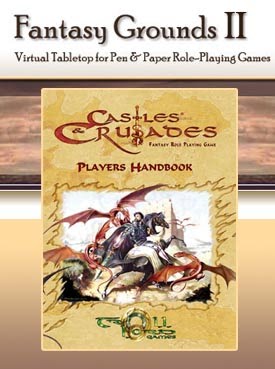
It's a slender (96 pp.), softcover volume with cover art supplied by cut-rate rpg illustrator Peter Bradley. In fact, combined with its mottled beige border, the artwork could easily give inattentive bookstore browsers the impression that they are holding a
Castles & Crusades supplement. I'm not a huge fan of Bradley's work, at least not in the context of the fantasy rpg genre. His illustrations have a removed, contemplative quality better suited, I think, to a classic comics version of
Wuthering Heights or some other brooding psycho-drama. Even the wyverns tearing at the knight's armor on the
C&C PHB give the impression that they have something else weighing heavily on their minds. [Note: On the ERP cover, is that bard off to the side the Scottish James Hetfield?]
The interior art is provided by Eric Bergeron. My impression of his work is that he found a really awesome set of well-endowed action figures--BBW fans need to check out the bikini-clad ogress on page 63--photographed them against some cool backgrounds, and slapped a few Photoshop filters on 'em. Not necessarily a bad thing, but if you're looking for clean, bold, line drawings a la Trampier, you won't find 'em here. But this game makes no pretense at Olde Schoolatry, and Bergeron's art does an adequate job of brightening up the pages.
To demonstrate
ERP's New Schooledness, there's a character sheet in the back* that's 7 (seven!) freakin' pages long--I get the sense that despite the brevity of this tome, this is not going to be a "rules lite" game. I see some terms that beg to be acronymized ("Active Defense Pool"), some acronyms that need some explaining ("MRV"), and 4 different kinds of experience points: Victory Pts, Role Playing Pts, Excess Pts, and Character points. Other things gleaned from the character sheet: there are lots of skills listed--can you say skillz based system?--and there are no attributes in the Old School sense--no Str, Int, Wis, etc. [but then if you can find me a game besides D&D and its progeny that uses the Wisdom attribute/ability, I will buy you a
steak dinner**].
* I also tend to read rulebooks (and magazines) from back to front.
** Does not include travel or housing expenses.
The index does not even fill 2 pages. For an rpg, I think this is a bit too slight too get the job done; we'll see.
Thankfully, there is none of that tedious background/border art crap on every page that virtually every game book finds mandatory to include nowadays. How much cheaper would these $40 rule books be if they weren't wasting so much ink on a halftone background print of a dragon's hoard plus a border etching of buxom mermaids on every g*ddamn friggin' page? Probably only negligibly cheaper, I suppose; but in my cantankerous old guy opinion, they just add noise to the page and I refuse to spend money on such over-wrought texts.
The Basics:
You've got the standard menagerie of AD&D character races, nothing new about them. There are 3 major "occupations"--Fighter, Rogue, and Arcanist--each occupation offering several sub-categories (11 fighter subclasses include your paladin et al. but also samurai, mystic warrior, and Calvary
[sic]*) that represent a different bundle o' skills. That's where you'll find clerics and druids, as 2 of the optional sub categories of arcanist. Each occupation is discerned by its "basic abilities," "specializations," and "masteries" which are generally more and more refined skill sets. For instance, Gladiators have Melee as a basic ability, Exotic Weapons as a specialization and Net as a mastery. This linked set of abilities is, I believe, called an ability tree, and would allow the character the chance to roll 3 dice when using his net in melee. I could be wrong about this though.
 * This is the third time in recent weeks that I've seen the word Calvary used instead of cavalry. Just to see if they're at least consistent in their (mis)usage I checked the index: no mention of either one. Or Golgotha.
There are no fixed attributes but, rather, all your attributes and skills are lumped into the same Universal Gaming Mechanism. Basically, you start out with "average" abilities in everything from agility to animal husbandry with some adjustments depending on your race. You use character points to buy-up a few abilities to better than average: "respectable," "good," "great," and "superb" are the superlatives of choice. As you improve you get to roll bigger dice, starting with d4 at average until you reach d12 at superb, which is the pinnacle of human mastery. These dice are thrown against whatever dice the GM deems significant to determine whether you achieve success. So if you have, say, "good" stealth ability and you're trying to be stealthy in an "easy" situation, you roll a d6 against the GM's d4. A "moderate task" gets 2d4 and "difficult" gets 2d6 etc., until your d6 seems pretty puny.
Character Generation As I mentioned earlier, it's a point-buy system where you pay for your race and some advanced abilities. Unlike a lot of games, there is no price break for buying a human--they have advantages for which you must pay as well. The process is broken into 5 steps:
- Choose race, advantages & disadvantages,
- Choose abilities & occupational path;
- Calculate defense pools;
- Determine character concept, and
- Pick equipment.
Pretty straight forward stuff, except number 3 definitely caught me off guard. Is it really that vital that your "defense pools"--whatever they may be--need to be calculated before you develop your character concept?
Especially considering that over at the Goodman Games website, the tag line for their ERP line of products reads "Character concept is king!" According to this outline, a more apt rank of nobility might be "Viscount" or "Marquise." Seriously, if you've waited until after you've already chosen your race, abilities, and occupational path to determine your character concept then what was guiding all those decisions? Your Passive Defense Pools? Sheesh.
It's also not immediately obvious how one is supposed to "buy" one's occupational path and requisite abilities, specialties and masteries--you won't learn how to do this until you read the next chapter. Fortunately, there's a narrative of a sample character creation session provided in sidebar format that offers enough guidance to allow a crafty reader to hack his way through the wilderness. This appears to be the major flaw of this book, however: again and again the information needed to do what is being discussed has not been covered in the text, forcing the reader to flip ahead to find a useful example or table or flow chart (yes, they use flow charts) to provide edification. And despite the prevalence of these tables and flow charts, I have yet to find a piece of text that references them.
[If Goodman Games is looking for a technical editor--and they should be if this book is at all indicative--I could definitely set them up--TR]
Combat is all about mitigating threat points with your defense pools. What the eph does that mean, you ask? Good question. Basically, you roll a bunch of dice--the number and size of which are dependent on your level of mastery of whatever applicable combat abilities you possess--to determine your "Threat Points." Don't call it "damage" or the authors will come to your house and inflict massive Potential Harm* on your ass--which the defending character then "mitigates" by throwing around his own action points and dice rolls: evading pts, parrying pts, armor pts, talking pts, needle pts, whatever. I believe "hit points" are also mentioned in here somewhere, but they don't mean what you think. Unmitigated threat points are deducted from the defender's "toughness" score.
* Yes, this is another term used by the authors. Good luck discerning its significance.
I think I've aptly demonstrated that this is not a 0 to 60 in 30 minutes kind of game--even for seasoned gamers. Again, I don't believe this to be an inherently unappealing aspect of the game, but it is definitely something to consider if you have impatient players to contend with.
Magic there are 4 sources of power: mystic (normal wizardry), supernatural (summoners; clerics also live here), primordial (druids and elementalists), and psychogenic (psionics). You use spell points to cast spells, you're better at casting those within your specialty than others, they do stuff. At this point I'm still suffering from fatigue from the combat section, give me a few minutes to rest my medulla oblongata...
The spell descriptions are provided in the appendix section titled "Sample Spells" which leads me to believe that players and/or GMs are largely expected/encouraged to devise their own magicalations. Spell descriptions get a 6 item "stat" block that offers you such scintillating info as the source, school, effect, manifestation, range and aspect--all given in analog form; no numbers. The text underneath is often even more terse; Heal spell reads thusly: "This spell mends wounds." There are virtually no references to dice rolls or numbers of any sort for that matter; things like range and area of effect are covered by a universal formula involving your ability with the spell ("average," "respectable," what have you) and some multiplier, while the effect of your spells is gauged using the "Master Effects list," which is presumably located somewhere in the Magic section.
Back to the index: none of the following terms are anywhere to be found: master effects list, magic, effect, list. I hate to say I told you so... After some digging around in the magic chapter I find that there is, in fact, a list under the heading "Major Effects Descriptions" (pg. 44) that I believe is the intended target of this reference. That comment I made about a technical editor becomes more and more pertinent, eh?
Misc. Experience is based on earning Victory Points--by surviving dangerous situations--and Role-playing Points--doled out for playing to your character concept. Accumulate enough of both types of points and you raise level, which grants you more character points to spend on improving your character. Nothing outlandish here, right?
There's also a campaign setting in the appendices, though "campaign concept" is really a better term for it. There's no map or descriptions of geo-political entities or other things one might expect in a campaign setting. Rather, what they describe is a world where 2 types of lands exist:
settled an
unsettled.
Settled lands are those where normal laws of science are followed; grass is green, if you open your bathroom door you will find your bathroom, that sort of stuff.
Unsettled lands, however, are some sort of dreamy alterna-reality where the environs are defined by some concept or emotion and proximity is not based on physical distance but rather conceptual propinquity. For instance, an unsettled land whose theme is love might be rosy, warm, and comforting--though love can also be tumultuous, I suppose. Traveling from this land of love, one might pass through the lands of cute, friendly, cordial and various other shades of affection before reaching the land of hate. Once you get to Hateland you'll likely find a bunker full of Nazis next to an Al Quaeda camp which is directly adjacent to Westboro Baptist Church. An interesting concept, but it belies the rather conservative character race selection. I would think a game with such a trippy setting would allow for a more customizable character race development system, which only leads me to believe that the authors didn't really have such a setting in mind when they crafted the rules.
Closing remarks (wherein I might give my opinion on something):
Overall, I'm pretty intrigued by this game. I like the rolling-my-bag-o'-dice-against-yours approach to conflict resolution, though I could see that it would take some practice to become fluent in the numerous branches of the "ability trees" and their influence on various actions. And I like the notion of the 3 realms of adventuring abilities: combat, stealth & magic. I'm always hoping that some OSR retro-cloner will make a game that removes clerics as a class in favor of a system like this, even though this would immediately disqualify such an entry as an Aulde Skewle game
. I'm also a fan of bringing a character to the table that you have invested some sort of concept into, and I think point buying systems generally facilitate this kind of character conceptualization in a way that random generation does not.
ERP also has the advantage that, unlike
GURPS and similar point-buy systems, one is not forced to buy a bunch of quantified disadvantages in order to avoid complete mediocrity. That said, the act of making up a new character without
any element of randomness has been scientifically proven to be less fun (1); so there's that to consider.
From the author's afterword: "this game is not 'rules light.'
[agreed--TR] Such is not the aim of our design. Rather... ERP seeks to be Rules Transparent." Despite this load of gobbledy-gookery, I commend the game-smiths for putting together a system that seems workable, original,* and intriguing. They could definitely have used some help making the rules more reader-friendly but, overall, I think they're onto something. That said, will I ever convince anyone to spend their precious few gaming hours on this? Magic 8-ball says: "Outlook not so good."**
* More knowledgeable gamers will likely be able to trace ERP's antecedents better than I. Bear in mind that I did spend ~20 years frozen in a glacier.
**Things I just found out: the magic 8 ball has a 20 sider in it. 20-siders are called icosahedrons.
(1) Unfrozen Caveman Dice-chucker, 2010.
Building characters on a budget: Analysis of character generation processes of the "Olde" and "Nieuw" schools. An as-yet un-posted blog dissertation