Wednesday, July 31, 2013
LotFP (hee hee hee)
For better or worse, I've never paid much attention to Raggi's blog for the same reason that I don't bother reading many blog posts with the word "Kickstarter" in them: marketing copy rarely makes absorbing reading.
As such when people throw around the acronym "LotFP", it carries a very different meaning to me. Everyone knows from Tolkien that "L.o.t.-" means "Lord of the-" and as for F.P., I direct you to the following discussion between office manager Michael Scott and Ryan the Temp from season 2 of The Office (U.S. edition):
Michael: For emergency contact put down Todd F. Packer. You know what the "F" stands for?
Ryan: Fudge?


Friday, July 26, 2013
Starting Equipment and Class Abilities
So the last thing I read before I went away on a camping trip last week was 9n30's post about universal first level characters (WARNING:
no internet access + lots of time thinking by the campfire = 1
overcooked blog post upon return to civilization). The timing was
crucial, as just the day before I had been reading the Holmes and/or
Moldvay rules and noticed that fighters in the Basic rules are not
actually any better than anyone else at hitting stuff. The only thing
that sets them apart as combaticians is their unrestricted access to armaments and an
increased potential for taking a beating--can you spell cannon fodder?
The Original rules are even more exacting on this point: at first
level, Fighting Men are not even better to hit than Normal Men.
Normal-freaking-Men! And yet we call these chumps veterans?
So for
those who live in the OD&D or B/X domains, Fighters are defined not so much by their prowess with arms but by their access to them. This
sort of dovetails somewhat with my recent obsession with starting equipment: since buying a sword essentially makes you a fighter, what
if, at 1st level, you could pick up extra-classular abilities as part of the starting equipment allotment? Like Talysman’s notion,
everyone has access to the other class’s specialties, though they would
only advance in those abilities related to their chosen class. But
you’ll need to apportion your limited resources, which means that you’re
not likely to have every other class’s stuff without unleashing the old jack-of-all trades-master-of-none maxim. Rather than just picking what you want or buying the skills with an allotment of build points or gold pieces or what have you, you would roll 4 sixers on Table 1.01-f (below) and apply two of the dice to the column most pertinent to your class, splitting the rest of your dice amongst the other columns as you see fit.

*For spells, roll again on a table that would look something like this:

Monday, July 1, 2013
How much iron is in your rations?

If you're like me, you don't really have much of an idea what the hell iron rations look like, much less what they're made of. As a kid I assumed they were cakes made of compressed Product 19; that assumption hasn't changed much in the intervening years. [Does Kellogg's still make Product 19? I don't think I've seen it since the 80s.]
Anyway, my recent foray into Equipment Theory has led me to seek out a clearer image of what sort of food my PCs are noshing on down on the 5th level of Adventure Module FU2 Abyss of Tumescent Malice. Here are a few options I've discovered:
Dungeon Pucks—Unpalatable crumpets of dwarven manufacture, they are comprised of rendered catoblepas lard and quarry dust; only the truly hungry can bring themselves to eat one of these. It is said that rats turn up their noses at these biscuits and no known mold can find purchase on its dense surface. Each provides one meal worth of sustenance, though it is a mean existence; after a week of consumption, save vs. Will to Live or sublimate into wraith-form.
Cialembas—Sickly-sweet tortillas made of acorn flour and pixie semen baked in an oven made of sugar cane, they provide lite yet satisfying fare, can be carried in great quantities without impinging on encumbrance, and cause prolonged erections. Extended use may result in cavities and/or spontaneous gender reassignment. Beware: acquisition of these wafers requires interaction with high elves of exceptionally tiresome demeanor.
Uruk-hooch—Foul but invigorating liquor made from goblin adrenal glands and Wild Turkey. Small doses allow for improved strength and stamina; prolonged use causes psychosis of the liver. Highly corrosive to metal, must be stored in glass or ceramic containers. It is rumored to be an antidote to some of the side-effects of Dungeon Pucks and Cialembas.
Thursday, June 27, 2013


Tuesday, June 25, 2013
Elves: Weirder Than You Think
Elves are weird. Weirder than most players realize when they
first sign up for a character of the pointy-eared persuasion. Here are a
few facts about elven ecology that might give you pause before you roll up another Legolas:
* Not so eternally after all since I changed the name of the blog in summer 2014.
- Elves are born wearing hats. And the hats grow up with the elf. As half-elves are born without hats, they are often called "hatless ones" by true elves.
- Elves are the byproduct of human heroes fornicating with nymphs. See Odysseus and Calypso, Odysseus and Circe, Odysseus and your mother, etc. Seriously, if your character is an elf, odds are pretty good Odysseus is your daddy. Of course nobody is aware of this since nymphs don't waste a single second of their eternal lives being maternal. Rather, shortly after copulation, they wander off to some private spot in their grove, glen, glade, or grotto, lay an elf-egg, and never give the matter another thought. Instead,
- Elflings are raised by sprites or pixies or some other faerie-type beings who collect the nymph eggs and tend to the baby elves until they outgrow their surrogate parents. At which point the elf-in-training gloms on to the community of elves that inevitably crops up around every nymph dell after Odysseus passes through town.
- Elves are androgynous in appearance. In size, build, and, often, in temperament, both male and female elves closely resemble adolescent boys, minus the acne and boners. Incapable of growing hair on their excessively angular faces and emaciated bodies, and with high, often squawky, voices, they're sex appeal to humans is more limited than you might think.
- Elves are capable of expressing only 3 emotions: amusement, disinterest, and sarcasm. And at least one of those is not actually an emotion. As a result, Humans and most other, non-fey races find the company of elves to be unsettling if not downright obnoxious.
- Elves cannot procreate with their own kind. Or maybe they find the company of other elves just as off-putting as the rest of us do. In any event, the offspring of elves are always half elves, fathered by humans, gnomes, mind flayers, whatever; so long as their mate is not elven in any way.
- Those eyes are creepy. In the immortal words of Phil Hartman, to whom this blog is eternally* indebted:
Hartman: The eyes, the window to your skeleton.
Straight man: Don't you mean "soul"?
Hartman: If you have one.
* Not so eternally after all since I changed the name of the blog in summer 2014.
Friday, June 21, 2013
Art of the Monster Manual Part II
Other Things I learned from playing Dis or Dat:

- DCS drew all the freakin' dragons! How did we not get even one iconic dragon illustration out of Tramp? DCS also did all the Dinosaurs and most of the Demons--with the exception of Juiblex. Tramp, on the other hand, got all the devils except Asmodeus. Man, the D section is loaded.
- Dispater (Arch-devil) has mismatched feet: one human-seeming foot and one cloven hoof.
- The doomed fighter in the Violet fungi drawing looks like he might actually have detached his rotting right arm.
- Another DCS trait: screwing with the frame. See the rust monster, right, but also leprechaun, hippogriff, fire elemental, dwarf, chimera, and probably a few others.
- The knight fighting the hobgoblins (p. 52) might very well be the Paladin in Hell from p.23 of the PHB. And possibly the same dude who's watching his friend get chowed by giant ants back on page 7.
- Has anyone ever made any sense out of the illustration on p. 57 showing the ki-rin tangling with Quetzalcoatl?
- TSR re-used the satyr drawing from the MM on page 187 of the DMG, next to the "Faerie and Sylvan Settings" random encounter table, appropriately enough.
- Rakshasa: Suave-ass Mofo. Not a revelation, but it's still worth saying.
- DAT's elves, p. 40, are sufficiently weird looking. DCS's elves on the previous page are too uptight for my tastes.
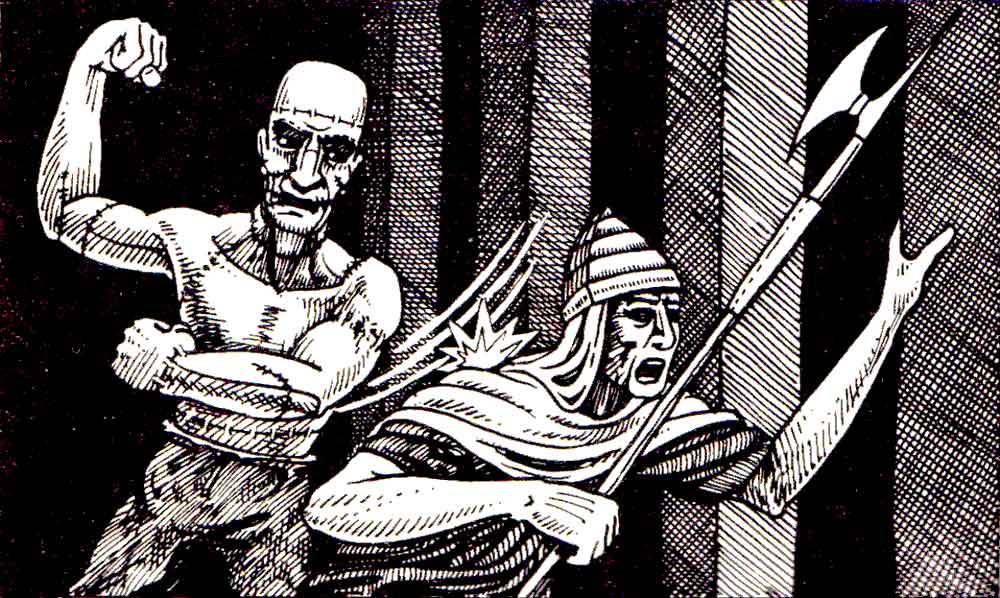
- The flesh golem is an enigma. It's clearly the work of Tramp--just look at those metacarpals!--but the columns in the background lack the confidence typical of his work. Note the wobbly lines and the clumsy hatchwork of the pillars compared with the smooth curves of the halberd blade and the dude's forearm. I'm wondering if Tramp drew the foreground but, pressed for time, handed it off to another artist named Dave to help finish it up. The blotchy hatching of the Golem's pants are also more typical of Dave S.

Thursday, June 20, 2013
Art of the MM: DCS Black Leg Syndrome
So I was looking through the Monster Manual the other day playing a game of DCS or DAT (pronounced "dis or dat") wherein I look at all the illustrations in the MM and guess whether each was drawn by Dave Sutherland (DCS) or Dave Trampier (DAT). Anyone familiar with the artists in question probably knows that this is not a particularly difficult task. [The works of DCS and Tom Wham--who also has a number of illustrations in the MM--on the other hand, are actually much harder to discern.]
You play this game a few times and you begin to pick up a few traits of each of the artists. Trampier hands, for instance, have long fingers and prominent metacarpals, while DCS, well, is no Tramp.
One distinctive feature of Sutherland's work is that he often drew the far leg of people and critters in silhouette. See the troll on the left below for an idea of what I'm talking about:

Indeed, while DCS does this all the freakin' time, Tramp--the master of fine hatching--never uses this technique. Nor does--to the best of my knowledge--Tom Wham. From Baluchitherium through Yeti, if you see a leg, wing, arm, or other extremity filled in completely in black ink, it might as well have "Sutherland" written across it in flaming letters. Check out everyone's favorite pig-faced orc, below; he gets the silhouette treatment over the entire right side of his body:

But right there on the facing page of the orc you'll see Jean Wells' Otyugh illustration featuring a fully blackened rear leg as well as a mostly blackened hind tentacle.

Now I know with absolute certainty that this is a Jean Wells drawing because none of her illos appeared in the earliest printings of the MM, and the copy I had as a kid was, apparently, one of those early printings, cuz whenever I see the violet fungi or the giant rat or that bellicose otyugh I'm still taken aback by these newcomers. Fortunately for the DCS Black Leg Theory, a not-too-close inspection quickly reveals that the femur sticking out of the muck-pile is signed "Jean & Dave" so, presumably, DCS had a hand in this after all.
You play this game a few times and you begin to pick up a few traits of each of the artists. Trampier hands, for instance, have long fingers and prominent metacarpals, while DCS, well, is no Tramp.
One distinctive feature of Sutherland's work is that he often drew the far leg of people and critters in silhouette. See the troll on the left below for an idea of what I'm talking about:
Indeed, while DCS does this all the freakin' time, Tramp--the master of fine hatching--never uses this technique. Nor does--to the best of my knowledge--Tom Wham. From Baluchitherium through Yeti, if you see a leg, wing, arm, or other extremity filled in completely in black ink, it might as well have "Sutherland" written across it in flaming letters. Check out everyone's favorite pig-faced orc, below; he gets the silhouette treatment over the entire right side of his body:

But right there on the facing page of the orc you'll see Jean Wells' Otyugh illustration featuring a fully blackened rear leg as well as a mostly blackened hind tentacle.

Now I know with absolute certainty that this is a Jean Wells drawing because none of her illos appeared in the earliest printings of the MM, and the copy I had as a kid was, apparently, one of those early printings, cuz whenever I see the violet fungi or the giant rat or that bellicose otyugh I'm still taken aback by these newcomers. Fortunately for the DCS Black Leg Theory, a not-too-close inspection quickly reveals that the femur sticking out of the muck-pile is signed "Jean & Dave" so, presumably, DCS had a hand in this after all.
Subscribe to:
Posts (Atom)