Tuesday, June 4, 2013

Weaponised Livestock


Due to overwhelming demand (thanks for the set up Lum), I'm releasing the Weaponized Livestock Table mentioned in my Starting Equipment post last week.

  1. Fighting Cock: d4 hp, 2 attacks for 1-3 ea. On a 20 leaps up to your face and tears out an eye, your nose, or your tongue.
  2. Guard Dog:  Woof.
  3. Venomous Sheep: 2HD, AC5, 1 attack for d6 dmg but save vs. poison or die of botulism in 2d6 seconds.
  4. Warcrow: As fighting cock except speaks up to 3 languages and it can wield a crossbow or pole arm.  Also flies a lot better than any homicidal poultry ever could.
  5. Carnivorous Goat: As venomous sheep except these vicious mo' fo's are hella fast (15") and get 4 attacks per round for 1d6 ea.  On a 20 it shreds your armor; AC value is reduced by 3 permanently.  Also, it is not venomous. 
  6. Battle Ox: 8 HD, AC 5, 1 attack for 2d8 dmg.  On a 20 the ox has impaled you on his horns and is thrashing his head around trying to dislodge you.  Drop everything and continue to take 2d8 damage every round thereafter until you save versus watching-your-innards-spill-out-on-the-ground.

Friday, May 31, 2013

Starting Equipment

Hopping on the ol' starting equipment bandwagon kicked off by Zenopolis Archives the other day, I decided to toss my two cents on the heap.

My preference is for something along the lines of this from the always excellent Built by Gods Long Forgotten.  Basically, you roll 3d6 for your stuff, but rather than adding up the total to determine your net worth in coinage, you use the value of each die to determine how many items from each of 3 or 4 categories of value ranging from the prosaic--torches and sacks--to the nifty--gilded chainmail  interlaced with gemstones and an integral heart rate monitor with digital readout.      

What I like least about BGLB's approach is that it's too easy to use; so easy that someone might actually be tempted to use it in their game.  So I'm taking the same premise but developing a more convoluted approach that will make it less user-friendly.

So here's how it works:
  1. roll 4d6
  2. assign each die to a column in the table below.
  3. more than one die may be assigned to any one column.
  4. just in case it has to be said, only MUs can assign dice to the Spell column.

Table 1: Starting Equipment
It should be noted that I haven't gotten around to making a "gear list," so stop looking for one.

Once an MU has assigned dice to the Spell column, he or she then rolls a d6 on the Spell List table below and consults the appropriate column to determine which spell he gets. For example:
Thrombo the Thaumaturge rolls a 5, two 3s, and a 1 for his starting equipment.  After burning the 1 on the obligatory staff, he decides to fore go any other gear and assigns his remaining dice to the spell column, which will net him 3 total spells. The 5 earns him a roll on the B list, the 3s earn him two rolls on the D list. He rolls a 1 and a 6 on the D list: Comp. Languages and a free choice: he selects Detect Magic. For the B list he rolls a 4: Light--really? Light made the B list? Who's responsible for this crummy list?
Table 2: Starting Spells


Optional rules for enhanced convolution:
  • One might want to apply INT score to dice assigned to the spell column.  Eg. Thrombo in the above example has an INT of 13, so he has a +1 bonus.  He may add 1 to any dice he assigns to the spells column, resulting in a promotion to one A list spell and two C list spells.  Dumb MUs are stuck with crappy spells at first level.
  • Maybe you allow folks to add dice, so Thrombo could have added up his two 3s to get a 6, affording him a roll on the A list instead of 2 rolls on the D.
  • If you roll starting gold with 3d6 like I do, treat it like any other ability score.  Apply modifiers to the dice rolled: an 18 Gold score means you add 3 to all dice rolled for starting gear.  1s become 4s, assuring you that your wealthy character will always have the best and most fashionable accoutrements while an impoverished warrior must consider himself lucky if he manages a pole arm and leather armor.
  • Alternatively, the Gold bonus might manifest itself in additional d6 to be rolled for items.  That guy with +3 bonus gets to roll 7 dice for starting crap.  A pauper would get a single die roll with which to supply himself.

Tuesday, May 28, 2013

Parrying

Here's what I'm contemplating for my new, improved* parrying rules. If a player wants to parry an attacker's blow, the defender must follow the ensuing procedure:

Step 1: Declare his intent to parry after an attacker has successfully rolled to hit--there's nothing more shameful than a premature parry--but before the ensuing damage die is rolled.  Once the die is cast, it is loo late for action.  Parrying takes quick wits.

Step 2: Once the intent to parry has been successfully declared, the parrier** must achieve a higher result on a d20 roll than the attacker rolled, adding combat level and other to-hit bonuses.  If the attacker rolled a natch 20 then put your dice away, the blow cannot be parried.

Step 2 Option B:  For those preferring the extra-convoluted approach, the defender can roll as if trying to score a hit using the attacker's weapon speed factor as AC.

Step 3: If the defender rolls successfully, he or she then rolls damage as if they had hit their opponent.  This is the total amount of damage the defender has deferred from their person. 

Step 4: The attacker rolls damage.  If the damage roll is equal to or less than that rolled by the defender in Step 3, the defender receives no damage from the assault.  Any damage in excess of the defenders damage roll, however, is applied to the defender's person.  Thus, a dagger-wielder is not likely to successfully stave off the entirety of a bardiche attack.

Exceptional Rolls:
20--Roll a nat'l 20 and all damage is blocked.  Other possible results of a criterical hit might  include: riposte--an immediate attack against the opponent; roll to hit as normal. Prise de fer--the attacker is disarmed.

1--The attempt to parry fails and no damage is blocked.  Additionally, a despicable die roll might result in the parry attempt leaving the defender in an awkward position allowing the attacker a second, immediate attack; the defender may find himself suddenly bereft of weaponry; and, indeed, his or her weapon might be decimated in the attempt to stymie the assault.  

Consequences:
  1. Regardless of the success of the parry attempt, the parrier loses any further attack this round (with the exception of the possibility of a riposte as mentioned above).  If they have already attacked this round, then they automatically lose initiative in the next round, should they survive.  They may, however continue to parry blows, though each successive attempt puts them further on the defensive.
  2. Anytime the attacker rolls in excess of twice the damage blocked, the defender is disarmed. 
  3. If the defender rolls max "dmg" when parrying yet the attacker's dmg roll exceeds that total, the defender must roll a saving throw for his weapon or it is sundered.

Synopsis:

Depending on which option you use, either the combination of skill and luck of the attacker or the swiftness of his weapon determines how hard a particular blow will be to parry.  The heft of your weapon is a significant factor in determining how effectively you will parry.  Parrying results in diminished offensive opportunity and a fairly decent likelihood of disarmament or worse.

Thoughts?  Comments?


*Regular readers of this blog will understand that "improved" in Caveman-speak generally means "Now more convoluted!"

** Sadly, this is not a real word. 

Wednesday, March 20, 2013

Celebrate the Feast of St. Cuthbert

As all you hagiophiles already know March 20th marks the feast day of St. Cuthbert who died on this day in 687.  Greyhawkophiles will know St. Cuddy as one of the original deities of EGG's home campaign.  But here are a few things you might not have known about the patron saint of quality head-wear:

Banner of St. C: Where's the cudgel?
  • Good ol' Cuddy was probably ~53 years old when he died of an unspecified illness in his hermitage in Northumbria.
  • He began his monastic career only after serving in a war against the King of Mercia.  
  • After the war, Cuthbert arrived at the monastery of Melrose bearing a spear, not a cudgel.
  • In 664 he was named prior of the monastery at Lindisfarne which would later bear his name.  
  • Though he ultimately returned to Lindisfarne as Bishop, he spent much of the last decade or so of his life living as a hermit--not unlike a certain mad man in the environs of the Keep on the Borderlands.
  • His monastery would gain fame in 793 for being the first known location in the British Isles to be raided by Vikings.  Whether this event inspired the sacking of the monastery in the Sample Dungeon of the AD&D Dungeon Masters Guide cannot be known for certain.
  • St. Cuthbert's Gospel, based on the Codex of Grandior, is the oldest extant example of a "western binding."  Awesome, right? 
  • There are two caves in northeast England that bear his name.  Possibly they are named such because his sanctified remains were hidden in one or both of them to keep them safe from the Danes who continued to ravage the area for centuries.
  • Cuthbert's aforementioned gospel was also stashed in his coffin for safekeeping.  On a somewhat creepier note, so was the head of poor St. Oswald.
  • Once, after praying in the ocean, otters breathed on St. Cuthbert's cold feet to warm them up.
  • Two more Cuthberts were later canonized but, as is often the case, the sequels were not as cool as the original.
  • The Cuddy Duck is a species of waterfowl found in the vicinity of Lindisfarne. 
  • The "Liberty of St. Cuthbert's Lands" was a political entity in Northumberland that operated as a sovereign entity--a Palatinate--run by the Bishops of the vicinity.  According to Wikipedia, the people here were known as the haliwerfolc, meaning, rather literally, "holy man people", and it was believed that St. Cuthbert was "fiercely protective of his domain."  Inspiration for the See of Veluna?
  • An eagle once brought him some fish n' chips, which he shared with the eagle.
  • The Venerable Bede, a saint himself, wrote two hagiographies of Cuthbert.
  • Bede failed to mention Cuddy's affinity for hats in either tome.
  • St. Cuthbert's horse once interrupted his prayers to point out a delicious packet of bread and cheese stashed in a nearby roof.  Animals, apparently, couldn't help but give ol' Cuddy a hand.
  • It might just be a coincidence that the hermit in B2 K. on the B'lands had a protective pet puma.
  • Welsh Anglicans prefer to celebrate his feast day on Sept 4 while Episcopalians in The States pay their respects to ol' Cuddy on August 31.   Y'dey, Canoness of Hommlet, took it a step further instituting a 5 day celebration that spanned both dates.  

Thursday, March 14, 2013

Random Gonzo Encounter Tables

Here's the table I'm going to use in my next Gonzo campaign.  As you will see, the genre tables are not done yet, I've only managed the one for 007.

Random Encounter Genre Table:
  1. Roll on mutant table
  2. Roll on cyborg table
  3. Roll on Cthulhoid table
  4. Roll on James Bond table (see below)
  5. Roll on Nazi table
  6. Roll on evil smurf table
  7. Roll on Shakespearean table
  8. Roll on KGB Table
  9. Roll on Ruby Spears  table
  10. Roll on hillbilly table
  11. Roll on Thomas Pynchon table
  12. Roll twice--ignoring further 12s--and hybridize an encounter from two different encounter results, e.g. a roll of 2 and 6 would result in a cyborg evil smurf encounter.
Random James Bond Encounter Table:
  1. 3-18 glass-jawed flunkies
  2. High ranking SPECTRE officer
  3. save vs. traps or fall into a glass-sided shark tank
  4. Saucy tart with useful information; roll d6 for exposed cleavage/skirt length
  5. High speed chase in progress: (d6) 1-car, 2-boat, 3-helicopter chasing motorcycle, 4-motorcycle chasing skier, 5-skier chasing parachutist, 6-parachutist chasing helicopter
  6. CIA ally
  7. Attractive enemy agent of the opposite/preferred sex; save vs. libido or join enemy cause
  8. Tricked-out vehicle (d6): 1-car, 2-boat, 3-hovercraft, 4-snow mobile, 5-gondola, 6-blimp
  9. Secret hideout in (d6): 1-underwater dome, 2-mountaintop resort, 3-1970s Harlem, 4-active volcano, 5-capsized cruise ship, 6-aligator farm
  10. Heavily-armed person(s) (d6): 1-para-skiers, 2-kung-fu babes, 3-Cellist, 4-Clowns, 5-siren on a vengeance bender, 6-rogue triple agent
  11. MI6 crony: (d6) 1-Moneypenny, 2-Bill Tanner, 3-Judy Dench, 4-Q, 5-009, 6-Lazenby
  12. Non-Bondean spy (d6): 1-George Smiley, 2-OSS 117, 3-Sterling Archer, 4-Sarah Walker, 5-Scarlet Pimpernel, 6-Chuck Barris

Thursday, March 7, 2013

Greyhawk: Origins of the Oeridian People

Can you guess where this is heading?
We know from the history of Eastern Oerik that the Oeridian peoples came to the Flannaes from the west, sweeping across the eastern portion of the continent, pushing aside Suloise and Flannish peoples alike to dominate the region politically (The Great Kingdom), linguistically (Common Tongue), and even calendrically (C.Y.).   It's possible that their dominance even gave name to the continent (Oerik) and the planet (Oerth) of which the Flannaes are a part.  But we don't really know for certain where these fierce peoples came from.

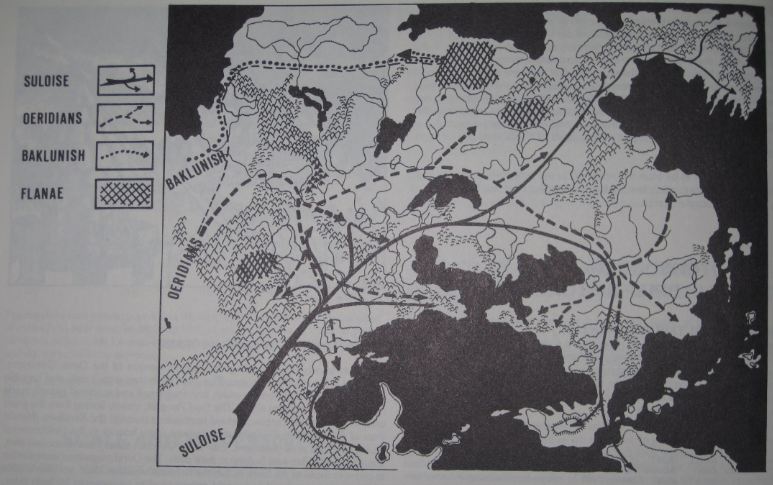
We do know that, harried by the humanoid mercenaries employed by the Bakluni in the Baksulian Wars, the Oeridians began migrating eastward from their homelands somewhere west of the vast mountain chains that separate the Flannaes from western Oerik.  Thanks to the chronology in the Gazetteer, we also know that this migration peaked in 187 O.R. (Oeridian Reckoning, subtract 644 to determine C.Y dates). But official sources are somewhat vague about the actual source of the migrations.

If we take the map of migrations in the Gazetteer as accurate, see figure 1, it would appear that the Oerid people originated in the environs of the Dry Steppes.  However, the text describes the Dry Steppes as the once-fertile homeland of the Bakluni peoples, rendered inhospitable by the Invoked Devastation.  No mention is made that Oeridians ever occupied this area. 
Figure 1. Map of migrations to Flannaes, Gazetteer (1980)

Perhaps addressing this very concern, the map of migrations in 1983's  A Guide to the World of Greyhawk moves the label of the Oeridian migratory arrow to indicate that maybe the Oeridians came not from the Dry Steppes, but from Ull [see figure 2].  The Guide describes the area as being the homeland of "a strong tribal clan of Paynim nomads."  Again, no mention is made of the Oeridians ever having lived there.

Figure 2. Guide map (1983)
It is conceivable that the Oeridians were completely uprooted from their "native" lands.  But the question it raises is why wouldn't the cataloguer who compiled the Guide and Gazetteer--who betrays an Oeridi-centric worldview elsewhere in the tomes--have mentioned the significance of these lands to the Oeridian people when the map indicates that the two are inextricably linked? 

To further obfuscate the matter, the Old Oeridian language is described as:
"A younger language, totally free of outside influences until a few centuries ago.  As a result, its linguistic components are unique and translation into any language except Common is all but impossible." (p. 8, Gygax 1980) 
This works well with the chronology which sets the Oeridian Reckoning of years as the most youthful calendar in Oerik--other than the Aerdian Empire's conflated "Common Year" of course--by 1500 years.  But how could a people whose homeland was in such close proximity to another, older culture--the Bakluni--develop a language so alien from their neighbors?  And what happened 1220 years ago that made these people start a new calendar? 

On our planet this would be a mystery indeed.  But Oerth is, happily, a fantasy setting where all sorts of cool stuff goes down.  It's entirely possible that the Oeridians were gated in from another plane; possibly by some deity or even the powerful wizards of the Bakluni; these were, after all,  the same dudes who brought down the Rain of Colorless Fire.

But there's another, more bizarre, explanation for how these foreigners arrived in the Flannaes; an explanation that has its roots in the body of Greyhawk literature: they came from space, Battlestar Galactica style.  There is, after all, a history of alien landings in the area: remember the spaceship that crashed into the Barrier Peaks near the land of Ull?

That's right, the Oeridians came from outer-freakin-space.  At least one of their ships crash landed in the mountains, many, many others apparently landed safely on the fringes of the Bakluni lands. And perhaps they melted down their space ships to make swords and plowshares.  Or they are still hidden somewhere; perhaps in an incomprehensibly vast underground hangar--I smell a megadungeon!

Anyway, the new arrivals established commerce with the nearby Bakluni peoples and, in order to facilitate such, a mutually agreeable language developed.  This language would provide the basis for the Common Tongue that would be spoken throughout the Flannaes in centuries to come.  That they call themselves Oeridians and  inhabit the continent of Oerik on the planet Oerth is either an attempt on their part to fit in by adopting the name of their new home, or it's the great irony of the Greyhawk saga: the planet is named after its alien infiltrators.
Take that you Suloise mo-fos!

Bibliography
Gygax, Gary. The World of Greyhawk Gazetteer. Lake Geneva: TSR Inc. 1980
Gygax, Gary. Expedition to the Barrier Peaks. Lake Geneva: TSR Inc. 1980
Gygax, Gary. A Guide to the World of Greyhawk, Volume III: A  catalogue of the land Flannaes, being the eastern portion of the continent Oerik, of Oerth. Lake Geneva: TSR Inc. 1983

Thursday, February 28, 2013

Hommlet: Heart of a Village

One of the coolest things about The Village of Hommlet is that it is not just a static village setting designed solely as a medium for PC activity.  There are things going on here--big things that may have little or no bearing on the actions of the PCs.  Things that are too big for your puny PCs to affect or too subtle for them to notice.

Obviously, there's the rise of the nefarious Temple of Elemental Evil.  But what about the concurrent rise of the Church of St. Cuthbert, as members of both cults infiltrate the village, each in their own fashion.  The Cuthbertines are generally lawful good artisans and craftspeople and seem intent on becoming a part of the growing community.  The Temple members are evil and secretive and presumably are trying to return to the era of oppression that precipitated the warfare of a decade ago. We don't know which of the two groups the Druidic natives of Hommlet find more objectionable.   Though the Cuthbertines are not outwardly malevolent, tight-knit, homogenous populations are, historically, not too well disposed to large influxes of new folks with different cultural values and beliefs. 

Then there's Rufus and Burne's castle under construction on the hill east of town.  Though it's not finished, the town map conveniently shows the ultimate plan of the structure, just so you know what the future has in store for Hommlet.  Is the castle a sign that Hommlet is already being subjugated to a higher power even without the Horde of Elemental Evil? How does the village elder feel about its  presence?  Glad for the safety provided?  Threatened by the assumed diminution of the traditional authority of the village?

And at the Church o' St. Cuthbert, Canoness Y'dey has "left unexpectedly and has not returned."  What sort of business is she tending to that it is accompanied by such mystery?  Terjon, the acting Canon--who would rather be off adventuring himself--believes that she is off "on a quest", but what sort of quest do churches send their Canons on?  

Furthermore, Calmert--the officiant of the church--is mysteriously diverting funds from the church to the construction of the new castle across town.  This suggests that perhaps the church does not officially support the new castle or its inhabitants, even though R&B are devotees of the Chapeau.  At the least, it indicates that Calmert's loyalties are somewhat misplaced.     

Many of these features are, I assume, further evidence of the palimpsestuous nature of T1.  As I may have mentioned in another post or two this module is unique in that it was created for play in Gygax's own campaign but then modified to incorporate many of the actions and characters--P- and NP- alike--from that original campaign into the final, published work.  Elmo and Lareth seem like they were probably members of that original party; likely Rufus and Burne were as well.  But was the Cuthbert Infiltration also a result of the original campaign?  Was the entire Battle of Emridy Meadows an outcome of their actions? Can I get a witness?

While T1 offers the opportunity to uncover clues to the second rising of the Temple of Elemental Evil, The death knell for Hommlet has already sounded.  Soon it will be overrun either by baleful Temple followers or the docile-yet-obtuse followers of St. Cuthbert.  Either way, Old Hommlet is dying.   Which is the one bummer about the village, one gets the sense that you've arrived at the party only to find that the keg is floating in a tub of molten ice. A new regime, as represented by St. Cuthbert's middle class followers and the imposing phallus rising on the hill east of the village, has taken over and it's only a matter of time before the Hommlites of old either assimilate or emigrate.  The battle for Hommlet's soul has already been lost regardless of what those dorks in Nulb have up their sleeve.