- Hobnailed Boots of Hiking
- Multiple Medallions of Machismo
- Deck of Several Things
- Libram of Illegible Instructions
- Lyre of Dissonant Jamming
- Manual of OSHA Dungeon Safety Standards
- Maul of America
- Ice Skates of Single Lutzing
- Mirror of Withering Judgment
- Incense of Hemp Concealing
- Neosporin's Ointment of Antibioticness
Thursday, February 2, 2017
d12 Underwhelming Magic Items


Sunday, December 25, 2016
Merry Christmas from the Borderlands!
 |
| Ho Ho Ho! |
Thursday, November 10, 2016
Autumn at the Moathouse
 |
| View from the moathouse. |
Back in October I spent a weekend in Hommlet with my family and took the time to hike out to the moathouse. It's not in good shape, just a weed-strewn pile of rubble at this point; even the giant frogs have abandoned the place. But the larch trees are still prevalent and were in full fall splendor so I snapped this photo from the crumbling remnants. I was standing on what would have been the bastion in the northeast corner looking out over the swamp.
Since a lot of you have been wondering about Gygax's affinity for larch trees--aka tamaracks--I thought I'd share this photo; the larches are the orange-ish trees beyond the cattails and reeds. Their fall color is typically more yellow than this in my experience, but I suspect that there's still a fair amount of elemental evil in the soil around there that's causing this coloration.
Thursday, November 3, 2016
The Loquaciosness of Hommlet
 |
| "Hey Coverdale, 'loved you in Whitesnake." |
Last week my longtime nemesis Patrick of Renovating the Temple fame dared slander Hommlet, and called me out in so doing. You don't need me to tell me that the poor fellow is delusional, but he does raise a point about the verbosity of Gygaxian prose; or at least I think that was the point he was making. The dude can certainly veer to the prolix. As evidence check out the first three sentences from the background of T1:
"The Village of Hommlet--Hommlet as it is commonly called--is situated in the central part of the Flanaess, that portion of Eastern Oerik which is known and "civilized." The village (actually hamlet-sized, though local parlance distinguishes it with the term "village") is located some 10 or so leagues southeast of the town of Verbobonc. It is at a crossroads." --Gary Gygax, T1 Village of HommletThat's a whole lot of words--60 to be exact--for very little information.Compare it to the following sentence:
"The village of Hommlet is located at a crossroads some 10 leagues southeast of the town of Verbobonc in the central Flanaess."* --Dicerod the NunChucker, This here blog.
Pretty much the same amount of information in 67% less words. And we pass the savings on to you, dear reader.
*Is Flanaess really spelled with two esses**? I've always spelled it with just one.
**And how do you write out the plural of "s"?
That said, there is a certain genius in the way he divulges information in his dungeon write ups--or at least in V of H. Though he takes the time to describe the homes and occupations of everyone in the village, except on rare occasions he doesn't bother telling us the interconnections of the villagers though certainly such a small, isolated populace must be rife with cliques and extended families and the various rivalries and feuds that these sorts of groups tend to engender.
As I've mentioned before, he also fails to indicate any sort of social rift that might occur between the native, tree-hugging farmers and the yuppie, hat-wearing newcomers. Indeed, one gets the impression that the locals are glad to have their company. Sure, having a tailor in town is a boon--though his obsession with knives and crossbows is a little creepy (see below). And sure people probably feel safer with that castle going up on the hill than they did couped up in the Elder's pigsty. But you start to throw newfangled religions into the mix, noses are going to get bent out of shape. For evidence, see the Old Testament, Northern Ireland, the partition of India, Palestine, the Spanish Inquisition, etc.
As evidence of EGG's disdain for tying down the narrative of the village, he doesn't even bother telling us what the various evil cultists are up to beyond they're desire to monitor and disrupt the PC's endeavors. Rannos and crew are tasked with aiding "any and all evil creatures who come in Temple service," not too specific, eh? Furthermore, it's not made explicit whether any of the town-based cultists has any knowledge of Lareth or vice versa.
Likewise, we learn that Zert, 2nd level fighter who resides at the 'Wench, is "actually a spy for the temple" but has no agenda other than screwing with the PCs, regardless of whether they go to the moathouse or not. He doesn't know about the traders so obviously he isn't taking orders from them; at least not directly anyway--we are informed that they know about him. Presumably he doesn't know about the spy working on the castle either, as that dude reports to the Rannos crew. Is Zert aware of Lareth and his cronies under the moathouse? Is he aware of the moathouse at all? Or is he just a free radical tasked with sowing chaos wherever he deems it worthy of sowing?
Similarly, we don't know what the relationship is between the bandits up in the moathouse and Lareth's shock troops down in the basement. It seems catastrophically unlikely that Lareth would be unaware of the bandits's presence even if he (or she) isn't the smartest "dark hope" that Chaotic Evil could hope for. Do they work for him? Did they just wander on the scene or did he set them up in their sweet digs? Gary is mum on the topic.
Despite all that we don't know, we do know a lot of unique details that allow us to sew a tapestry of intrigue all our own. For instance,
- The tailor, a frail man worthy of only 2 hit points, attacks as a 7th level fighter when firing a crossbow or throwing a knife. We can reasonably assume, therefore, that the door of his outhouse is riddled with knife-holes and that he can frequently be seen carrying his crossbow out to the woods for a little practice.
- Calmert, officiant at the Temple of St. Cuthbert "... is anxious to give a sum to the builders of the fortress under construction, and although it would seem otherwise, most of the miscellaneous money he collects for 'the church' from characters will go to wards building the castle." Does he have some secret knowledge of the ToEE's return that is spurring on this need to fund the castle? Or has Burne put some sort of geas or charm on him? Does he believe that Terjon and/or Y'dey might not approve of supporting the castle construction? What might that reason be?
- Rannos Davl has a scarab with the letters "TZGY" inscribed on it which 1 in 5 sages will recognize as a "pass" of some kind used in the Temple of ED. What do the letters refer to? Remember, when this module came out in '79 no one had ever heard of Tsuggtmoy, and even if they had, there's no reason to assume that the two are connected. I mean, is it really all that wise to have an abbreviation of a demoness's name written on your secret hall pass?
- Also, are we to believe that it is just a coincidence that Rufus also has a scarab?
- When Rufus reaches 8th level (he's currently a 6th level Fighter) he has instructions to "return to Verbobonc for special service in the Viscount's behalf." What sort of service are we talking about here?
I suspect that some of these loose ends and tidbits are the product of Hommlet's unique development as a module; as you'll recall, Gygax modulized Hommlet based on his experience running his chums through the adventure. This gives the module a degree of richness, as the NPCs have actually interacted with PCs; there's a history on which to base their personae. It makes for a very lush setting without handcuffing the DM or boring the reader with a static story line that they are expected to follow. Obviously, every group of players is going to make the module their own in some way, but no module encourages this sort of free-range action as well as Hommlet. With the possible exception of Restenford.
Thursday, October 27, 2016
4th Edition Hommlet: Bowdlerized for your viewing pleasure
So Reader Rick tells me that there's a 4th Edition D&D version of V. of Hommlet and he's hoping I'll rail into it for him. Since I'm pretty hard up for new material around here--as evidenced by my post-count for the year--I'm jumping all over it.
The Down Low
Back in 2009, the TSRs of the Coast sent out a revised-for-4th-edition-D&D Version of Hommlet to members of their D&D club. A few years later, that module was reproduced in Dungeon Magazine #212, which also happens to be the area code for Manhattan; coincidence? Anyway, thanks to Rick for helping me secure a review copy of the original, bookclub version of the module.
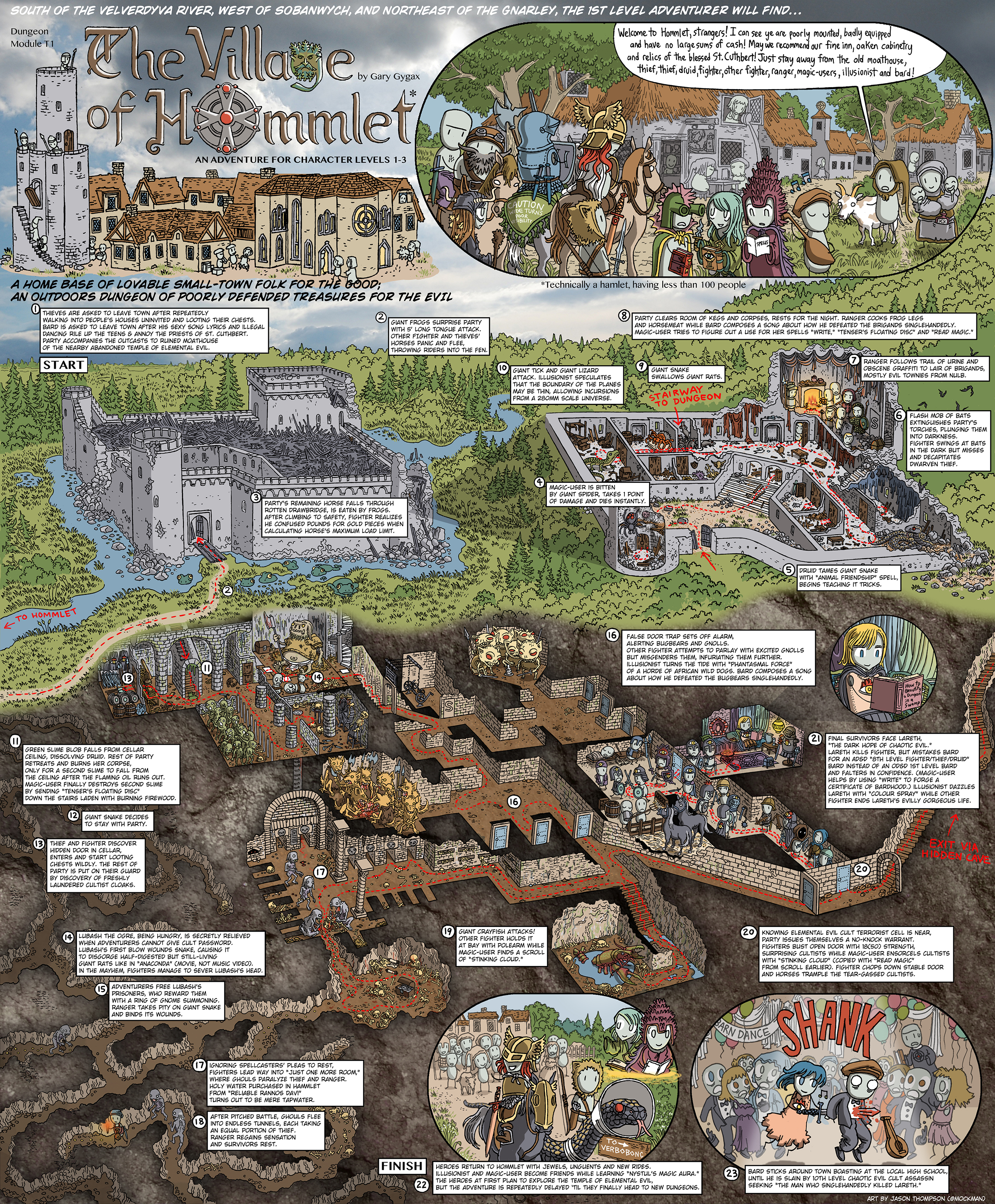
Those unfamiliar with Gygax's original T1 may find this illustrated summary helpful, if not amusing.
Before we go any further, I'd like to point out that this is the closest I've ever come to a 4th ed. Big D product. My first impression: it looks an awful lot like Magic The Roleplaying Game. The statblocks are set up like a Magic the Gathering card what with the named attacks, the odd titles and creature types; "Zombie drake attacks with flying and lifelink!" That pretty much exhausts my knowledge of Magic the Gathering.
But I'm not here to review 4th Ed. Dung & Drag, I'm here to tear off a piece of Latter Day Hommlet and chew it up. So here we go...
General Impression
First, the artwork. The cover photo clearly was selected at random from a pile of fantasy clip art as it bears no resemblance whatsoever to Hommlet; maybe it's Minas Morghul? But later on there's a cool picture of a giant, bloated frog outside the moathouse, which, in my opinion, is the iconic encounter of this module; I fully approve. And there's Tramp's classic birds-eye view of the moathouse from the original, 'nuf said. The bookclub version also has extensive, large scale plans for the moathouse and other locations; these are not included with the Dragon Mag version.
The village description has been reduced to a few notable locations: the Inn, Temple of Pellor (who?), Trader's Establishment, etc., and denizens: mostly the occupants of the notable locations, while the rest of the town has been reduced to single word descriptions such as "Brewer," "Farmhouse," "Herder," etc. This contrasts sharply with Gary's original, wherein even the least significant locations in town got 10-15 lines of text describing, at the minimum, the structure, its occupants, their occupation, religious views, notable combat acumen, as well as the location and quantity of treasure they have inevitably stashed somewhere on their estate. Leaving out these details is going to make the DM's job a lot harder when the PCs decide to "clear
out" the town rather than/after they've tired of the moathouse. Not
showing a lot of foresight there, Wizards.
Over at the moathouse, the update is a fairly straight cover version of the original. The monsters have been updated for the current version of the game which is to be expected. And even though they failed to update the map of the dungeon level to make room for the last pair of zombies, they did at least get them all inside a cell. Sadly, the treasure is assigned in random "parcels" which apparently was a thing in 4th ed. D&D, no? I say sadly because the treasure in the original helps establish a link between the moathouse and the DMG sample dungeon, removing it isolates this version even further from the source material.
Since the greatest degree of variation appears, at first glance, to be in the village rather than the moathouse, that's where I'll focus for the remainder of this here review. Perhaps I'll delve into the moathouse some more in a future post. Anyway...
The Village
Probably the most significant change in town can be found over at the Church of St. Cuthbert, now described thusly:
I know nothing about Pelor--I assume he's the patron of something incredibly insignificant like elbow-patch-less tweed jackets or low-VOC mayonnaise--and the module provides no insight into the values his cult adheres to other than their openness to non-adherers. Contrast this with T1 where Gygax lays the groundwork for the hardheaded and venal doctrine of Cuthbert--if you visit the Church of Cuddy, the clergy won't even acknowledge your existence until you toss a few gold pieces in the ol' collection basket. Hommlet sure seems a lot less interesting with Pallor around. Why did they change it? Did they lose the rights to Ol' Cuddy in the divorce? Did Pellor the Homogenized somehow mastermind a hostile corporate takeover?
Here's a summary of other changes from the original. Many are innocuous, others not so much, and some, dare I say it, might actually represent an improvement on the original.
The whittling away of many (most) of the details in town certainly makes 4th ed Hommlet a less lush setting than the original, removing the nooks and crannies that crazed loons like me--and, if you've made it this far, likely you as well, dear reader--thrive on, sinking the talons of our imaginations into them, kneading and prodding until we've rendered a more fully formed image in our minds. But most people who've gone through T1 never put most of the village into play, so they're not likely to notice the lack of information--other than the demise of the cult of Cuthbert of course.
As an adventure for your gang to go through on the odd Friday night, does it suck compared to good ol' T1? That's not really my area of expertise but I would say that the new version is so close to the original in terms of actual action that any attempt to malign it on these lines would likely risk smearing Lord Gary's original as well. I think for 96.83% of people, this is likely a perfectly adequate rendition of a classic. Where it differs is in the softening of the details, and for me, and others who like to obsess over minutiae, the new version's glossiness is a strike against it.
The Down Low
 |
| Hommlet? Is that you? |
Those unfamiliar with Gygax's original T1 may find this illustrated summary helpful, if not amusing.
Before we go any further, I'd like to point out that this is the closest I've ever come to a 4th ed. Big D product. My first impression: it looks an awful lot like Magic The Roleplaying Game. The statblocks are set up like a Magic the Gathering card what with the named attacks, the odd titles and creature types; "Zombie drake attacks with flying and lifelink!" That pretty much exhausts my knowledge of Magic the Gathering.
But I'm not here to review 4th Ed. Dung & Drag, I'm here to tear off a piece of Latter Day Hommlet and chew it up. So here we go...
General Impression
First, the artwork. The cover photo clearly was selected at random from a pile of fantasy clip art as it bears no resemblance whatsoever to Hommlet; maybe it's Minas Morghul? But later on there's a cool picture of a giant, bloated frog outside the moathouse, which, in my opinion, is the iconic encounter of this module; I fully approve. And there's Tramp's classic birds-eye view of the moathouse from the original, 'nuf said. The bookclub version also has extensive, large scale plans for the moathouse and other locations; these are not included with the Dragon Mag version.
 |
| Moathouse Roll Call: Giant Frog? Present. |
Over at the moathouse, the update is a fairly straight cover version of the original. The monsters have been updated for the current version of the game which is to be expected. And even though they failed to update the map of the dungeon level to make room for the last pair of zombies, they did at least get them all inside a cell. Sadly, the treasure is assigned in random "parcels" which apparently was a thing in 4th ed. D&D, no? I say sadly because the treasure in the original helps establish a link between the moathouse and the DMG sample dungeon, removing it isolates this version even further from the source material.
Since the greatest degree of variation appears, at first glance, to be in the village rather than the moathouse, that's where I'll focus for the remainder of this here review. Perhaps I'll delve into the moathouse some more in a future post. Anyway...
The Village
Probably the most significant change in town can be found over at the Church of St. Cuthbert, now described thusly:
"Ostensibly dedicated to Pelor, this temple welcomes worshipers of any good or lawful good deity."That's right, Y'dey and Terjon no longer dispense the obtuse wisdom of St. Cuthbert. Rather, they labor at the temple of a deity who is made of toast so milquey that the clergy's primary job is apologizing to parishioners for running out of gluten free communion wafers. And since the villagers no longer get their 15 lines of infamy--and thus their religious affiliations are undeclared--none of them is required to attend his tepid temple. Hoser.
I know nothing about Pelor--I assume he's the patron of something incredibly insignificant like elbow-patch-less tweed jackets or low-VOC mayonnaise--and the module provides no insight into the values his cult adheres to other than their openness to non-adherers. Contrast this with T1 where Gygax lays the groundwork for the hardheaded and venal doctrine of Cuthbert--if you visit the Church of Cuddy, the clergy won't even acknowledge your existence until you toss a few gold pieces in the ol' collection basket. Hommlet sure seems a lot less interesting with Pallor around. Why did they change it? Did they lose the rights to Ol' Cuddy in the divorce? Did Pellor the Homogenized somehow mastermind a hostile corporate takeover?
Here's a summary of other changes from the original. Many are innocuous, others not so much, and some, dare I say it, might actually represent an improvement on the original.
- Gary's pedantic and pointless distinction between villages and hamlets has been removed from the background. I admit, I've always found this trivial tidbit to be inordinately annoying but now that it's gone I miss it.
- Spugnoir, 2nd level MU and resident of the Inn, has changed his name to Spugnois--which is too bad because that doesn't rhyme with Guy Noir.
- Furnok of Furd is now a dwarf.
- Kobort the Moron and Turuko the Malcontent, roommates at the original Welcome Wench, have made their way to the cutting room floor in the updated version.
- So has almost every other villager including the likes of Black Jay and the family of infidels with the bossy but attractive daughter that lived by the mill.
- The village elder is now a woman named Hesta.
- Calmert reprises his role as officiant at the temple but rather than secretly diverting church funds to the construction of Rufus & Burne's tower, now his point of interest is that he's hot for a barmaid over at the 'Wench.
- The PCs get bonus XPs if they pass a note to the barmaid during study hall on Calmert's behalf. This juvenile set up is in keeping with the church's change in denomination from St. Cuthbert of the Cudgel to Pelor the vacuous glow worm.
- There are maybe one or two other innocuous side quests such as this planted in town; it's all very reminiscent of 90s computer games.
- Rufus and Byrne's castle is being funded by unnamed "royalty" rather the than the Viscount of V'bonc and the Arch C. of Veluna as in the original. Not very significant except perhaps in establishing that this Hommlet is only precariously linked to the World of Greyhawk.
- There's a shrine to Avandra on the edge of town. Mysteriously, there is no priest or following for this deity in Hommlet. The Ostler at the 'Wench has his staff maintain the shrine, which I suspect is done more out of civic pride than devotion to Avandra, otherwise he'd tend to it himself, no? The shrine adds a bit of mystery, which I appreciate.
- Dannos Ravl still has the TZGY scarab, but its significance is distinctly left to the DM--it is no longer necessarily a pass to the T of EE. Nor do 1 in 5 sages understand its significance.
- Rannos Davl and Gremag are much more amiable characters than they were under EGG's regime, which is
smart. In T1, Gary portrayed them as such unlikable dickheads that no
one would ever bother to deal with them, which is not very good for business if
you're a merchant trying to make a living and possibly even less good if
you're a spy who's trying to gain the trust of the locals.
- Aside: Rannos Davl is obviously another near-anagram for Dave L. Arneson--as you may recall, one of the giant chieftains in G1 was named "Nosnra." But the best I can make of Gremag is Mare Gg which could maybe possibly be an abbreviated pseudo-anagram for Mary Gygax, EGG's first wife. Or maybe it's "Gamer G," a reference to Gary himself? Or maybe it's just Gremag, a cool sounding name.
The whittling away of many (most) of the details in town certainly makes 4th ed Hommlet a less lush setting than the original, removing the nooks and crannies that crazed loons like me--and, if you've made it this far, likely you as well, dear reader--thrive on, sinking the talons of our imaginations into them, kneading and prodding until we've rendered a more fully formed image in our minds. But most people who've gone through T1 never put most of the village into play, so they're not likely to notice the lack of information--other than the demise of the cult of Cuthbert of course.
As an adventure for your gang to go through on the odd Friday night, does it suck compared to good ol' T1? That's not really my area of expertise but I would say that the new version is so close to the original in terms of actual action that any attempt to malign it on these lines would likely risk smearing Lord Gary's original as well. I think for 96.83% of people, this is likely a perfectly adequate rendition of a classic. Where it differs is in the softening of the details, and for me, and others who like to obsess over minutiae, the new version's glossiness is a strike against it.
Thursday, September 29, 2016
Linguistics in the Flannaes: Oeridians are still from outer space
 Over on Canonfire I found this cool article An Alternative Linguistic History of the Flanaess written by someone identified only as Ullmaster [EDIT 12/21/16: Actually, Ullmaster is just the dude who uploaded the post, Joe Chevalier is the actual author of the piece.]. If you're a Greyhawk weirdo like me then you'll find that it's definitely worth your time. Here's a highlight:
"I subscribe to the theory that they arrived on Oerth from another world, and brought their language with them." Ullmaster, An Alternative Linguistic History of the FlanaessAnyone who remembers my bit on the Oeridians being extraterrestrials based on linguistic and spaceship crash-site evidence will think I've found my soulmate here, except that the "they" that the author is referring to in this case is the Olman people who occupy the jungles to the south of the Flannaes, not the Oeridians. Ullmaster, offers no justification for why the Olman (Olmen?) might be from a galaxy far, far away, and yet by his very name he should know damn well that the Oeridians landed their starfleet in or near Ull some 1200 years ago. As the Oeridians are very secretive about their origins, it's only natural that Ullmaster--indubitably an Oeridian himself--is trying to deflect attention from UFO seekers to a point as far from Ull as possible.
To further demonstrate the lengths to which the Ullmaster is willing to go to mask Oeridia's true origin, s/he has this to say:
"Oerid: This people came from a land to the northwest of the Suel, in a coastal land ruled by dragons."Only by tacking the words "and unicorns" to the end of that sentence could it be made into a more blatant fabrication. We're on to you and your alien-people, Master of Ull.
All kidding aside, it is a pretty fascinating read wherein the author compares Greyhawkian languages to earthly ones. I highly recommend it.
Thursday, September 1, 2016
Nortonian Greyhawk Part III: The Quag Keep Companion
 No way did I think it would take an entire month to get around to this, but here it is September 1 and I still haven't put that friggin' map together. So I'm moving on without it. That's right, we're skipping the map and going straight to Part III of the Nortonian Greyhawk series: The Quag Keep Companion, my heavily researched reference guide to the Land of Greyhawk as depicted in Andre Norton's groundbreaking novel Quag Keep.
 I intended to keep this thing a straight-up reference work, using only info gleaned from the book. But, alas, too many items were only mentioned by name with no further details given or inferences made, so I started applying a little of the ol' blogger's license. It made the thing a lot more fun to write though it'll be a bit more irritating for you to read.
Remind me to scan that friggin' map and I'll put it up soon.
Yours,
Yngrge
Quag Keep Companion: A Guide to Nortonian Greyhawk
A note
on abbreviations: I use two abbreviations prominently throughout this
guide
- CoG referring to the City of Greyhawk, and
- LoG referring to the Land of Greyhawk, which encompasses the entire continent on which CoG resides.
And a note or five on page citation symbology:
- Page numbers are given in parentheses following statements which are lifted directly from the text or can be reasonably inferred from it.
- Page numbers coincide with the first Tor trade paperback edition: May 2006.
- Where a number sign (#) is given, the preceding statement is derived from the book, but the cataloger is just too damned lazy too look up the page number for you at the moment.
- Statements which are not followed immediately by a page citation are fabrications of the cataloger and should not be trusted.
- Statements followed by the word (Map) are inferences made based on the Olde Thyme Map of Greyhawk (Figure 1), not the Darlene maps published by TSR in 1980.
- Other symbols are just there to sow chaos.
eg. the first entry below indicates that the word Blackmoor appears on pages 28 and 47 of my trade paperback edition of Quag Keep, the bit about it's location is based on the map, and the rest is just made up stuff.
Blackmoor (28,47) A
barren land on the western shores of the Great Bay. (Map) Home to many
peculiar locales including the Pinnacle of the Toad and other
oddities.
Brethern A band of mercenary-adventurers responsible for armed incursion into some of the most notorious regions of LoG in search of legendary treasure hoards.
Castle of Kyark
Citadel of the great wizard Kyark, built in the outskirts of the City
of Greyhawk (CoG), the
place is believed to induce madness in those who visit. (71) First built centuries ago, it is believed to be so
enchanted that it has continued to build and reconfigure itself ever
since, an ever-growing labyrinth of constantly changing chambers and
corridors populated by an ongoing influx of monsters, tricks and
traps; all of which keep adventurers returning time and again.
Dom A
discipline of eldritch magic named after Dom, a mage of antiquity who
developed much of the body of knowledge upon which the school is
founded. It concerns itself primarily with the summoning and abjuring
of demons and other beings of Chaos.
Druids
Members of a “close knit, secretive fraternity” (p.23), often
aligned with the dark forces of chaos, who have some ability to use
magic. (#)
Dry Steppes
Vast, arid plains on the western extreme of the Land of Greyhawk
(LoG). What few watering places there are within the Steppes are
considered the hereditary property of the Nomads of Lar. (#) See also
Kalastro.
Elves
A race of humans who have mastery over communication with all animals
and birds (p. 21, 28). They are also possessed of Power Lore, a body
of insight into the machinations of the world about which most humans
are not capable of giving a damn. (51)
Faltforth the Sun Crown Deity of LoG mythology represented by the sun.(#)
Faltforth the Sun Crown Deity of LoG mythology represented by the sun.(#)
 |
| Figure 1: Is this the map Gygax showed Norton? |
Fane of Wings
Ancient temple of unknown provenance. Noted for its unique
architecture, it predates all current civilizations in LoG. (88)
Faraaz
A land to the west of Greyhawk between Geofp and Verocunby. (Map) It is
comprised of loosely affiliated city states, each run by a “Holy
Lord.” Also known as “Holy Lords of Faraz” or “Land of the
Holy Lords.” They use copper coins in the shape of a cross, and
half moon silver coinage.(52)
Fon du Ling
One of the “Holy Lords” of Faraaz. An adventurer and collector of
rare and fabulous animal species. He is rumored to have found and
explored the secret Temple of Tung. (65)
Foreteeth of Gar
An epithet (#) referring to the prominent mandibles of a minor deity with
no small following in Narm. Also refers to two prominent peaks which
stand guard at the headwaters of the unnamed river that separates the
lands of Geofp and Narm.
Ganclang
Lesser deity of LoG, noted for his (or her) brazen voice. (192)
Gar A
deity heeded primarily by mountain tribes in Narm and Geofp. He
is seen as a protector of the mountain people and is noted for having
large tusks and for belching lightning from his mouth.
Gar-Eagle
A very large bird that resides in mountain regions, roc.(#)
Geofp Region
of Greyhawk in the foothills of the Western Mountains which separate
the Sea of Dust form the fertile eastern lands. The Grand Duke rules
the land as a stronghold of Chaos. And yes, there is a “p” on the
end. Obviously it's a typo, but they were diligent in repeating it
throughout the book, so it's now canon. (#)
Great Kingdom A
realm to the north of Urnst
along the southern shores of the Great Bay.
(Map) It comprises five legendary cities which pre-date current history. (88)
The lands of Blackmoor, Parth, and
the Wild Coast have
at times been considered a part of this realm, though citizens of
those lands rarely acknowledge the sovereign. (𝞯)
Greyhawk,
City of (CoG) A free city with no master where the
struggle between Law and Chaos often plays out its drama.(#)
Griff Cat
griffin (😼)
Han-gra-dan
A wizard of legend, the “mightiest of Northern Adepts” lived a millennium ago or more. His scholarship in arcane knowledge is
unsurpassed and artifacts of his creation are still highly sought
after by wizards and sages alike.(#)
Harrowing of Ironnose Bardic saga regaling the epic battle between Lichis the Golden and Ironnose. (#)
Harvel's
Axe, Sign of An inn of dubious reputation on the edge of the
Thieves Quarter in CoG frequented by wereboars and druids. (#)
Hither Hills Hilly
region to the north of Narm. (map) The tribesmen of these hills are known
to be adepts of some renown though it is often said that they are
descended from the intermixing of men and demons of chaos. (67)
Kalastro, Empire of
Land of legend located in the area that is now the Dry Steppe. (#) Kalastro was a vast and powerful empire that fell to decadence and
depravity before turning to Chaos entirely. In what has
become known as the Plague of Fire, Lichis the Golden lead a flight
of dragons over the land and scorched it to the barren waste that it
remains to this day. (🙊)
Keoland
The largely depopulated lands to the south and east of CoG. (71) Made up of dry plains in the south and
west. (#) Most of the remaining population of Keoland lives in a hilly region
to the east of Greyhawk which is sometimes referred to as Keo Major when differentiating it
from the dry plains to the southeast, aka Keo the Less. See Rieving of said land for more info.
Kyark
Legendary wizard who built a stronghold on the outskirts of CoG. It
is widely believed that any who enter his stronghold will succumb
to insanity or worse. (71) Nonetheless, adventurers flock to the stronghold in search
of treasure and glory.
Landron of the Inner
Light A deity who serves the
forces of Law. His disciples are known to carry nought but a knife to
defend themselves. (#)
Lar
Region of land on the fringes of the Dry Steppes inhabited by warlike
nomadic tribes who engage in raids on their neighbors for resources.
Noted for their steeds, see Steppe Mounts. (#)
Liche
A form of undead, much like a zombie but possessed of greater
quickness and intellect. If severed into pieces, its parts will
continue to fight on independently of each other.(#)
Lichis
Legendary golden dragon who supported the side of Law through
thousands of years of struggle with the forces of Chaos. Was the
adversary of Ironnose in the legendary battle that became the subject
of the “Harrowing of Ironnose.” Has retired form the world and no
longer interacts with humankind. Resides in the Southern
Moutains which divide the
fertile east from the arid west. (#)
Loice, Mirror of This artifact of the great queen Loice is a flat stone of a shimmery, reflective rock that is said to have mystical properties. As with the Standard of King Everon, it is said to be lost in Troilan Swamp, though a group of mercenary adventurers known as the Brethern claimed to have acquired it in recent years.
Loice, Spectre of The ghostly embodiment of Loice, legendary queen of Troilan who reigned over the land before it sunk into a swamp, is said to rise from the mire and command its denizens in defence of her soggy domain should it be threatened by outsiders. (#)
Lyra Gems (65) Low quality gemstones
that are often crafted into cheap jewelry and hawked in shoddy
merchant stalls throughout the LoG.
Maritiz
An island nation noted for its coinage made of mother of pearl and
incised with the “fierce head of a sea serpent.”(52)
Narm
(61) Region to the north of Geofp in the area labelled "Neron March" on the map.
Never-fail Shield Shields of legend purported to have magical powers. (65) Vendors of dubious reputation are known to offer
counterfeits for sale to gullible adventurers. They originally were used by certain elite regiments of the lost Empire of Kalastro. They were round shields of light weight yet impregnable steel with a silver star in the center and could, in the hands
of a skilled soldier, be thrown as a weapon and would return to the
hand of the wielder.Very few of these are known to still exist. (♘)
Northern Bands
Matriarchal society that inhabits the land of the far north. Its
women are fierce warriors referred to alternately as amazons and Valkyrie. They are ruled by the High Horned Lady and fight under the
banner of the Unicorn. During a time of famine some years ago a
regiment of amazon warriors of the Northern Bands went south to offer
their services as Mercenaries in order to provide for their starving
families. In the employ of the Regor, Lord of Var, they were on hand for the Rieving of Keo the Less. Great numbers of these proud warriors were
not merely killed but tortured, defiled, and dismembered in unimaginable fashion.(#)
Om The
pattern which maps all human activity, no matter how insignificant
such activity may seem. The pattern is invisible to men and their "earth-tied" senses. (217)
Oszarmen
Desert nomads of indeterminate provenance. (209)
Outer
Dark source of mystical powers available to adepts aligned with
Chaos (23)
Parth
Seafaring nation (178) located on a peninsula at the mouth of the Great
Bay.
Paynim
Nation in the northwest of WoG. (map) Wine from this region is widely
regarded as among the best in LoG.
Plague of Fire A cataclysmic event that breathed forth from the from the Southern Mountains destroying the Kalastro Empire (192) in what is now the Dry Steppes (Map). Lichis the Golden lead a host of Dragons over
the decadent Empire, burning and laying waste to its
cities, which had turned to Chaos. (🎱)
Prim Lizard A
lizard that appears to be made of stone.
Regor of Var🎰oubles a generation ago. Their names were added to the death toll during the Rieving of Keo the Less. (74) It is not known whether it was he who was responsible for calling down the Rieving or if the opposition took that tragic step or another party entirely, but it is certain that everyone involved met a grievously horrible end.🎯
Rieving of Keo the Less Described as “a treachery so black that it blotted
the dark pages of Chaos's own accounting—death so hideous a man
might retch out his guts if he thought too long upon it.” (#) This horrifying event took place during the wars that wracked the lands of Keo a
generation ago. During the siege of Var, someone called upon a force so dark that the entire city was razed, everyone in the vicinity--including all inhabitants as well as the besieging army--was slaughtered, their tortured, twisted corpses were found in a fetid stinking heap. Sounds
bad, right? It effectively ended the uprising and left Keo as a derelict state. 🎳
Rockna the Brass
Dragon residing in the Sea of Dust. Possibly aligned with Chaos.
(207)
Salzak the Spirit Murderer A menacing demon who committed 96 sins, at least one of which was murdering souls. (35)
Sea of Dust A
fatal trackless wilderness of fine dust so shifty it is impossible to
walk on it without special equipment (49). Dunes of shifting dust
sweep across this land much as waves of the ocean. An ancient
civilization once plied these dunes on sailing vessels, the remains
of which—along with their valuable cargoes are said to litter the
“Sea.”(#)
Seven Swamps Homeland of the Lizardfolk and their reptilian steeds(#), this large Wetland complex lies between Faraaz and Geofp. See also Troilan Swamps.⚄
Sign of the Pea Stalk
An inn and provisioner located in the City of
Greyhawk. Noted for providing good value on merchandise to the
adventuring class. (#)
Song of Far Wings
Enchanted shanty which, when sung by a skillful bard, summons
gar-eagles and/or other winged critters to the aid of the songster. (139, 143)
Song of Herckon
Soul shredding tune played by expert bards which will temporarily reduce certain
spirit forces to pools of quiescent liquid. (137-8)
Southern
Mountains Mountain range which holds the Sea of Dust at bay from the LoG to the east. Inhabited by Lichis the Golden and other dragons.(#)
Standard of King Everon
Banner of the afore-named monarch, last king of Troilan. Under this banner, Everon led his people against an invasion but was overwhelmed and met his end on the field of battle. At
his death, the land of Troilan sank into a mire into which his banner
was lost. Just as the meadows of Troilan sank into a dismal swamp, its
people morphed into a lizardlike breed which holds drylanders with
contempt. This item was captured by a group known as the "Brethern"
[sic].
Stranger's Tower A prison tower in the CoG primarily occupied by drunks and brawlers.(66)
Stranger's Tower A prison tower in the CoG primarily occupied by drunks and brawlers.(66)
Steppe Mounts These
light horses are bred by the Nomadic tribes of Lar on the fringes of
the Dry Steppes. They are known for their endurance. They are trained
to answer only to the call of one master. Strangers caught riding on
a Steppe Mount by Laric nomads are likely to face serious sanctions.
It is said that an elf or were-being can influence such steeds to
allow someone other than their trained master to ride them. (59-62)
Sword of Seven Spells
Enchanted sword (65) that reputedly allows the bearer to cast one of seven
spells. Such a sword may once have existed but those on sale in the
markets of Greyhawk are unexceptional frauds in every way.௹
Temple of the Frog
Sacred temple believed to be at the heart of Troilan Swamps from
whence malignant creatures are spawned. Few who have seen it have
survived to tell of it. No one is known to have entered it and
returned to pass on their tale. (221)
Temple of Tung
Legendary temple believed to be filled with treasures of great value. (65) It is thought to be located in the Hither Hills. Many adventurers
claim to have found it and made off with booty from its crypts. It is
believed that doing so bears a horrendous curse.🌝
Thera “The
Maned Lady” Lesser deity of the LoG, aligned against Chaos. The
tribes of Lar are known to pay heed to her. (61)
Toad, Pinnacle of the
Located in the northern reaches of LoG (107), perhaps in Blackmoor, the Pinnacle is an enormous, grotesque obelisk dedicated to the Toad God. It is said
to mark the “navel the world” and the gateway to the realm of the
greater beings. It is central to the worship of a malignant cult of
festering chaos called the Fellowship of the Toad.
Toad, Fellowship of the
A cult dedicated to the worship of the foul toad god. (107) Though their
agents are hidden throughout lawful society, their territory is
located in a fen on the northern fringe of Blackmoor. (𝞫)
Troilan Swamps
A forested wetland that is home to
several tribes of lizardfolk. (85) It lies between Geofp and Faraaz and is also known as the Seven Swamps.(Map)
Two Harpies A
tavern in CoG noted for its inexpensive and potent fortified wine. It is a favorite watering
hole of caravan guards (66), possibly due to its proximity to the municipal stables. The place is notorious for brawling. As such,
the furniture is quite stout and fixed to the floor to prevent its
use as weaponry. The cups, on the other hand, are cheap wooden affairs
that break quite easily, providing a satisfying spray of splintered
wood and cheap wine while causing relatively little damage. Patrons of this establishment often find overnight accommodations at the Strangers Tower.
Ulik
(#) A mage of great power who spawned a discipline of magic that bears
his name.
Urnst
Province to the north of the free city of Greyhawk. Currently ruled
by a Grand Duke. (47)
Var
(#) A devastated city located on the arid plains of Lesser Keoland. It was razed during the Rieving of Keo the Less and remains a cursed and ruined place to this day.
Vold A
river originating in the foothills of the Southern Mountains which
flows northward from the plains of Keoland, eventually becoming a
mighty river as tributaries feed into it. (77)
Wild Coast Coastal region over which Ironnose was at least partially harrowed by Lichis the Golden. (#)
Wine of Pardos Legendary tipple with healing properties. (192)
Yerocunby
Land to the west of CoG. Other possible spellings include Yerocundy,
Yerocanby, and Verocunby. (#)
Subscribe to:
Posts (Atom)