Saturday, May 18, 2024

Shadowdark: Thieves are called Thieves!

Cover art


[Pretending it's not already mid-May before I finally acknowledge my damn blog for the first time this calendar year] 

I'm about to start running a gang of nerds through the old Giga-dungeon I was working on back, oh, 12-ish years ago--I swear I wrote about it here on the ol' blog but I can't find any evidence to support this notion. 

Anyway, I was casting about for a good rule set, and I've settled on Shadowdark as the rules of choice. I'd toyed with many others--AD&D, HackMaster, Castles & Crusades, DCC, ICRPG, Mork Borg--but never felt like either a) it was a system I felt comfortable running or b) it was a system that my posse of gamers would be willing to play. Enter Shadowdark; the recent kickstarter phenom that raised a quarter of a trillion dollars in just under six minutes. It's a nice blend of old school stuff plus some of the modern bullcrap that kids these days seem to like; a game of the Nouveau Old School if you will. I like it for the lightness of its touch and emphasis on resource management; my players tolerate it because it looks like D&D. But most importantly, thieves are called thieves in this game!

I had reservations about Shadowdark, but they're mostly semantic. In particular, the name Shadowdark is reminiscent of "Underdark," a term used in latter-day Big-D that I've always found a bit cringey. But balancing that small misstep: in this game thieves are called thieves! 

Furthermore, the first thing you'll see in the extreme upper left corner of the inside the front cover is the weapons list. And the first weapon listed is the Bastard Sword! Thank you Shadowdark for bringing the bastard back to Big D. In an odd backward step, there is no battle axe, just a great axe. As there are no lesser axes listed, what is this greataxe supposed to be greater than? But still, thieves are called thieves!

Anyway, I made a half-assed effort at identifying the sources of many of the rules that are included in Shadowdark and wrote them down. Below is a list of games which I've identified as the source (probably mistakenly) of various rules for Shadowdark. Please accept this in lieu of an actual blog post.

Olden D&D (also Basic D&D)

  1. Tripartite alignment: Lawful-Neutral-Chaotic
  2. tripartite armor selection: Leather, Chain, Plate
  3. The 4 classic classes
  4. level titles (Footpad, Burglar, Acolyte, etc.) 
  5. thieves have d4 HD (BOOOOOOOO!)

 AD&D

  1. Bastard Swords!
  2. Race (aka ancestry) is NOT class (YAAAAAAAAY!)
  3. 1 minute melee rounds--KIDDING! Nobody ever thought that was a good idea

DCC

  1. level titles vary with alignment--I'm not going to be doing alignment so whatevs [still too old]
  2. roll spell checks to see if your magic succeeds
  3. 0-level character funnel (called The Gauntlet) 
  4. five spell levels (called "tiers")

5e

  1. contemporary ability score modifiers
  2. roll with Advantage© 
  3. Death saves when ya' reach 0 HP
  4. roll a 20-sider for initiative; that might actually be from versions 2-4e

ICRPG

  1. Constant initiative; not just for combat anymore
  2. Close, Near, Far movement/range classifications
  3. Easy, Normal, Hard, and Extreme difficulty for your challenge s
  4. Ya' need to roll a 20 for a successful death save

All Reasonable Versions of D&D

  1. THIEVES ARE CALLED THIEVES!

Sunday, December 31, 2023

Happy New Year from the Dice Mines!


"Do you think they have Holmes-made pumpkin pie?"
A lot of you wrote in to inquire about yesterday's post [Does anyone believe me when I imply that I've received feedback or do you all see through these claims for the sham that they are?] I mentioned the baleful god of Blogger OCD without quite explaining the significance of it. You see, for the first several years that I maintained this blog, my end of year post count was always a number divisible by 6. I'm not sure when I became conscious of this, but I do know that I spent the last week of 2015 scheming to achieve 24 posts for the year. 

Then came December 2016. I started the month with an admittedly meager count of 18 posts on the year; all I had to do was sit tight until January and I was good for the year. But with one week to go, I decided to fly in the face of superstition; I posted an unlucky 19th post on Christmas day featuring Erol Otus's famed photo of the KEEP on the Borderlands, as seen above. Maybe I was trying to spur myself on to crank out 5 more posts in the week between Christmas and New Years--if so, it failed as inspiration. Or maybe I wrote that post months earlier, set it to auto-post for Christmas Day and forgot all about it. That was seven years ago, who can remember that crap?

The fallout has been tragic. Even though 2016 was my least active blogging year at the time, I have never achieved even that low standard in the years since. And only once have I managed to achieve another multiple of 6. True nerds will note that just last year I posted 13 times, missing the mark by just one post once again, but on that occasion, that 13th post came out in July; I had more than 5 months to come up with a few more posts, I just... didn't.

And so it is that, in hopes of fending off forces beyond my understanding, I am here typing this pointless, uninformative missive on New Years Eve. May the new year bring you all peace and prosperity, so long as it's divisible by 6.

Saturday, December 30, 2023

Flame Princess review; or How to fend off the Baleful God of Blogger OCD

I started writing this post in 1973, but decided that the subject matter was a bit out of date already, so I never posted it. Now, with less than 32 hours left in the year 2023 and finding myself only two posts away from hitting a multiple of six posts for the annum, I need to squeeze out some content in a hurry. So here, read this if you want. Or don't, what do I care? I'm only posting it as filler.

On the advice of the dudes over at 3TRPG, I finally got around to buying Lamentations of the Inflamed Princess--holy hell that's a long-winded title. Even the abbreviation "LotFP" is too many syllables. If you're like me you can't even type LotFP without saying "Ell-o-tea-eff-pee" in your head. I could go with "LFP" but where's the sophomoric humor in that? Well, how about "LotFaP"? By adding one vowel I've shortened the name to a two syllable, completely innocuous, incorruptible word. Well done. Let's get to it.

Lotfap (snicker) is undeniably a good looking book. And a good size for a book. I was excited to see it on the shelf of my local gaming store, so I snatched it and ran home to start reading it. Don't worry, I paid for it first. 

Between the art, the reputation for dark subject matter, and the loquacious title of the game, I had expectations of a game that pushes boundaries. But once you start reading the book, you quickly notice that this is just an improved form of Basic D&D. Don't get me wrong, it's a pretty good distillation of D&D and an upgrade on Mentzer et. al., but, aside from the art, it's no more provocative than Labyrinth Lord.

Which isn't to say that LotFap has nothing to contribute; it certainly does. Following are the 11 coolest things Raggi's version of Basic D&D has brought to the world:

  1. Specialist: Raggi succeeds where D&D so desperately failed. While renaming thieves as "rogues" may have decreased the likelihood of idiotic players trying to pick the pockets of their adventuring colleagues mid-adventure, it is a catastrophically terrible name for a character class, and still implies that members of the class are inclined to not be team players. The specialist is vague enough that you have no problem running this dude as a straight and narrow type who would never mix with the Artful Dodger. Also, they get a wider variety of abilities to choose from--such as "bushcraft"--so they can be kind of like rangers too.
  2. Only fighters get better at fighting. That's right, every other class has reached their peak combat acumen on the first day they fill out their character sheet.
  3. No standardized monsters: no orcs or bullywugs or Type IV demons or even dragons unless you make them up for yourself. Every adventure gets its own custom set of critters to deal with. This does raise the question: if there are no orcs to slaughter, why are dwarves, elves, and halflings available as player races? Did Raggi give in to pressure from the demi-human lobby?
  4. Cool Art. No Peter Bradley.
  5. Much vaunted Encumbrance rules: carry 5 things and you're fine. Pick up more things and you're gonna slow down. Still not sure people will track this in play but it could be done pretty easily.
  6. Much vaunted naval combat and property ownership guidelines. Yes, they're a thing. Are they great? I'll try them out. 
  7. -11. Ha. I just made that up, there are only 6 things.


Wednesday, November 22, 2023

If there are zombies in these rooms you all owe me a beer

Back in the 80s, TV personality Geraldo Rivera opened the supposedly as-yet unopened vault of Al Capone on live tv. Hoping to find the skeletal remains of Jimmy Hoffa, the Ark of the Covenant, or, at the least, verifiable proof of String Theory, instead the vault was empty and Geraldo was sealed inside, never to be heard from again.

Well, I'm doing the same thing here today, but in Blog form. You see, I just noticed this section of map from level 1 of the TofEE:


And its similarity to this section of map from the DMG sample dungeon--minus the back doors off of rooms a, b, and c:


Some of you might recall that I once surmised that the DMG sample dungeon and the moathouse in T1 are different versions of the same dungeon. And that those six chambers were once the homes of the same zombies skulking in prison cells under the moathouse in T1:

You can read all that tripe here if you want--I can't bring myself to re-read it so I will forgive you if you skip it.

Anyway, I recently (it was 2 years ago now; I've been busy) bought the Goodman games massive 2-volume hagiography of everyone's favorite place of worship dedicated to alliterative evil. Which is to say that for the first time I have a hard copy version of T1-4 to study. 

You should also know that even though my obsession with Vill. of Homm. is well documented, I have never paid much--read: any--attention to the post-T1 portion of T1-4. Which is why I just noticed the similarly arranged cells now, the day before Thanksgiving 2023. But this gives me the opportunity to either confirm or deny my long standing theory here, live and in person, on the ol' blog. That's right, for the first time ever, I'm going to turn to the dungeon key to find out what the heck is in those cells. Cuz if it's zombies then all of you bastards owe me a beer.

Here we go, turning to the key for level 1... room 150/a-e and--I suspect that some of you already know what's in store, don't spoil it for the rest of us--let's see... 

"150. cells." Good start but not just any cells, these are "gaol cells"--nice bit of pretentiousness there. Each door has a small barred window, straw on the floor... chains on the wall.. fine. What's this bit: "the inside is found to be covered with a sheet of rusty iron." Huh, I wonder what that's about. Chekhov's sheet of rusty iron?

Eastern rooms--aka rooms a, b, and c--are neither locked nor barred..."but as long as they remain shut, their 'ragged human' occupants (three zombies in each) stay huddled in their straw"  

F*ck yes!

Monday, November 13, 2023

Dark Greyhawk: Why didn't I think of this?

Somebody came up with an incredibly cool idea that I really wish I'd thought to do: they've made a map of Greyhawk that illustrates the consequences if the PCs had failed at all the classic modules. Awesome, right? 

Side note: when showcasing someone else's work, I like to direct readers to the artist's site whenever I can, but for whatever reason, the direct link doesn't always connect from Bloogle. You can try it, click below:

https://inkarnate.com/m/dwJQEe-dark-greyhawk/ 

If that doesn't work, copy the text into your browser:

https://inkarnate.com/m/dwJQEe-dark-greyhawk/

If all else fails (or you're just lazy) click on the image here.

The source of the Land of the Elder Elemental God where Veluna once stood is fairly obvious. Explicticus's Defile is awesome (N1). The Witch Queen has got to be Iggwilv of S4 fame. And we've got the giants and drow kingdoms from the G and D series in the Hellfurnaces and Sheldomar valley. That said, I'm not actually familiar with a lot of the other references: because it's in the Pomarj, I'm assuming the Earth Dragon has something to do with the Slaver series though I don't recall any reference to such in the original modules. The Kingdom of the Efreet brings to mind the cover art from the original DMG, but I'm guessing there's a module out there that explains this more fully. And I'm not sure why the Lendore Isles are now the Lost Isles and not something more assassin-y or Bugbear-y. And why are the Sea Barons now the Hold of the Sea Pirates? Anyway, neat idea. 


Thursday, November 9, 2023

How to Read the AD&D Rules Part XV: A Surprising rule about Encounter Distance

Remember this old gimmick where, in a fit of hubris, I tried to clarify and paraphrase the AD&D rules into a more concise text? Remember how badly I failed? 

It was pretty laughable, yes, but it also helped me understand rules that I never knew that I didn't know. Unknown unknowns, if you will. Most egregiously, I completely misunderstood the whole surprise segments thing. You can read the whole dreaded affair if you like. Or not, my feelings won't be hurt. (sniff)

In classic D-Chux fashion, I'm dragging this old pony out of the glue factory to abuse it some more, because I started reading the DMG again and, a few pages on from the surprise rules, I encountered the rules on Encounter Distance. Read on if you dare, my fellow dice chuckers...[pardon the horror show antics, this post was supposed to go up before Halloween but I overslept]

Distance

As in, how far apart two parties are when they come into contact. You might think this would be obvious based on the terrain, lighting, where the DM planned for the monsters to pop up in the dungeon, etc, but the DMG leads off the discussion with this sentence:

"When encounters occur, the distance between concerned parties will be 5"-10" (d6+4) subject to the following modifying factors..."

The author then lists off the following six factors: 

  1. Line of sight, 
  2. Noise, 
  3. Actual Area, 
  4. Planned or unplanned appearance, 
  5. Surprise, and 
  6. Light. 

Which is to say, use your head and figure out where first contact is most reasonably going to occur.  And because even a novice dungeon-master will be able to determine where contact will occur without even thinking to consult with the rules, this entire section has never been read by anyone.

And since no one ever read this section, no one uncovered this tidbit:

"Surprise can only be a factor in close encounter situations. If either or both parties are surprised, the distance must be either 1" to 3" or it must be less as determined by the actual area modifier." DMG, some page.

Or, as a loquaciousness-deprived person might put it: 

Parties must be within 30' of each other in order for surprise to occur.
Seems like a pretty important piece of information, right? But, even though Gygax just finished writing 12 paragraphs of befuddling text about surprise, he decided to obfuscate even further this crucial piece of information by placing it in a separate, and entirely superfluous, section of the book. 


Monday, September 25, 2023

Grading Classic Module Towns

Today's assignment is to run through the town-ish settings from nine classic--or at least old--D&D modules. Scoring is based on four categories:
Details: how well the setting is described; 
Intrigue: are there reasons to interact with the setting beyond spending a night at the inn and replenishing supplies, 
NPCs: are there interesting characters in town? And 
Map: did the cartographer make an effort? Includes maps of structures if any are provided.

As always, this is a non-comprehensive list. If you know of a town that I've missed--I know there was one in Ravenloft--let me know and maybe I'll get to it in a future post.

Hommlet (T1 V. of H.)  Grade: A

If you've ever read this blog before you probably expected Hommlet to score pretty high on this list. Likewise, if you've ever played/run T1, you probably expected this as well. Weighing in at only 8-ish pages, each building in town gets a couple of paragraphs describing the residents and where they've hidden their life savings. There's also the agents of Elemental Evil lurking about, the unspoken tensions between the cult of Cuthbert and the old time Druids, Rufus and Burne's castle and the accompanying displacement of traditional authority in the village; it goes on. Slight points lost because a DM really needs to devise their own means of injecting this intrigue into the adventure. And while the map is good by early TSR standards, that is not a very high standard.

Details: A+
Intrigue: A-
NPCs: A
Map: B+

Garrotenstadt, AKA Shankton, Murdergard, Assassinville, etc. (L2 Assassins Knot)   A-
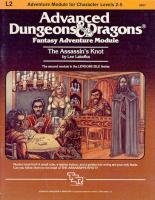
I'm still not done making fun of the name of this burg but, despite the name, Garrotenford is provided with a wealth of detail and in depth descriptions of all the "worthy" townsfolk (those with levels in some class) plus a table summarizing the entire populace. The entire adventure will likely take place within city limits--unless you go off on that silly octopus hunt--so high marks for intrigue. And this town wins the best-in-class map score because it is, to the best of my knowledge, the only published TSR map ever to include latrine facilities. 

Details: B+ 
Intrigue: A
NPCs: A 
Map: A-


Orlanes (N1 Reptile God) A-

The plot requires that the PCs skulk around town investigating the populace, dragging up muck while drawing the attention of nefarious elements. Most if not all of the residents are provided with almost Hommlet-esque level of details--though many homes are abandoned which makes the job slightly easier. A solid town with a good plot, this is the first modge penned by Douglas Niles and is likely his best effort as well. 

Details: A
Intrigue: A+
NPCs: A-
Map: B


Restenford (L1 Bone Hill) B+ 

For those who don't know, I have a whole other blog dedicated to this module and its quirky town full of weirdos. For those who do know about that other blog, you're probably surprised Resty finished this low in the grading; we'll get to that later. R'ford is loaded with intriguing NPCs like the well-meaning but incompetent baron who barely rules over a town whose citizens feel nothing but disdain for him; his wife who carries on an affair with her spiritual advisor; his daughter who openly seeks his throne; and a manipulative sorcerer who is the real authority in town. And let's not forget the psychotic priest or the treacherous bait salesman. But this burg is dragged down by it's maps; underwhelming even by the standards of the day, it loses even more points for the building plans; they all suffer from 1-story syndrome, and are so poorly laid out that no sane builder would ever construct such monstrosities. It seems unfair that the maps should count for a quarter of the grade here but I don't make the rules--Pelltar does--so we're stuck with giving Resty a B+.  
 
Details: B+
Intrigue: A+
NPCs: A+
Map: C-


The KEEP (B2 KotB)  B

Another place you probably thought would rate higher, given my predilections. This one, though, rates a B by intent. Gygax left out details like names for any of the NPCs and intrigue for any of the KEEP's residents--excepting the Cleric of Evil Chaos in apartment 7b; who is basically the Zert of the Borderlands--so that novice DMs could provide these details themselves. Not a strategy that many appreciate, but this was early in the days of module production, points for experimenting. Anyway, the KEEP is is really an over-achieving way station with the option of being developed into a cool town setting.

Details: A-
Intrigue: C
NPCs: B-
Map: B


Ducal City of Rhoona (X3 Curse of Xanathon) C

I just spent the last month lambasting this module for it's scripted plot and mis-drawn maps, now I'm taking down it's setting: the City of Rhoona. Despite almost all the action of X3 taking place within Ducal city limits, there is no incentive for the PCs to engage with the city outside of the Ducal Plot. The city provides little more than Ducal window dressing for the adventure; the only NPCs described are either inhabitants of one of the adventuring locales or the rabid dwarf and cryptic beggar-priest from scene 1 whose job it is to direct the PCs toward the adventure. While the neighborhoods are described in a general way--all buildings are 1-story, groan--Rhoona loses points because there are no details provided for any places or NPCs who are not directly involved in the action--you've already broken into the Ducal Barracks/temple/Ducal Palace before you will encounter them. And the map falls short of being half-assed by some distance, providing blank circles and squares that you have to fill in with business establishments. Though there are random tables provided to assist with that task, this yields a generic No-Place of a city.  

Details: C-
Intrigue: B
NPCs: B- 
Map: D


Suderham (A3 Aery of the Slave Lords) C
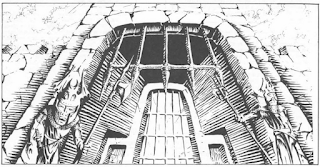
"Are you alright?"
Due to the tournament origins of this module, the secret city of Suderham is more like a puzzle for the PCs to solve than an actual urban setting to interact with. You're supposed to get in and follow the clues to the drop zone as quickly as possible, no time for loitering over pints at the tavern, joining the thieves guild for a heist, or patronizing any of the brothels in town--though 5 points to Gryfindor for including brothels. Interactions with NPCs  are highly discouraged other than a couple of informants who contribute only a single line of dialog each to the experience, and a couple of miscreants intent on slowing the PCs down. But there is the assumed cabal of abolitionists who are providing the informants with clues to pass on to the PCs, an obsessive wingnut like you should be able to develop that strand of intrigue into something. And, sadly, the map is very basic: a big old square filled with outsized single-story (groan) buildings, not much thought was put into this. I'm working on the assumption that the 1 square = 50' scale is a mistake, otherwise I'm downgrading the C- to a D-. But I do really like EO's illustration of the guards at the gate.
 
Details: C
Intrigue: C+
NPCs: D+
Map: C-


Guido's Fort (B5 Horror on the Hill) D

From the third Niles-penned module on this list, Guido's Fort really doesn't deserve to be here because it is only meant to be a way station, a place to kick off the adventure and move on. But too bad, you give the place a name like Guido's Fort and then don't bother telling us who the crap Guido is? You brought this on yourself, Niles.
 
Details: D
Intrigue: D-
NPCs: D
Map:F+


Saltmarsh (U1 Sinister Secret of) F+

I know that some folks have published a posthumously detailed town of Saltmarsh, we're not talking about that place. This grade is based solely on the text of the original release of U1 back in 1841, which I've already written about at length. This gets such an exceptionally low grade because, unlike Guido's Fort, the PCs are expected to loiter in this town for several days interacting with a town that the MWs didn't bother fleshing out--beyond telling us that it resembles a small 14th c. fishing village on the southern coast of England--not good enough for the weight this town is supposed to pull in this adventure. It earns a D--as opposed to an F--only because there are some NPCs mentioned such as the infamous "Receiver" and some rent-boys who will help row the party out to the smuggler's ship. There is also some intrigue--smoking out the Receiver and taking it/them down could be a good follow-up adventure--but, ultimately, the authors didn't bother to make an effort here so screw them.
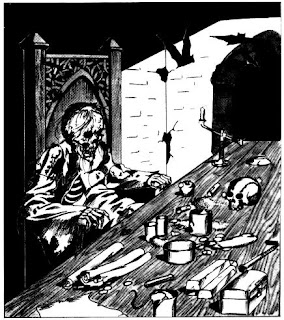
A novice DM tasked with "quite thoroughly" preparing the village of Saltmarsh so that TSR doesn't have to.
Details: F
Intrigue: D
NPCs: D
Map: F-