Wednesday, March 20, 2013

Celebrate the Feast of St. Cuthbert

As all you hagiophiles already know March 20th marks the feast day of St. Cuthbert who died on this day in 687.  Greyhawkophiles will know St. Cuddy as one of the original deities of EGG's home campaign.  But here are a few things you might not have known about the patron saint of quality head-wear:

Banner of St. C: Where's the cudgel?
  • Good ol' Cuddy was probably ~53 years old when he died of an unspecified illness in his hermitage in Northumbria.
  • He began his monastic career only after serving in a war against the King of Mercia.  
  • After the war, Cuthbert arrived at the monastery of Melrose bearing a spear, not a cudgel.
  • In 664 he was named prior of the monastery at Lindisfarne which would later bear his name.  
  • Though he ultimately returned to Lindisfarne as Bishop, he spent much of the last decade or so of his life living as a hermit--not unlike a certain mad man in the environs of the Keep on the Borderlands.
  • His monastery would gain fame in 793 for being the first known location in the British Isles to be raided by Vikings.  Whether this event inspired the sacking of the monastery in the Sample Dungeon of the AD&D Dungeon Masters Guide cannot be known for certain.
  • St. Cuthbert's Gospel, based on the Codex of Grandior, is the oldest extant example of a "western binding."  Awesome, right? 
  • There are two caves in northeast England that bear his name.  Possibly they are named such because his sanctified remains were hidden in one or both of them to keep them safe from the Danes who continued to ravage the area for centuries.
  • Cuthbert's aforementioned gospel was also stashed in his coffin for safekeeping.  On a somewhat creepier note, so was the head of poor St. Oswald.
  • Once, after praying in the ocean, otters breathed on St. Cuthbert's cold feet to warm them up.
  • Two more Cuthberts were later canonized but, as is often the case, the sequels were not as cool as the original.
  • The Cuddy Duck is a species of waterfowl found in the vicinity of Lindisfarne. 
  • The "Liberty of St. Cuthbert's Lands" was a political entity in Northumberland that operated as a sovereign entity--a Palatinate--run by the Bishops of the vicinity.  According to Wikipedia, the people here were known as the haliwerfolc, meaning, rather literally, "holy man people", and it was believed that St. Cuthbert was "fiercely protective of his domain."  Inspiration for the See of Veluna?
  • An eagle once brought him some fish n' chips, which he shared with the eagle.
  • The Venerable Bede, a saint himself, wrote two hagiographies of Cuthbert.
  • Bede failed to mention Cuddy's affinity for hats in either tome.
  • St. Cuthbert's horse once interrupted his prayers to point out a delicious packet of bread and cheese stashed in a nearby roof.  Animals, apparently, couldn't help but give ol' Cuddy a hand.
  • It might just be a coincidence that the hermit in B2 K. on the B'lands had a protective pet puma.
  • Welsh Anglicans prefer to celebrate his feast day on Sept 4 while Episcopalians in The States pay their respects to ol' Cuddy on August 31.   Y'dey, Canoness of Hommlet, took it a step further instituting a 5 day celebration that spanned both dates.  

Thursday, March 14, 2013

Random Gonzo Encounter Tables

Here's the table I'm going to use in my next Gonzo campaign.  As you will see, the genre tables are not done yet, I've only managed the one for 007.

Random Encounter Genre Table:
  1. Roll on mutant table
  2. Roll on cyborg table
  3. Roll on Cthulhoid table
  4. Roll on James Bond table (see below)
  5. Roll on Nazi table
  6. Roll on evil smurf table
  7. Roll on Shakespearean table
  8. Roll on KGB Table
  9. Roll on Ruby Spears  table
  10. Roll on hillbilly table
  11. Roll on Thomas Pynchon table
  12. Roll twice--ignoring further 12s--and hybridize an encounter from two different encounter results, e.g. a roll of 2 and 6 would result in a cyborg evil smurf encounter.
Random James Bond Encounter Table:
  1. 3-18 glass-jawed flunkies
  2. High ranking SPECTRE officer
  3. save vs. traps or fall into a glass-sided shark tank
  4. Saucy tart with useful information; roll d6 for exposed cleavage/skirt length
  5. High speed chase in progress: (d6) 1-car, 2-boat, 3-helicopter chasing motorcycle, 4-motorcycle chasing skier, 5-skier chasing parachutist, 6-parachutist chasing helicopter
  6. CIA ally
  7. Attractive enemy agent of the opposite/preferred sex; save vs. libido or join enemy cause
  8. Tricked-out vehicle (d6): 1-car, 2-boat, 3-hovercraft, 4-snow mobile, 5-gondola, 6-blimp
  9. Secret hideout in (d6): 1-underwater dome, 2-mountaintop resort, 3-1970s Harlem, 4-active volcano, 5-capsized cruise ship, 6-aligator farm
  10. Heavily-armed person(s) (d6): 1-para-skiers, 2-kung-fu babes, 3-Cellist, 4-Clowns, 5-siren on a vengeance bender, 6-rogue triple agent
  11. MI6 crony: (d6) 1-Moneypenny, 2-Bill Tanner, 3-Judy Dench, 4-Q, 5-009, 6-Lazenby
  12. Non-Bondean spy (d6): 1-George Smiley, 2-OSS 117, 3-Sterling Archer, 4-Sarah Walker, 5-Scarlet Pimpernel, 6-Chuck Barris

Thursday, March 7, 2013

Greyhawk: Origins of the Oeridian People

Can you guess where this is heading?
We know from the history of Eastern Oerik that the Oeridian peoples came to the Flannaes from the west, sweeping across the eastern portion of the continent, pushing aside Suloise and Flannish peoples alike to dominate the region politically (The Great Kingdom), linguistically (Common Tongue), and even calendrically (C.Y.).   It's possible that their dominance even gave name to the continent (Oerik) and the planet (Oerth) of which the Flannaes are a part.  But we don't really know for certain where these fierce peoples came from.

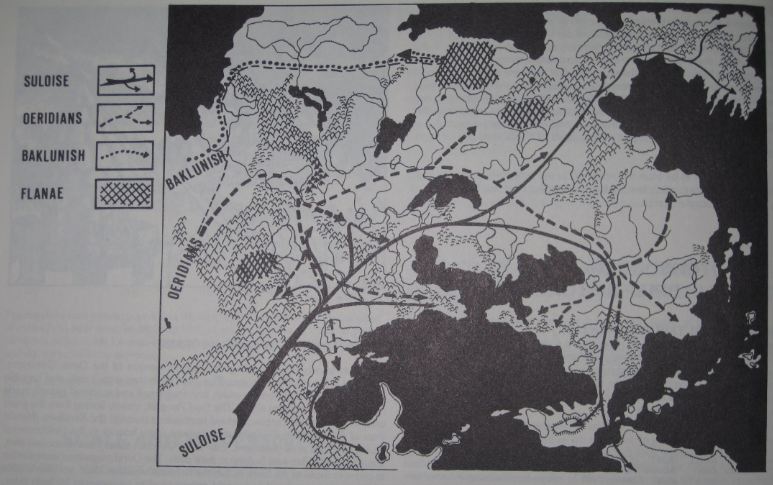
We do know that, harried by the humanoid mercenaries employed by the Bakluni in the Baksulian Wars, the Oeridians began migrating eastward from their homelands somewhere west of the vast mountain chains that separate the Flannaes from western Oerik.  Thanks to the chronology in the Gazetteer, we also know that this migration peaked in 187 O.R. (Oeridian Reckoning, subtract 644 to determine C.Y dates). But official sources are somewhat vague about the actual source of the migrations.

If we take the map of migrations in the Gazetteer as accurate, see figure 1, it would appear that the Oerid people originated in the environs of the Dry Steppes.  However, the text describes the Dry Steppes as the once-fertile homeland of the Bakluni peoples, rendered inhospitable by the Invoked Devastation.  No mention is made that Oeridians ever occupied this area. 
Figure 1. Map of migrations to Flannaes, Gazetteer (1980)

Perhaps addressing this very concern, the map of migrations in 1983's  A Guide to the World of Greyhawk moves the label of the Oeridian migratory arrow to indicate that maybe the Oeridians came not from the Dry Steppes, but from Ull [see figure 2].  The Guide describes the area as being the homeland of "a strong tribal clan of Paynim nomads."  Again, no mention is made of the Oeridians ever having lived there.

Figure 2. Guide map (1983)
It is conceivable that the Oeridians were completely uprooted from their "native" lands.  But the question it raises is why wouldn't the cataloguer who compiled the Guide and Gazetteer--who betrays an Oeridi-centric worldview elsewhere in the tomes--have mentioned the significance of these lands to the Oeridian people when the map indicates that the two are inextricably linked? 

To further obfuscate the matter, the Old Oeridian language is described as:
"A younger language, totally free of outside influences until a few centuries ago.  As a result, its linguistic components are unique and translation into any language except Common is all but impossible." (p. 8, Gygax 1980) 
This works well with the chronology which sets the Oeridian Reckoning of years as the most youthful calendar in Oerik--other than the Aerdian Empire's conflated "Common Year" of course--by 1500 years.  But how could a people whose homeland was in such close proximity to another, older culture--the Bakluni--develop a language so alien from their neighbors?  And what happened 1220 years ago that made these people start a new calendar? 

On our planet this would be a mystery indeed.  But Oerth is, happily, a fantasy setting where all sorts of cool stuff goes down.  It's entirely possible that the Oeridians were gated in from another plane; possibly by some deity or even the powerful wizards of the Bakluni; these were, after all,  the same dudes who brought down the Rain of Colorless Fire.

But there's another, more bizarre, explanation for how these foreigners arrived in the Flannaes; an explanation that has its roots in the body of Greyhawk literature: they came from space, Battlestar Galactica style.  There is, after all, a history of alien landings in the area: remember the spaceship that crashed into the Barrier Peaks near the land of Ull?

That's right, the Oeridians came from outer-freakin-space.  At least one of their ships crash landed in the mountains, many, many others apparently landed safely on the fringes of the Bakluni lands. And perhaps they melted down their space ships to make swords and plowshares.  Or they are still hidden somewhere; perhaps in an incomprehensibly vast underground hangar--I smell a megadungeon!

Anyway, the new arrivals established commerce with the nearby Bakluni peoples and, in order to facilitate such, a mutually agreeable language developed.  This language would provide the basis for the Common Tongue that would be spoken throughout the Flannaes in centuries to come.  That they call themselves Oeridians and  inhabit the continent of Oerik on the planet Oerth is either an attempt on their part to fit in by adopting the name of their new home, or it's the great irony of the Greyhawk saga: the planet is named after its alien infiltrators.
Take that you Suloise mo-fos!

Bibliography
Gygax, Gary. The World of Greyhawk Gazetteer. Lake Geneva: TSR Inc. 1980
Gygax, Gary. Expedition to the Barrier Peaks. Lake Geneva: TSR Inc. 1980
Gygax, Gary. A Guide to the World of Greyhawk, Volume III: A  catalogue of the land Flannaes, being the eastern portion of the continent Oerik, of Oerth. Lake Geneva: TSR Inc. 1983

Thursday, February 28, 2013

Hommlet: Heart of a Village

One of the coolest things about The Village of Hommlet is that it is not just a static village setting designed solely as a medium for PC activity.  There are things going on here--big things that may have little or no bearing on the actions of the PCs.  Things that are too big for your puny PCs to affect or too subtle for them to notice.

Obviously, there's the rise of the nefarious Temple of Elemental Evil.  But what about the concurrent rise of the Church of St. Cuthbert, as members of both cults infiltrate the village, each in their own fashion.  The Cuthbertines are generally lawful good artisans and craftspeople and seem intent on becoming a part of the growing community.  The Temple members are evil and secretive and presumably are trying to return to the era of oppression that precipitated the warfare of a decade ago. We don't know which of the two groups the Druidic natives of Hommlet find more objectionable.   Though the Cuthbertines are not outwardly malevolent, tight-knit, homogenous populations are, historically, not too well disposed to large influxes of new folks with different cultural values and beliefs. 

Then there's Rufus and Burne's castle under construction on the hill east of town.  Though it's not finished, the town map conveniently shows the ultimate plan of the structure, just so you know what the future has in store for Hommlet.  Is the castle a sign that Hommlet is already being subjugated to a higher power even without the Horde of Elemental Evil? How does the village elder feel about its  presence?  Glad for the safety provided?  Threatened by the assumed diminution of the traditional authority of the village?

And at the Church o' St. Cuthbert, Canoness Y'dey has "left unexpectedly and has not returned."  What sort of business is she tending to that it is accompanied by such mystery?  Terjon, the acting Canon--who would rather be off adventuring himself--believes that she is off "on a quest", but what sort of quest do churches send their Canons on?  

Furthermore, Calmert--the officiant of the church--is mysteriously diverting funds from the church to the construction of the new castle across town.  This suggests that perhaps the church does not officially support the new castle or its inhabitants, even though R&B are devotees of the Chapeau.  At the least, it indicates that Calmert's loyalties are somewhat misplaced.     

Many of these features are, I assume, further evidence of the palimpsestuous nature of T1.  As I may have mentioned in another post or two this module is unique in that it was created for play in Gygax's own campaign but then modified to incorporate many of the actions and characters--P- and NP- alike--from that original campaign into the final, published work.  Elmo and Lareth seem like they were probably members of that original party; likely Rufus and Burne were as well.  But was the Cuthbert Infiltration also a result of the original campaign?  Was the entire Battle of Emridy Meadows an outcome of their actions? Can I get a witness?

While T1 offers the opportunity to uncover clues to the second rising of the Temple of Elemental Evil, The death knell for Hommlet has already sounded.  Soon it will be overrun either by baleful Temple followers or the docile-yet-obtuse followers of St. Cuthbert.  Either way, Old Hommlet is dying.   Which is the one bummer about the village, one gets the sense that you've arrived at the party only to find that the keg is floating in a tub of molten ice. A new regime, as represented by St. Cuthbert's middle class followers and the imposing phallus rising on the hill east of the village, has taken over and it's only a matter of time before the Hommlites of old either assimilate or emigrate.  The battle for Hommlet's soul has already been lost regardless of what those dorks in Nulb have up their sleeve.

Thursday, February 14, 2013

Ethnology of Greyhawk: Racial Purity in the Hold of the Sea Princes

"In a few places the [Suel and Oerid] racial stocks intermixed -- notably in the Sheldomar Valley where, except the Hold of the Sea princes, the peoples... are mixed Oerid-Suel stock." -- Gary Gygax, The World of Greyhawk Gazetteer, 1980.

From this statement found in the Brief History of Eastern Oerik (p. 5) we are made to understand that the people of the Hold of the Sea Princes are not racially intermixed--or at least not of Suel-Oeridian mixture--but of which stock are they?  Suel, Oerid, or another race entirely?

Given the Hold's close proximity to the former grounds of the Suel empire and that slavery is practiced in this land,* it would seem a rather safe bet that the Hold is comprised of a predominantly Suel population.  Furthermore, the Sea Princes are described as the strongest naval force of the region, and have a long history of piracy and other maritime activity--hence their name.  As the historically landlocked Oerid peoples are described as being "indifferent sailors," only taking to the sea when the Great Kingdom sought to expand to the Islands off its eastern shores, the evidence clearly favors a Suel occupation over an Oerid one.


Contradicting this, however, is the map of migrations (right) which clearly shows that both the Suel and Oerid peoples managed to find their way to the lands of the Hold.

Furthermore, A Guide to the World of Greyhawk Volume III--the later edition of the Gazetteer published in 1983--includes a table which uses a symbology of letters to indicate the racial mixture of various regions of the Flannaes.   The entry for the Hold reads thusly:
 "Sea Princes -- SOf" 
This encryption indicates that the people of the Hold are comprised of a heavy mixture of Suel and Oerid peoples, with a bit of Flan thrown in for good measure.  Which is to say, the Hold is no different in its racial make up than the rest of the Sheldomar Basin; so why did it get called-out in the Brief History as being somehow distinct from the rest?  A rational mind would say that the author either thought better of the notion of racial purity in the Hold, or forgot that he'd ever mentioned it at all.  An irrational mind would link this oversight to the human skull in the crayfish encounter in T1.  I always prefer the latter approach but haven't come up with anything good yet.

*Greyhawk enthusiasts will know that the Suel people were the sole practitioners of slavery in all of Oerik. Bastards.

Thursday, January 31, 2013

Incentivized XPs

While I fully expected to have a new orifice torn for me after my last post on Sacred Cows for XPs, I was a bit surprised by the angle from which commenters drilled my new colon.

Though never stated, my intent was to call into question some of the logic behind using GPs for XPs, but the meat of the debate in the comments focused on using XPs as a form of in-game incentive to guide player actions.  The rest of you are all saying "well no shirt Dice-chucker" but I was completely unaware that this practice existed; it was eye-opening for me.

Initially, I was pretty averse to this sort of metagamey gimcrackery infecting my own game table.  But, then, who loves gimcrackers more than me?  Nobody.  So I decided to experiment with an incentivized experience element in my next gaming session, which is scheduled for this Saturday night--assuming none of my A-hole players need to undergo another emergency vasectomy or something. 

But how to implement incentivized gaming?  I haven't counted XPs since 1986 and I'm not about to implement accounting-heavy rules at my game table now either, so XPs for GPs still ain't gonna happen.  And one-size-fits-all XPs = ker-snooozzzzzz...  Instead, characters will benefit only from challenges befitting their class and status as adventurers.  Thaumaturges rifling the pockets of dead orcs to beef up their XP score?  Puh-leeze.

So without further ado, I present to you The Dice-chucker's Guide to Experimental Class-based XP Incentives: 

Thieves: Liberating valuable treasure
Liberating treasure is more than scooping up buckets of coin.  In order for treasure to be truly liberated, a thief must ply some form of stealth, trickery, or skullduggery in its acquisition.  And while treasure may be valuable in the traditional, monetary sense, the value may be non-monetary as well: say your thief pilfers a key that opens the cell that holds that stupid fisherman from my last post. Though neither the key nor the fisherman have much cash value, they are valuable to the thief whose goal it is to free the dude.

Fighters: Slaughtering worthy enemies
Worthy enemies are those that stand a decent chance of taking out the warrior.  Myrmidons stacking up kobold corpses = unworthy.  And the worthy enemy must have some capacity to fight back.  Slaughtering hogtied hill giants also no good.  For cavalier and paladin types, the fight must be conducted in an honourable fashion; surprise attacks, use of missile weapons, low blows and cheap shots would negate the value of the combat for those noble warriors.

Wizards: Ensorceling adversaries
Ensorceling entails overcoming adversaries that would not be possible through mundane means.  "Adversaries" are pretty much any obstacle that needs overcoming.  This basically means effectively casting spells in non-gratuitous situations.

Clerics: Cleansing shrines
In order to raise level, a cleric must clean a shrine.  As they achieve greater glory, clerics must clean ever-larger shrines of greater and greater impotence.

As you can see, these are not quite half-baked.  This experiment is going to require some hammering out on the fly--my players love when I pull this kind of crap.  I don't know how this is going to play out, but I like the idea that the players may very well be at odds with one another as they try to gather incentives.  I'm hoping for lots of bickering between thieves and fighters about the appropriate course of action; as it stands, my players are way to chummy.  We'll see.


Monday, January 7, 2013

XPs for GPs: Deeply Flawed?

Let us consider:
GPs are their own reward:  Players don't need another reason to collect them.  Giving them character advancement on top of material wealth is double-dipping. 

Logical Disconnect:  Why would gathering and hauling large sacks of coins make you better at casting dancing lights or improve your standing with Thor?  Why would having a huge stash of priceless tapestries and gawdy jewelry increase your combat endurance?  By this standard, porters and antique dealers should be pretty badass.

GPs are not inherently commensurate with the difficulty of acquiring them:  A million GPs guarded by a hoard of syphilitic stirges, 16 flatulent purple worms, a commune of aggro-liches, and a venerable arch-demodragon are worth just as many XPs as a million GPs guarded by a single leprechaun sleeping off a 3-day bender.  You can make up some sort of bylaws to assure that the value of treasure retrieved is correlated to the difficulty of acquiring said treasure, but any work-around you come up with is as good as a sworn admission that XPs for GPs is deeply flawed

How much for the sack?
The opposite is even more true:  Difficult and even heroic actions are not necessarily rewarded with equivalent tubs of treasure.  Indeed, true heroism is often its own reward.   Let's say two thieves break into the Duke of Kroten's castle.  Thief 1 rescues a wrongly-accused fisherman from the dungeons; the other raids the duke's treasury making off with an armload of bearer bonds.  Both of them succeed without engaging in combat.  Thief 1, gets the satisfaction of averting a miscarriage of justice but no cash and zero XPs.  Thief 2, for the same effort, gets fifty large plus an equivalent haul in XPs.  So why should the character who takes home a paycheck for his efforts advance further than the one who works pro bono?