Tuesday, January 25, 2022

How to Read the AD&D Rules Part V: Title Redacted

Also: page 24 of the DMG.

For this part you'll need to go to your local government surplus store and procure a military grade Dark Black marker, regular black won't do; it has to be so dark that no light can escape it's pull. Now go to page 34 of the Players Handbook and, without reading them first, thoroughly blot out paragraphs 2 and 4--paragraph 3 is ok--under the Character Languages heading. I said don't read them! If you understand the language you are reading you will do this or align yourself with forces most foul.

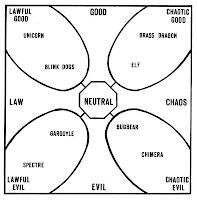
Now, just to be safe, turn to page 29 and do the same to the first primary ability of assassins, it's right there on the bottom of the left column, just above the Minimum Fees for Assassination table. It continues on the top of the right column so make sure to get that bit too. You can leave the list of alignments there if you wish; it's fairly harmless on it's own. Done? Excellent. That's all for today. School's out, run along kiddies.

No idea why this is here.

Friday, January 21, 2022

How to Read the AD&D Rules Part IV: Weapons

We're looking at weapons today kiddies so open to page 37 of your textbooks. You'll notice two tables on this page: 

1. Weapon Proficiency Table:

This table lets you know the following:

  • how many weapons you can be proficient with depending on your class, 
  • how much worse you are at hitting things when attacking with a weapon in which you are not proficient, and 
  • how long you have to wait to get a new weapon proficiency. 

Nowadays everyone is proficient in all the weapons all the time, but I actually like that folks weren't as effective with weapons that they'd never actually used before. 

and 2. Weight and Damage by Weapon Type:

This economical table gets it. Except for the Speed Factor business.

The second table tells you how much your weapon weighs. None of you are going to track your encumbrance, but at least you can meaningfully contemplate whether your footpersons mace is worth its weight in gold.

More importantly, this table tells you you're going to do 2-16 pts of damage to large creatures with your Bastard Sword. If you don't want your fighter to do 2d8 damage against ogres then close the book now, AD&D is not for you. 

Those of you who took a gander at the weapon price list on page 35 are probably wondering why you can't buy such weapons as the Chauves Souris, Ransom, Rhonca, Rhoncie, or Runka. Fear not gentle reader, this table assures us that those implements are all covered under "Ranseur."

Notice the ** next to the "spear" listing. These asterices indicate that 

"This weapon also does twice the damage indicated to any opponent when the weapon is set to receive their charge." 

When you consider that in AD&D anyone who travels more than 10' to engage in melee is, technically, charging, and that weapon length determines who strikes first in a charge situation, and spears are 5-13' long... the spear becomes a very intriguing weapon, no? Does that mean that spears were preferred among savvy gamers? Heck no! Why not? Well, since that thing about only moving 10' to engage in melee was roundly ignored, "charging" only came into play when you were on horseback and carrying a lance. 

On the next page we have another weapon table: Weapon Types, General Data, and "To Hit" Adjustments

"General Data" includes how long your weapon is and how much space you need to use it; information you can probably figure out how to use on your own, right? But then there's a column labelled "Speed Factor." Nowhere is this explained but that's ok because if you use this information while playing a game called Advanced Dungeons & Dragons then you are, by definition, playing 2nd edition.

The table goes on to list combat adjustments based on the armor class of the opponent. Since the ACs listed only go from 2-10, it seems obvious that this is intended to simulate the relative effectiveness of certain weapons against specific armor types, e.g. a staff is not going to be very effective vs. a guy in platemail, and a -7 adjustment reflects that. What's less obvious is whether your staff is also -7 to hit a guy with Bracers of Defense AC 4 who has a 16 Dex (-2 AC adj.). You could--and should--ignore this business based on inadequate information and overly complicated rules but really you're going to ignore it regardless because in the heat of the moment you're not going to remember to apply these modifiers.  

At the bottom of the table is a separate section just for missile weapons. This section includes the already obsolete AC adjustments mentioned above but also throws in some very useful info such as Fire Rate and Range. Penalties for launching missiles beyond short range are only mentioned in an underhanded footnote:

"Armor Class Adjustment is based on the weapon or missile being discharged at short range. Adjust by -1 for medium ranges, -2 at all long ranges."

So underhanded is this note that I never noticed it before today, the 21st of January 2022! This note is noteworthy because these range modifiers were overruled by the combat matrices on page 74-75 of the DMG; under each table it is noted that missiles are -2 at medium range and -5 at long. So there was a brief period between the publication of the PHB in 1978 and the DMG a year later when archers were 15% more effective at hitting targets at long range.

Fire Rate seems pretty self explanatory and is even explained in a note under the table but the folks over at GGNoRe were confused by it and they're a pretty seasoned bunch, so I'm guessing that folks coming at this from later editions are not necessarily going to realize that each round you can fire your long bow twice, throw 3 darts, or launch half of a bolt from your heavy crossbow. Does this mean that no one ever used a heavy crossbow? Yes, that is precisely what it means.


Tuesday, January 18, 2022

Cheers!: Tavern Signs in Old School Modules

It's hard to believe that in twelve--12!!!--sporadic years in the blogging business, I've never done a piece on taverns. Well, that streak ends today. 
 
Sometimes you'd prefer they didn't know your name

I have always had a thing for taverns in D&D, so the next time you complain about what a cliche it is for an adventure to start out with an encounter in a tavern, I won't hear you because I'll already be quaffing a pint while listening to the minstrel noodling by the fire. 

I also have a thing for old timey modules--as you may have noticed by my extensive rants about Hommlet, Saltmarsh, Bone Hill, and, most recently, the Slaver series. So today I'm going to dig into the taverns and inns that provide hospitality in a few of these old settings.

But I'm going to look not at the the taverns themselves, but the signs hanging out front. These are the shingles that are intended to indicate the name of the place to the PCs as they wander into town. I went back through the classic AD&D modules (I define classic as published back when they still listed all the available D&D products on the back of modules, a practice which ended ~1983, I believe). Also some of these modules feature more than one ale house; I'm only addressing the ones I can remember.

For this analysis, I'm including the text from the module describing the sign, a likely interpretation of that sign, and any significant notes relating to the sign or its meaning from the module.
 
Inn of the Welcome Wench (T1 Village of 'omlet)
Sign Description: "The square wooden sign shows a buxom and smiling girl holding a flagon of beer."
Likely Name: Inn of the Buxom Wench
Significance: If you thought we were going to start with some other tavern, then this is probably your first time here and I offer my sincerest greetings to you. I've always called this place the Buxom Wench, but I was an adolescent when I first encountered it and I haven't really grown up in the ensuing decades. 

Inn of the Slumbering Serpent (N1 Against the Cult of the Reptile God)
Sign Description: "A large, colorful sign pictures a red dragon with its head
resting contentedly on its paws. A plume of smoke rises
from the serpent's nose and its eyes are closed."
Likely Name: Sleeping Dragon
Significance: Given that the name of the adventure is "Against the Cult of the Reptile God"; if you wander into a town with an inn named the Slumbering Serpent, are you going to stay in it? No. But if you see a sign with a sleeping dragon on it? I think of dragons as scaly magical beasts not reptiles, so sure, I'd stay there. Aside: do dragons have "paws"?

Sign of the White Knight (A3 Assault on the Aerie of the Slave Lords)
Sign Description: "Above the door is a painted chesspiece-
a White Knight
" (see illustration)
Likely Name: Horse Head, White Horse, Chess Piece
Significance: When they enter Sunderholm the party is given a clue to "Seek out the Ivory Paladin." This establishment is the place that the clue is intended to indicate. While the horsehead on the sign is pretty obviously a chess piece, without the flavor text it's not all that certain that the players are going to see it and make the connection: white horse head = white knight = ivory paladin.Why didn't the clue just say "Go to the White Knight on the corner of Dave St. & North Arneson and ask for Gary"? Because it's a tournament dungeon Dice Chucker, that's why.

Inn of the Dying Minotaur (L1 Secret of Bone Hill)
Sign Description: The sign is not described in the text, but "Geilcuff, the innkeeper has a minotaur's head stuffed and hung up on the wall above the bar."
Likely Name: Bull's Head 
Significance: Everyone knows that a minotaur is a creature with the body of a man and the head of a bull, so that "minotaur" head over the bar is probably just the head of a bull that Geilcuff bought from the slaughterhouse.

House of Abraham (L2 Assassins Knot)*
Sign Description:  "a large bright green shingle that reads, 'House of Abraham:
Food, Lodging and Ale.' In the center of the shingle is a picture
of a smiling man holding out a large tankard of ale.
"
Likely Name: Abe's Place
Significance: Lakofka cheated us here by assuming a high literacy rate in Assassinsburg.

Blood of the Vine (I6 Ravenloft)*
Sign Description: the sign "proclaims" this to be the "Blood ofn the Vine"
Likely Name: Well, Blood on the Vine, I guess
Significance: Literacy trumps good sign design once again, this one devoid entirely of illustration. But it is written into the module that some wag has vandalized the sign, scratching out the "f" in "of" and replacing it with an "n" to add to the macabre tone of Ravenloft.

*In addition to having signs with words on them instead of pictures, other TSR products were not listed on the back of these modules when first published. So maybe I can also use literate tavern signs as an indication of the end of the classic module era.

Monday, December 13, 2021

How to Read the AD&D Rulebooks Part III: Character Race and Class

The title sounds like a seminar offered by the sociology department, no? Rest assured, we're not getting into heavy topics here at Dicechucker Taverns. We will be looking at pages 13-17 of the Players Handbook; which deal with race and class selection. Why not pages 18 & 19? Probably because the cat was on my lap and I couldn't reach my PHB so I had to do this from memory. 

Let's hop right into Character Race Table I.: Character Class Limitations. This gloomy table tells you that no, you can't have a gnome Paladin in AD&D, and, yes, folks adhered to this. Sometimes someone would get papal dispensation to run an elven druid or a halfling ranger/assassin or something but it was rare in the extreme and usually limited to the first few months of your dungeon master's AD&D career. 

No gnomes, no halflings. Take it to heart.


This table also informs you of the alignment restrictions for each class. Yes, we adhered to this in as much as we wrote the appropriate alignment down on our character sheets, much as we wrote down weapon speed factors and encumbrance value of our gear initially. More on that later, but you probably get the drift.

Then there's the dreaded Table II Class Level Limitations. While the previous table limited the classes your demi-human could choose from, this one ups the ante by telling you that the gnome illusionist/assassin you settled on when you found out you couldn't be a paladin will be retired once it reaches 7th/8th level. That's insane, right? You'll also see in the footnotes under table II that even if your character did pick a class that was limited to a certain level--pretty much thief is the only class that allows unlimited advancement to non-humans--your character is furthermore restricted based on their ability score in the prime requisite for their class. So your ≤16 Str elf was stuck at 5th level for the last thousand years of its life! Even if she got a gym membership and bulked up to an 18/51 Strength, he was only squeezing 2 more levels out of their career. You'd think Rule 2 (common sense) would come into play again, but we usually a) rolled characters until we got one with at least one 18, and b) retired characters around 7th or 8th level, so level limits weren't really a big deal; see Rule 5. And demi-humans were almost always multi-classed either as F/MU and/or Thief--dwarven fighters being the big exception here, they could reach 9th level--so they still had room to grow in other directions. Also, every race except halflings is allowed to be an assassin.

For reference only.

Confusingly, according to this table NPCs of certain races can be members of classes that PCs can't. NPC dwarves, for example, can be clerics though PCs are denied such access to the divine class. While you might think folks would have incited Rule 2 Common Sense and ignored this nonsense, rarely did you see a PC buck the system on this one. Mostly because those NPC-only exceptions only applied to clerics and halfling druids; clerics in AD&D were henchmen 99.9% of the time--and therefore technically NPCs--and no one wanted to play a halfling, see below, so it's Rule 5 once again. 

Which brings us to Character Race Table III: Ability Score Minimums & Maximums. This stunningly unimportant table summarizes all the minimum and maximum ability scores mentioned in the Ability Tables we talked about in part 1. Let's move on.

Did I mention that there's a mini-psuedo table that shows ability penalties and bonuses for race? No? This subtle little table, more of a list really, tells you that races with Con bonuses also have charisma penalties (Dwarves, half orcs). Yes 5E-ers, ability score penalties were once a thing.

Sadly, there are no more tables in the Character Races section of the book; you're going to have to read the descriptions to get the rest of the info, but it's un-Gygaxianly concise, you can manage this. Gamers of the 80s didn't swing too far from the text here. Early on I remember a debate about whether halfling PCs should benefit from the +3 to hit with missile weapons that the Monster Manual ascribes to them--the ruling is not mentioned in the PHB. We allowed it initially--the poor little dudes are limited to 4th level fighter, at least let them shoot a crossbow like they're 7th level--but at some point it was ruled that since it's only mentioned in the Monster Manual then it only applies to NPC halflings (like the druid thing). As a result, no one ever played a halfling again. Problem solved.

Monday, November 29, 2021

How to Read the AD&D Rule Books Part II: Ability Scores

Did you ever notice that his book says "AD&D"


So you've played some modern version of Big D and for reasons known only to yourself, you've decided to read the AD&D Players Handbook? Or perhaps you're an old timer who's played plenty of AD&D and you just want to heap scorn on some other jerk who played it all wrong? Well you've come to the right place; Uncle Dice Chucker--or D-Chucks as he was known back in the day--will guide you through the rules as they were played not by the pedants in the ivory-paneled basements but by the regular nerds living and dying by the 20-sider on the mean streets of the 1980s.

You've all read part I in this series, right? And you've made a crib sheet with the Rules for Ignoring Rules written on it? No? Here it is:


Good. Let's crack open your Players Handbook, be it the Trampier original, the Easley editions from the mid-80s, or the recent reprints from Lizards of the Toast and learn some AD&D!

First off. you're going to see an ocean of text; fear not, everything between Tramp's illo of a wizard sitting on a giant 6-sider in the woods and the Strength tables on page 9 can and should be skipped over without a thought.  Which lands you on:

Strength

You'll see two tables explaining how your strength score will impact your character's career. And honestly, Table I is not very informative--just tells you the minimum and maximum strength scores for various races, classes, and genders--so the first thing you're going to pay any attention to is Strength Table II.: Ability Adjustments.

If you're coming from 5e or Moldvay Basic you're going to notice that to hit and damage bonuses are pretty stingy in AD&D-land. A 17 strength gets an AD&D character the same bonuses that one would get with a 12 or 13 strength in those versions. But if you were coming from Holmes Basic or the original Little Brown Books, you're thinking:

 "You get a damage bonus for having a high strength?! The gods must love us after all!!!"

But what's up with those weird numbers once you get beyond 18; 18/01-50, 18/51-75, etc.? Gird your loins, you are going to have to make your first foray into Gygax's Quagmire of Prose to find out. Don't worry kids, this trip into the muck is definitely worth it.

Look to the left of Table I, second paragraph, after a few skippable sentences describing what strength is and how to quantify your score in real world terms, somewhere towards the middle you learn that if your fighter has managed to roll an 18 for strength, you then roll percentile dice, and that number is appended to your strength score. Roll a 24, write that next to the 18 on your character sheet and note that you get +1 to hit and +3 damage. Roll an 18/00 and you are a +3/+6 skull-crushing machine!

[It should be noted, kids, that Rangers and Paladins are subclasses of fighter in AD&D and therefore qualify for "exceptional strength."]

Next up on the table we have Weight Allowance. The table says that strength scores of 8-11 grant you a "normal" allowance, everyone else gets adjusted up or down by a certain amount of gold pieces. No, you don't get extra gold pieces for being strong; you get to carry extra gold pieces for being strong. The text below tells us that 10 gold pieces equal 1 pound--good to know--but it doesn't tell us what the normal allowance is that we're adjusting. Nothing on the adjoining page either. You've done your due diligence, it's time to invoke Rule #1. Plus, we all know that Encumbrance rules are the first thing to be ignored from every version of the game so feel free to get started early.

Open Doors: As described on this page of the PHB, this rule is fine; Open Doors is for use when "opening a stuck or heavy door." You have a 15 strength, you get a 2 in 6 chance of opening a stuck or heavy door. You might argue that that seems a bit feeble but there's nothing fundamentally heinous about it.

But this rule gets truly hideous if you look on pg. 97 of the DMG--which I don't advise you to do right now, stay focused!--wherein it says that all doors should be considered stuck or heavy when PCs are trying to open them, even though an exceptionally puny kobold has just effortlessly opened and closed that very same door moments ago. Rules 1, 2 and 3 all apply to the DMG ruling. No one ever played that way outside of Gygax's basement and, as the DM, you have a choice: ignore the DMG ruling or sew a Dickhead merit badge onto your Dungeon Master sash.

There's also bend bars/lift gates, which is fine but probably falls into rule 5 if you are using some other sort of ability check rules. Moldvay basic, I'm told, had some.

Intelligence

The table tells you that you get extra languages for high intelligence. What is not obvious is that this is only for Humans, and though this is alluded to in an unclearly worded note (Rule 1) in the text above Intelligence Table I, you will not have bothered reading that text because you already know what the word "intelligence" means and that it is the prime ability for MUs, which is what the bulk of that paragraph goes to length explaining. So you'll be excused if you didn't quite catch this point and gave your gnome illusionist (Int 17) 6 extra languages in addition to the ones that come as part of the standard gnome linguistic package.

If you're not an MU [do 5e folks know the term Magic User?] and don't care to speak extra languages, a 3 Int bears no penalty whatsoever, making it, ostensibly, the perfect dump stat. But no one wants an idiot for a character, so you're likely to save a really bad roll for Wis or Cha.

If you are an MU you should note that if you ever want to cast 9th level spells, you'll need an 18 Intelligence score. And even though you can have a 9 Int and be an MU, you will never be able to cast spells higher than 4th level. Flip ahead to the MU class description and you'll see a table on page 26 that tells you that you'll be 9th level before you realize just how stupid you really are.

But we're not done with Int so back to page 10, "Intelligence Table II.: Ability for Magic Users" This is a very silly table, or at least 2/3rds of it is very silly. We pretty much ignored this table back in the day, but what it's supposed to do is limit the spells your MU knows. You've got a column labelled % know spells which you use in cases where your MU finds some poor, dead thaumaturge's spell book. You'd roll your % to know each spell in his book; each time you succeeded you got to write the spell in your own book, if you failed it you put that spell on the List of Shame; spells you just can't seem to figure out. A case could be made that it violates Rule 2: Common sense, and I don't think anyone would argue with you, but it does go some distance to make intelligence valuable to MUs in a practical way, so you decide.

The rest of this table, however, invokes both Rule 1, 2, and 4. The description of minimum and maximum number of spells per level can be interpreted to mean that you're supposed to roll the % know spells business not when you find a dead thaumaturge's spell book, but as soon as you reach 5th level, at which time you will pre-roll against every spell on the 3rd level spell list regardless of whether you've actually found the spell in a dead thaumaturge's spell book or not. In the event that you don't "know" enough spells to meet your minimum or you "know" more than your max. allows, you're supposed to re-roll against every spell on the list until you get a satisfactory result. This exercise does not confer on to you actual knowledge of the spell, merely the capacity to learn the spell in the event that you should ever come across it. I feel dirty just typing that out. 

I'm glad we ignored this back in the day, and you should do so with a clean conscience.

Wisdom 

We all know that, in D&D, Wisdom has nothing to do with how wise you are. Instead, the table tells us that you get a magical attack adjustment--which is a misleading way of saying you get a bonus on saving throws versus people messing with your head; charm person, fear, that sort of thing. Which makes wisdom more like willpower, which is what it has become in the modern era. You don't want a really low Wis or you're going to be easily charmed and a-feared, but otherwise an 8 wisdom is just as good as a 14 wisdom in every way, so this is an excellent dump stat. Which is probably why so many of the sub-classes in AD&D require high wisdom scores; Gary hated PCs. See Rule 3.

Wisdom Table II.: Adjustments for Clerics

Pretty self explanatory. We learn that even though you only need a 9 Wis to be a cleric, you really don't want a Wis lower than 13 because 12 or lower earns you a chance of spell failure every time you try to cast a cleric spell! I don't think I ever knew that. But then I never ran clerics if I could help it. Furthermore, you get bonus spells starting at 13. Pretty self explanatory, so on to...

Dexterity!

Everyone loves dexterity so even though it has a pretty large dead zone--non-thieves with a 7-14 get neither a bonus nor a penalty of any sort--no one wants to be perceived as slow or clumsy. If you can get a 15 on Dex you're getting an AC bonus--yes it says "-1" but that's a bonus in AD&D. Why does a -1 Dex adjustment improve your AC while a -1 shield makes your AC worse? This is AD&D, you've got bigger fish to fry.

At 16 Dex you start getting a bonus to "reaction/attacking adjustment." The attacking part is that bonus to hit with missile weapons that you've been looking for. The reaction part affects how long your character is surprised, which is to say you are going to ignore this because surprise is not explained anywhere near this table (rule 1) and is kind of silly anyway. We'll talk about it further when we get to combat. 

Furthermore, there is some murky text somewhere in the DMG (pg. 64, "Dexterity Bonus and Penalty Considerations") that implies that an individual can apply its reaction adjustment to the initiative roll, though it maybe only applies to missile fire or something? The statement provided fodder for folks to  add the reaction adjustment to all initiative rolls, which was a near-universal house rule. When you consider that every version of Basic D&D rules from Holmes on up gave some sort of advantage to initiative for highly dexterous characters, it was pretty much inevitable.

In AD&D of the first edition, adding dex bonus to initiative tend to give the PCs a significant advantage in combat because, while high dex PCs are fairly common--pretty much every character was putting either their highest or 2nd highest score on Dex--rarely if ever do monsters have there dexterity statted out, so the party was getting the drop on the critters more often than not. Which I think makes a good argument for why you might want to roll initiative with something larger than a d6. Just thinking out loud here.

Dex Table II: Thieves Suck: Pretty self explanatory. You can be a thief with a Dex of 9 but flip ahead to the Thief Function table on page 28 and you will learn that because of dex penalties, your 9 Dex thief will have a 0% or less chance of moving silently or hiding in shadows at first level! You'll also learn that thieves are pretty much incompetent at their jobs until at least 7th level, but we're not there yet.

Constitution 

The table tells us that at 15 you start accruing HP bonuses; they max out at +2 for non-fighters, +4 for fighters. Got it.

Also listed, your System Shock and Resurrection survival chance. Resurrection makes sense, you have a chance of not being resurrected when you die--though it should be noted for the literal-minded that this also includes Raise Dead. I'm all for making death deadlier in D&D; your mileage may vary, so maybe you apply rule 3; you're call.

But what's system shock? Every time your system takes a massive shock from magical effects, you have a chance of dying. What sort of magical effects? Aging, petrification, and polymorph. Every time one of these magical effects is inflicted on you, whether for weal or woe, you have a chance of dying. Not just when it is cast, but when the spell effect ends as well. Dig it:

In an effort to escape from the cliffside studio of Snargrot the Beautician, your character, Mcswiggans the Warlock, polymorphs into an eagle [5E kids don't get your hopes up; in AD&D "warlock" just means 8th level Magic User]. With your constitution score of 12 you have an 80% chance of surviving the shock to your system.

Stated another way, there's a 1 in 5 chance Mcswiggans will die immediately upon transforming into an eagle, but also, should you survive the initial transformation, there's another 1 in 5 chance that you bight it when you change back to warlock. Which, I think, adds up to only a 64% chance of surviving the ordeal. Is that a chance you want to take just to avoid a bad haircut?

Furthermore, aging is problematic because a detestable DM (check your DM's sash for the aforementioned Dickhead merit badge) could have you die from a haste spell [or potion], as aging is a side effect of being Hasted. That is to say, System Shock was an early attempt at nerfing magic. Apply Rule 3 and ignore System Shock Survival.

Because Constitution is not a prime ability for any of the character classes, there is no Consitution Table II. Also true of...

Charisma

You'll quickly realize that henchmen must have, once upon a time, been considered an important part of the game; they were so important that even a pathetic, lowly suckwad with a 3 Cha could not be deprived of the companionship of a good henchperson. 

Were henchfolk actually a big part of the game? Games varied widely but, generally, nobody wanted to be a cleric, so somebody had to hench one to do the healing. So it was important to have at least one in your party. I remember only one campaign where I had more than one hencher and I never had more than two. So the most tangible benefit of a high Cha was pretty useless (Rule 5), making it extra painful for your paladin--min. Cha of 17--to waste such a high roll. 

And Loyalty Base and Reaction Adjustments were only explained in the DMG so Rule 1 applied to them. Though, on reading them now, they're not half bad rules, if one were so inclined as to use them.

How to read the AD&D Rulebooks, Part I

Recently, the blokes over at the GGNoRe podcast decided to roll up 1e AD&D characters. [The episode in question is on their Patreon feed, so you'll have to cough up a dollar--or more, if you like--to listen.]  Abunch of non-old timers try to spelunk their way through the rules, hampered by the fact that only the DM has access to the PHB; hilarity ensues. They're trying to do it rules as written--which, I will argue, is not practical and has never actually been done before--except as short lived experiments by people hoping to prove that AD&D was no fun. They're doing this for entertainment value so carry on.

But, inspired by their bumbling attempt at deciphering the rules, I decided to compile guidelines for reading and interpreting the Advanced Dungeons & Dragons rules not as written but as played back in the day. Hence:

Dice Chucker's Guide to AD&D

First of all, you'll want to avoid reading the text as much as possible. Gygax liked to use a lot of words where only a few were needed, so perusing his verbose explanations can be very taxing on your attention span.

Instead, you'll want to skip the text and check out the tables and illustrations, they do a pretty good job of explaining most of what you actually need to know to play the game; assuming you already have a basic understanding of how the game is played. Treat the tables like stepping stones and the text as a pool of murky sludge. You'll want to stay on the stepping stones as much as possible, dipping into the murky sludge only on those occasions when you're fairly certain there's a piece of treasure to be had not far below the surface.

With that in mind, if something is not immediately obvious from the table, scan the adjoining text for clarification. If no clarification is provided in the text on that page, it can probably be safely ignored. In fact, 

Ignoring/altering rules is absolutely imperative to playing a functional and historically accurate game of AD&D. 

To this end I've come up with some guidelines for helping you determine whether a rule should be ignored--or at least altered in some way. 

DiceChucker's Rules for Ignoring Rules in AD&D

Please feel free to ignore a printed rule if any of the following conditions apply:

  1. The meaning of the rule is not made clear using a table, illustration, or concise paragraph of text--if you have to read several paragraphs, refer to a second volume, or turn more than a single page to get an explanation of a rule then it is probably going to be ignored.
  2. The rule defies common sense--use common sense here.
  3. The rule was made solely to thwart the PCs--some rules just seem like they were dreamt up by an angry DM who was tired of his plans being foiled by clever players.
  4. The rule is too complex or impracticable to have a positive impact on your game--how many people pay attention to encumbrance rules in any edition?
  5. The rule just doesn't come into play--maybe it's made superfluous by some other rule or is just not relevant to the way you play the game. This is the classic "It's not you, it's me" situation. 

For organizational reasons, I'm going to end this post here, but fear not bored individual, I shall return shortly with some further guidance on reading and rendering fruitful the wondrous tome that is the AD&D Players Handbook.


Thursday, October 28, 2021

The Twin Cataclysms of Greyhawk--Norton Style

Everybody knows about the great cataclysms of Greyhawk: the Devastation which was Invoked and the Rain of Fire Sans Color. But in the first published version of Greyhawk--that of Andre Norton's novel Quag Keep--she took a different tack with her conflagrations. As with much of her tome, it is obvious that she was working off a much earlier version of Greyhawk than was published in the 1980 folio. Likewise, she was not privvy to Big G's Brief History of Eastern Oerik. This is purely conjecture but I suspect it was not much developed at the time she sat down to write Quag Keep so we can give her some leeway for diverging from the script.

First up, the Plague of Fire: Not a rain of fire unleashed by Oeridian mages, rather the plague of Fire "breathed forth" from somewhere--I've conjectured elsewhere that it was a fleet of dragons, which isn't great but you're free to make up a better source. And the Plague of Fire didn't cause the Sea of Dust to come into existence, rather it destroyed the Kingdom of Kalastros which was located, I think, where the Dry Steppes would be in the Darlene maps. Indeed, the Sea of Dust is a much cooler locale in Nortonian Greyhawk, being a flowing body of fine particles that shift about in waves much like an ocean. Indeed, an ancient society once plied these sand waves on sailing vessels. If you don't think that's awesome then I doubt you're even reading this.

The second cataclysm is the Rieving of Keo the Less. The text describes this event even less than the plague of fire so it's very hard to determine what exactly this event entailed or even whether Keo is a place--as Greyhawkians will assume--or a personage of some sort; perhaps a maleficent demon or demigod of baleful intent. What we can decipher from the text is that, during a time of warfare, some really bad stuff went down resulting in the horrifying deaths of many, many people. It can be insinuated that the death and suffering meted out by this event was unspeakably terrifying. And the landscape is now devoid of human life. The city of Var, at least, is now lifeless ruin.

In neither case do we know who brought about these cataclysms nor their reasoning for doing so. And they do not appear to be reciprocal events, as the Plague of Fire seems to be a thing of relative antiquity while the Rieving happened within living memory.

And the problem is somewhat exacerbated by the fact that "rieving" is not an English word. It does look kind of like "reave" which means to plunder; perhaps Norton created her own word playing on grieving and reaving to create something new and awful sounding.

Though not quite a cataclysm in the sense that it doesn't seem to have altered the landscape or resulted in massive, widespread death, there is also a third major historical event of Nortonian G'hawk worth noting: the Harrowing of Ironnose. It was an airborne--and likely toxic--event involving the mighty dragon Lichis the Golden and the demon Ironnose which occurred over the Great Bay and continued on as far as the Wild Coast, wherever that is. The fight resulted in the defeat of Ironnose and retirement of Lichis to the Southern Mountains, where she avoided involvement in the activity of humans henceforth--at least until a gang of adventurers intent on finding the legendary Quag Keep--for no discernible reason--somehow coax her into aiding them. 

"Harrowing" has a few possible meanings: to cultivate a field with a harrow--probably not what Norton had in mind--but also to plunder, and, strangely, to rieve! Not really, but it does mean to torment or vex, which seems the likeliest suspect.

Fantastical events events like the Harrowing--a public brawl between a dragon and a demon--are sadly lacking from Gygax's low fantasy version of Greyhawk. And so different are the cataclysms of Nortonian Greyhawk--I've seen it labelled Quaghawk somewhere--that it seems likely that she was unaware of Gygax's notion of great cataclysms and perhaps--dare I say it--Gygax was inspired by Norton to include such events in his history of the Flanaess.